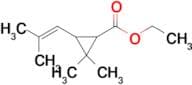
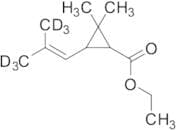
CAS 97-41-6
:Crisantemato de etilo
Descrição:
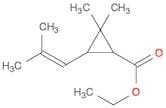
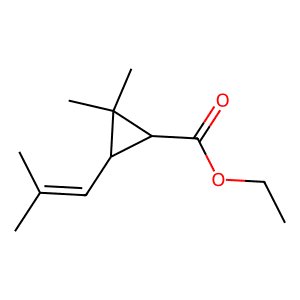
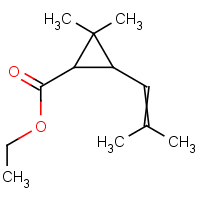
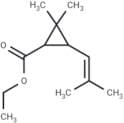
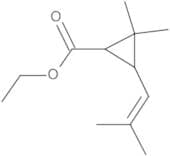
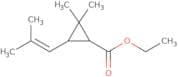
Crisantemato de etilo, com o número CAS 97-41-6, é um composto orgânico classificado como um éster. É derivado do ácido crisântemo e do etanol, resultando em uma estrutura que normalmente exibe um agradável aroma floral, tornando-o útil nas indústrias de fragrâncias e aromatizantes. Crisantemato de etilo é caracterizado por sua volatilidade relativamente baixa e solubilidade moderada em solventes orgânicos, enquanto é menos solúvel em água. O composto é conhecido por sua estabilidade em condições normais, embora possa sofrer hidrólise na presença de ácidos ou bases fortes. Suas aplicações se estendem além da perfumaria para incluir usos potenciais em formulações agrícolas, particularmente como repelente ou atrativo de insetos devido ao seu aroma atraente. Os dados de segurança indicam que, como muitos ésteres, deve ser manuseado com cuidado, pois pode causar irritação ao contato com a pele ou os olhos. No geral, Crisantemato de etilo é valorizado por suas propriedades aromáticas e versatilidade em várias aplicações industriais.
Fórmula:C12H20O2
InChI:InChI=1S/C12H20O2/c1-6-14-11(13)10-9(7-8(2)3)12(10,4)5/h7,9-10H,6H2,1-5H3
Chave InChI:InChIKey=VIMXTGUGWLAOFZ-UHFFFAOYSA-N
SMILES:C(=C(C)C)C1C(C(OCC)=O)C1(C)C
Sinónimos:- Chrysanthemic acid ethyl ester
- Chrysanthemum Monocarboxylic Acid Ethyl Ester
- Chrysanthemumic acid ethyl ester
- Chrysanthemummonocarboxylic acid, ethyl ester
- Cyclopropanecarboxylic acid, 2,2-dimethyl-3-(2-methyl-1-propen-1-yl)-, ethyl ester
- Cyclopropanecarboxylic acid, 2,2-dimethyl-3-(2-methyl-1-propenyl)-, ethyl ester
- Cyclopropanecarboxylic acid, 2,2-dimethyl-3-(2-methylpropenyl)-, ethyl ester
- Ethyl 2,2-Dimethyl-3-(2-Methylprop-1-En-1-Yl)Cyclopropanecarboxylate
- Ethyl 2,2-Dimethyl-3-(2-methyl-1-propenyl)cyclopropanecarboxylate
- Ethyl 2,2-dimethyl-3-(1-isobutenyl)cyclopropane-1-carboxylate
- Ethyl Chrysanthemate (Primary)
- Ethyl Chrysanthemate, Mixed Isomers Cis And Trans
- Ethyl chrysanthemat
- Ethyl chrysanthemate
- Ethyl chrysanthemumate
- NSC 10819
- Primary ethyl chrysanthemate
- ethyl (1R,3R)-2,2-dimethyl-3-(2-methylprop-1-en-1-yl)cyclopropanecarboxylate
- ethyl (1R,3R)-2,2-dimethyl-3-(2-methylprop-1-enyl)cyclopropanecarboxylate
- ethyl (1R,3S)-2,2-dimethyl-3-(2-methylprop-1-en-1-yl)cyclopropanecarboxylate
- ethyl (1S,3R)-2,2-dimethyl-3-(2-methylprop-1-en-1-yl)cyclopropanecarboxylate
- Ver mais sinónimos
Ordenar por
Pureza (%)
0
100
|
0
|
50
|
90
|
95
|
100
11 produtos.
Ethyl 2,2-Dimethyl-3-(2-methyl-1-propenyl)cyclopropanecarboxylate
CAS:Fórmula:C12H20O2Pureza:95%Cor e Forma:LiquidPeso molecular:196.2860Ethyl 2,2-Dimethyl-3-(2-methyl-1-propenyl)cyclopropane-1-carboxylate
CAS:Fórmula:C12H20O2Pureza:>95.0%(GC)Cor e Forma:Colorless to Light yellow to Light orange clear liquidPeso molecular:196.29Ethyl chrysanthemate
CAS:Ethyl chrysanthemate (Ethyl chrysanthemumate) is an allelochemical compound used as an attractantFórmula:C12H20O2Pureza:98.41%Cor e Forma:Clear LiquidPeso molecular:196.29Ethyl Chrysanthemate
CAS:Produto ControladoApplications Ethyl Chrysanthemate is an organic building block used in the synthesis of various chemical compounds, such as insecticide, Resmethrin (R144685). It is used in the preparation of trans-norchrysanthemates and trans-norpyrethrates, having insecticidal activity.
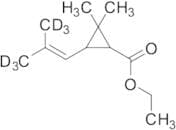
References Guorui, G., et al.: Youji Huaxue, 29, 589 (2009); Munoz, E., et al.: J. AOAC Int., 95, 1777 (2012);Fórmula:C12H20O2Cor e Forma:NeatPeso molecular:196.29Ethyl Chrysanthemate-D6
CAS:Produto ControladoFórmula:C10D6H10O2Cor e Forma:NeatPeso molecular:174.27Chrysanthemum monocarboxylic acid ethyl ester
CAS:Chrysanthemum monocarboxylic acid ethyl ester is a chemical compound that belongs to the group of chrysanthemic acid derivatives. It is synthesized by reacting the carboxylic acid with an alcohol in the presence of hydrochloric acid and sodium ethoxide. Chrysanthemum monocarboxylic acid ethyl ester has been shown to have genotoxic effects, as well as fatty acids that can induce lysine residues. This drug also has a pharmaceutical use for tissue culture, which may be due to its ability to inhibit l-tartaric acid, an alkanoic acid.Fórmula:C12H20O2Pureza:Min. 95%Peso molecular:196.29 g/molEthyl Chrysanthemumate
CAS:Fórmula:C12H20O2Pureza:95%(GC-MS);RGCor e Forma:LiquidPeso molecular:196.29Ethyl Chrysanthemate-D6
CAS:Produto ControladoFórmula:C10D6H10O2Cor e Forma:NeatPeso molecular:174.27