Substratos fluorogénicos
Nesta categoria, você encontrará uma seleção abrangente de substratos fluorogênicos projetados para catálise enzimática. Esses substratos são usados com vários tipos de enzimas e são capazes de produzir cor e fluorescência ao reagir. Os substratos fluorogênicos são ferramentas essenciais na pesquisa bioquímica e biologia molecular, permitindo a detecção e quantificação da atividade enzimática com alta sensibilidade e especificidade. Eles são amplamente utilizados em ensaios para estudar a cinética enzimática, triagem de inibidores de enzimas e monitoramento de processos celulares. Na CymitQuimica, oferecemos substratos fluorogênicos de alta qualidade para apoiar sua pesquisa, garantindo resultados confiáveis e precisos em seus ensaios enzimáticos.
Foram encontrados 284 produtos para "Substratos fluorogénicos".
Ordenar por
Pureza (%)
0
100
|
0
|
50
|
90
|
95
|
100
Resorufin phosphate disodium
Resorufin phosphate disodium is a fluorogenic substrate for phosphatase exhibiting a red color after cleavage that can be measured at ~ 585nm.Fórmula:C12H6NNa2O6PPureza:Max. 75 Area-%Cor e Forma:Brown PowderPeso molecular:337.14 g/mol6,8-Difluoro-4-methylumbelliferyl β-D-galactopyranoside
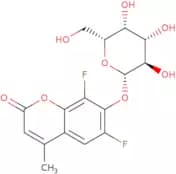
CAS:6,8-Difluoro-4-methylumbelliferyl b-D-galactopyranoside, commonly known as DiFMUG, is a fluorogenic substrate to detect beta-galactosidase. It has higher sensitivity than the common MUG (4-methylumbelliferyl beta-D-galactopyranoside) subtrate.Fórmula:C16H16F2O8Pureza:Min. 95%Cor e Forma:PowderPeso molecular:374.29 g/mol6-Hexanoylamino-4-methylumbelliferyl b-D-galactopyranoside
6-Hexanoylamino-4-methylumbelliferyl b-D-galactopyranoside is a chromogenic substrate for beta-galactosidase.Pureza:Min. 95%4-Methylumbelliferyl b-D-xylobioside
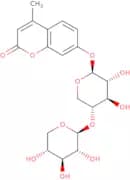
CAS:4-Methylumbelliferyl beta-D-xylobioside is a fluorogenic substrate for xylanase. After enzymatic cleaveage, free 4-methylumbelliferone (also known as hymecromone) is released, exhibiting blue fluorescence upon excitation with UV light. The strongest fluorescence of 4-methylumbelliferone requires deprotonation of the hydroxyl group (thus requires alkaline pH), with a maximal fluorescence intensity obtained with excitation at 350 to 370 nm and emission at 440 to 470 nm. The use of 4-methylumbelliferyl beta-D-xylobiosideas a substrate for measuring the xylanase activity is used for detecting bacterial infection and gut microbiome analysis.Fórmula:C20H24O11Pureza:Min. 95 Area-%Cor e Forma:White PowderPeso molecular:440.4 g/mol