Haletos orgânicos
Nesta categoria, você encontrará moléculas orgânicas contendo um ou mais átomos de halogênio em sua estrutura. Estes haletos orgânicos incluem compostos bromados, iodados, clorados e haletos cíclicos. Os haletos orgânicos são amplamente utilizados em síntese orgânica, farmacêutica, agroquímica e ciência dos materiais devido à sua reatividade e capacidade de sofrer uma variedade de transformações químicas. Na CymitQuimica, oferecemos uma seleção abrangente de haletos orgânicos de alta qualidade para apoiar suas aplicações de pesquisa e industriais, garantindo desempenho confiável e eficaz em seus projetos sintéticos e analíticos.
Subcategorias de "Haletos orgânicos"
Foram encontrados 20437 produtos de "Haletos orgânicos"
Ordenar por
Pureza (%)
0
100
|
0
|
50
|
90
|
95
|
100
H-Lys-Pro-OH hydrochloride salt
CAS:<p>H-Lys-Pro-OH hydrochloride salt is a monoclonal antibody that is used to treat psychotic disorders. It blocks the binding of gamma-aminobutyric acid (GABA) to its receptor, which reduces neuronal activity and has a calming effect on the central nervous system. H-Lys-Pro-OH hydrochloride salt also inhibits the phosphatase enzyme and prevents it from breaking down phosphotungstic acid, which is used in this process. The antibody also binds to the analog of gamma aminobutyric acid, preventing it from binding with its receptor. H-Lys-Pro-OH hydrochloride salt may be advantageous in treating kidney fibrosis because it prevents cell proliferation and growth in tissue cultures by inhibiting enzymes involved in collagen synthesis. H-Lys-Pro-OH hydrochloride salt may also be useful as an antitumor agent because it inhibits tumor growth by blocking uptake and replication of DNA.</p>Fórmula:C11H21N3O3Pureza:Min. 95%Peso molecular:243.3 g/molDABCYL-γ-Abu-Ile-His-Pro-Phe-His-Leu-Val-Ile-His-Thr-EDANS trifluoroacetate salt
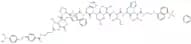
CAS:Produto Controlado<p>DABCYL-gamma-Abu-Ile-His-Pro-Phe-His-Leu-Val-Ile-His-Thr (DABCYL) is a fluorescent substrate that has been used to study the kinetics of peptide hydrolysis by proteases. It is an amino acid sequence that is present in angiotensinogen, which is a blood protein involved in regulating blood pressure. The DABCYL group on the terminal amino acid of the peptide provides a highly fluorescent molecule that can be excited at wavelengths longer than 400 nm. This fluorophore can also be used as a donor for fluorescence resonance energy transfer (FRET) with other fluorophores, such as EDANS, which has been shown to have high affinity for DABCYL. DABCYL can be used to measure enzyme activity or inhibition and has been found to be sensitive enough to detect changes due to dilutions at concentrations as low as 10 nM.</p>Fórmula:C90H120N22O16SPureza:Min. 95%Peso molecular:1,798.12 g/mol2-Chloro-4-Hydroxybenzyl alcohol
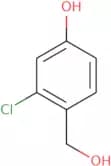
CAS:<p>2-Chloro-4-hydroxybenzyl alcohol is an organic compound that has been shown to be soluble in aqueous alkali metal solutions, but insoluble in water. It is also insoluble in polymer solvents such as acetone and ethyl ether. 2-Chloro-4-hydroxybenzyl alcohol is a sugar alcohol with 3 hydroxyl groups. The molecule has a molecular weight of 150.17 g/mol, melting point of -123°C (-198°F), boiling point of 179°C (354°F), and refractive index of 1.5774 at 20°C (68°F). This chemical can be used in the synthesis of polyhydric alcohols such as glycerol or hexanol. 2-Chloro-4-hydroxybenzyl alcohol is not soluble in hydrochloric acid, benzene or chloroform, and does not react to form any es</p>Fórmula:C7H7ClO2Pureza:Min. 95%Peso molecular:158.58 g/molH-Cys(Trt)-2-chlorotrityl resin (200-400 mesh)
<p>Please enquire for more information about H-Cys(Trt)-2-chlorotrityl resin (200-400 mesh) including the price, delivery time and more detailed product information at the technical inquiry form on this page</p>Pureza:Min. 95%6-Chloro-2-methylbenzoic acid
CAS:<p>6-Chloro-2-methylbenzoic acid is a methyl ester that is used in the synthesis of 2-chloro-6-fluorobenzaldehyde. This chemical reacts with hydrogen peroxide to produce chloride and 2,6-dichlorobenzoic acid. The compound can also be synthesized from 2,6-dichlorobenzaldehyde and methoxyethanol. 6CMB has been shown to react with anions such as Cl-, Br-, NO2-, SO3H, and PO3H2 to form organic carboxylates or sulfoxides. It has also been shown to be a byproduct of the reaction between chloral hydrate and potassium permanganate.</p>Fórmula:C8H7ClO2Pureza:90%Cor e Forma:PowderPeso molecular:170.59 g/molCART (55-102) (human) trifluoroacetate salt
CAS:<p>CART (55-102) is a specific amino acid that has been shown to bind to the CART receptor. It has been found in human and rat tissue, including the brain, pituitary gland, and pancreas. This compound is thought to be involved in regulating appetite and energy expenditure. The CART (55-102) trifluoroacetate salt has been shown to be active in a variety of animal models for obesity and diabetes, as well as for reducing food intake.</p>Fórmula:C225H365N65O65S7Pureza:Min. 95%Peso molecular:5,245.17 g/molLHRH II trifluoroacetate salt
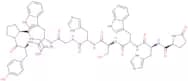
CAS:<p>LHRH II trifluoroacetate salt is a peptide hormone that is used to treat prostate cancer, breast cancer, and endometriosis. It binds to the ryanodine receptor in the cell membrane and induces the release of calcium from intracellular stores. LHRH II trifluoroacetate salt also promotes polymerase chain reactions which are important for DNA replication. This drug has been shown to increase epidermal growth factor (EGF) levels in carcinoma cell lines and has transcriptional regulatory activity in a model system. LHRH II trifluoroacetate salt can be used as an experimental model for clinical relevance because it can be used to study how hormones affect cellular processes such as transcriptional regulation.</p>Fórmula:C60H69N17O13Pureza:Min. 95%Peso molecular:1,236.3 g/mol(Arg8)-Vasopressin (free acid) trifluoroacetate salt
CAS:<p>Please enquire for more information about (Arg8)-Vasopressin (free acid) trifluoroacetate salt including the price, delivery time and more detailed product information at the technical inquiry form on this page</p>Fórmula:C46H64N14O13S2Pureza:Min. 95%Peso molecular:1,085.22 g/molpTH (1-37) (human) trifluoroacetate salt
CAS:<p>Please enquire for more information about pTH (1-37) (human) trifluoroacetate salt including the price, delivery time and more detailed product information at the technical inquiry form on this page</p>Fórmula:C195H316N58O54S2Pureza:Min. 95%Peso molecular:4,401.09 g/mol4-Chloro-6-methoxyquinoline
CAS:<p>4-Chloro-6-methoxyquinoline is an inhibitor of bacterial DNA gyrase. It has antibacterial activity against Gram-positive and Gram-negative bacteria, including Staphylococcus aureus, Enterococcus faecalis, and Pseudomonas aeruginosa. 4-Chloro-6-methoxyquinoline is a synthetic compound that was reinvestigated for its antibacterial activity. It has been shown to be effective in the treatment of Staphylococcal infections. The mechanism of action may involve inhibition of topoisomerase II or interference with the synthesis of DNA by binding to the enzyme bacterial DNA gyrase. Quinidine and cinchonidine are quinine derivatives that have been found to inhibit bacterial DNA gyrase. These compounds are found in the bark of Cinchona species, which includes Cinchona ledgeriana, Cinchona officinalis, and Cinchona succirub</p>Fórmula:C10H8ClNOPureza:Min. 95%Peso molecular:193.029442,2,2-Trifluoro-1-(3-Trimethylsilylphenyl)Ethanone
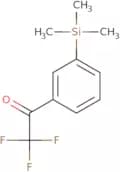
CAS:<p>2,2,2-Trifluoro-1-(3-trimethylsilylphenyl)ethanone is a chemical that can be used as an acetylcholinesterase inhibitor. This agent is designed to inhibit the enzyme that breaks down acetylcholine, which is responsible for transmitting nerve impulses and controlling muscle contractions. The activity of 2,2,2-Trifluoro-1-(3-trimethylsilylphenyl)ethanone is reversible by hydrolysis and it has a low bioavailability due to its high lipophilicity. Acetylcholinesterase inhibitors are mainly used for the treatment of inflammatory diseases such as rheumatoid arthritis. br> The pharmacodynamics of 2,2,2-Trifluoro-1-(3-trimethylsilylphenyl)ethanone are not well understood. This drug also has side effect profiles</p>Fórmula:C11H13F3OSiPureza:Min. 95%Peso molecular:246.3 g/mol(His(1-Me)2)-LHRH trifluoroacetate salt
CAS:<p>Please enquire for more information about (His(1-Me)2)-LHRH trifluoroacetate salt including the price, delivery time and more detailed product information at the technical inquiry form on this page</p>Fórmula:C56H77N17O13Pureza:Min. 95%Peso molecular:1,196.32 g/molNα-(5-fluoro-2,4-dinitrophenyl)-D-leucinamide
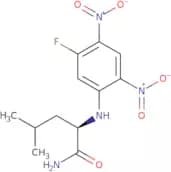
CAS:<p>Nalpha-(5-fluoro-2,4-dinitrophenyl)-D-leucinamide is a chemical compound that inhibits the activity of proteases. It has been shown to inhibit leukemia cells and actinomycetes. This chemical binds to the active site of proteases, inhibiting the hydrolysis of peptides by blocking the access of water molecules to the reactive site. In addition, Nalpha-(5-fluoro-2,4-dinitrophenyl)-D-leucinamide can also be used as a fluorescent probe for protease activity in analytical methods. The product research on this compound has shown that it is a potent inhibitor of cyclic peptide synthetases and can be used as an anti-inflammatory agent.</p>Fórmula:C12H15FN4O5Pureza:Min. 95%Cor e Forma:Off-White To Yellow SolidPeso molecular:314.27 g/molCortistatin-29 (human) trifluoroacetate salt
CAS:<p>Please enquire for more information about Cortistatin-29 (human) trifluoroacetate salt including the price, delivery time and more detailed product information at the technical inquiry form on this page</p>Fórmula:C149H223N47O42S3Pureza:Min. 95%Peso molecular:3,440.85 g/mol6-Bromoindazole
CAS:<p>6-Bromoindazole is a hydrogen bond inhibitor that has potential neuroprotective effects. It inhibits the enzyme DNA Gyrase, which is necessary for bacterial replication, and has antibacterial properties. 6-Bromoindazole interacts with the receptor tyrosine kinase axitinib and inhibits its activity. This interaction may be responsible for its neuroprotective effects.</p>Fórmula:C7H5BrN2Pureza:Min. 95%Peso molecular:197.03 g/molHIV (gp120) Fragment (421-438) trifluoroacetate salt
CAS:<p>Please enquire for more information about HIV (gp120) Fragment (421-438) trifluoroacetate salt including the price, delivery time and more detailed product information at the technical inquiry form on this page</p>Fórmula:C99H148N24O25S2Pureza:Min. 95%Peso molecular:2,138.51 g/moltrans-4-Hydroxy-L-proline methyl ester hydrochloride
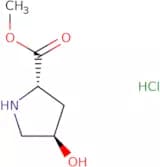
CAS:<p>Trans-4-hydroxy-L-proline methyl ester hydrochloride is a matrix metalloproteinase inhibitor. It inhibits the activity of matrix metalloproteinases, which are enzymes that break down collagen and other proteins in the extracellular matrix. The inhibition of these enzymes leads to a decrease in restenosis, which is the recurrence of artery narrowing after angioplasty or stent placement. Trans-4-hydroxy-L-proline methyl ester hydrochloride has been shown to be effective against chemokine receptors, including CCR5 receptor and chemokines such as TNFα. It also inhibits cytokine production by inhibiting signaling pathways that lead to inflammation and cell proliferation.</p>Fórmula:C6H11NO3·HClCor e Forma:White/Off-White SolidPeso molecular:181.62 g/mol4-Iodobiphenyl
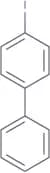
CAS:<p>4-Iodobiphenyl is a boronic acid that can be used in the Suzuki coupling reaction. It is an analog of biphenyl and diphenyl ether, with spacing that allows for aryl boronic acids to bind to it. 4-Iodobiphenyl has been shown to inhibit protein synthesis in the cytosol of erythrocytes and leukocytes. This compound can also be used as a bioactive molecule due to its ability to bind with proteins and lipids. 4-Iodobiphenyl has been shown to have anti-inflammatory activities due to its ability to inhibit prostaglandin synthesis by binding with arachidonic acid.</p>Fórmula:C12H9IPureza:Min. 98 Area-%Cor e Forma:White PowderPeso molecular:280.1 g/mol2-Bromo-3-fluoroaniline
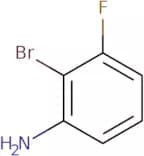
CAS:<p>2-Bromo-3-fluoroaniline is a reactive and nucleophilic compound that is synthesized by the reaction of aniline with bromine and sodium hydroxide. The drug development of 2-bromo-3-fluoroaniline has been hampered by its toxicity, but it has shown promising results in animal studies for the treatment of cancer. Mechanistic studies have demonstrated that 2-bromo-3-fluoroaniline causes cell death by reacting with DNA. This drug also acts as a prodrug to fluoroacetic acid, which inhibits cell proliferation by inhibiting protein synthesis.</p>Fórmula:C6H5BrFNPureza:Min. 95%Cor e Forma:SolidPeso molecular:190.01 g/molCortistatin-17 (human) trifluoroacetate salt
CAS:<p>Please enquire for more information about Cortistatin-17 (human) trifluoroacetate salt including the price, delivery time and more detailed product information at the technical inquiry form on this page</p>Fórmula:C96H139N27O24S3Pureza:Min. 95%Peso molecular:2,151.5 g/mol