Hidrazinas
As hidrazinas são compostos orgânicos caracterizados pela presença de um grupo hidrazina (N2H4). Estes compostos são usados em várias reações químicas, incluindo como intermediários em produtos farmacêuticos e agroquímicos. Na CymitQuimica, oferecemos uma ampla seleção de hidrazinas de alta qualidade para apoiar suas aplicações de pesquisa e industriais, garantindo resultados confiáveis e eficientes. Nossa seleção inclui hidrazinas adequadas para uma ampla gama de sínteses químicas e requisitos experimentais.
Foram encontrados 1360 produtos de "Hidrazinas"
Ordenar por
Pureza (%)
0
100
|
0
|
50
|
90
|
95
|
100
2-Chloro-4-hydrazinylbenzoic acid hydrochloride
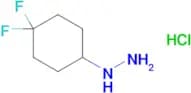
CAS:Fórmula:C7H8Cl2N2O2Pureza:96%Peso molecular:223.05(4,4-Difluorocyclohexyl)hydrazine hydrochloride
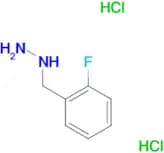
CAS:Pureza:97%Cor e Forma:SolidPeso molecular:186.63000491-(2-Fluorobenzyl)hydrazine dihydrochloride
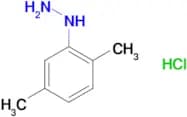
CAS:Fórmula:C7H11Cl2FN2Pureza:95%Cor e Forma:SolidPeso molecular:213.082,5-Dimethylphenylhydrazine hydrochloride
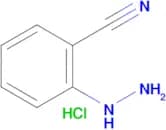
CAS:Fórmula:C8H13ClN2Pureza:97%Cor e Forma:SolidPeso molecular:172.662-Hydrazinylbenzonitrile hydrochloride
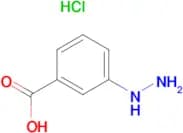
CAS:Fórmula:C7H8ClN3Pureza:95%Cor e Forma:SolidPeso molecular:169.613-Hydrazinobenzoic acid hydrochloride
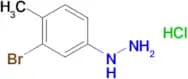
CAS:Fórmula:C7H9ClN2O2Pureza:95%Cor e Forma:SolidPeso molecular:188.61(3-Bromo-4-methylphenyl)hydrazine hydrochloride
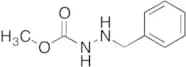
CAS:Fórmula:C7H10BrClN2Pureza:95%Peso molecular:237.53Methyl 2-Benzylhydrazinecarboxylate
CAS:Produto Controlado<p>Applications Methyl 2-benzylhydrazinecarboxylate is an intermediate for the synthesis of CFM 1571 Hydrochloride (C291720), which acts as a soluble guanylyl cyclase (sGC) activator while ignoring adenylyl cyclase. Inhibits collagen-stimulated platelet aggregation in vitro.<br>References Kotzki, S. et al.: J. Pharm. Exp. Ther., 346, 424 (2013); Selwood, D> et al.: J. Med. CHem., 44, 78 (2001)<br></p>Fórmula:C9H12N2O2Cor e Forma:NeatPeso molecular:180.23,5-Difluorophenylhydrazine HCl
CAS:3,5-Difluorophenylhydrazine HCl is a versatile building block. It is a fine chemical that is used in research chemicals and speciality chemicals. 3,5-Difluorophenylhydrazine HCl has been used as a reagent and as a reaction component for the synthesis of complex compounds. This chemical may be useful as a scaffold for the construction of novel molecules with desired properties.Fórmula:C6H6F2N2·HClPureza:Min. 95%Peso molecular:180.58 g/mol3-Chlorophenylhydrazine hydrochloride
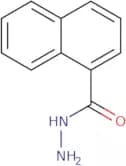
CAS:<p>3-Chlorophenylhydrazine hydrochloride is a pyrazole that has been shown to have potent antibacterial activity. It is used in the treatment of inflammatory diseases and has been shown to be effective against Helicobacter pylori, which causes gastritis, peptic ulcers, and stomach cancer. 3-Chlorophenylhydrazine hydrochloride is an acidic compound with a molecular weight of 192.2 g/mol. It contains a pyrazole ring that is eluted with hydrochloric acid and reacts with gyrase enzymes in bacteria, inhibiting DNA synthesis. 3-Chlorophenylhydrazine hydrochloride also has anti-inflammatory properties due to its ability to inhibit prostaglandin synthesis.</p>Fórmula:C6H7ClN2•HClPureza:Min. 95%Cor e Forma:PowderPeso molecular:179.05 g/molα-Naphthoylhydrazine
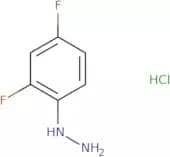
CAS:Alpha-naphthoylhydrazine is a nitrogen-containing heterocyclic compound with a carbonyl group at the alpha position. It has been shown to be an effective enhancer of 5-HT1A and 5-HT2C receptors, as well as having other pharmacological effects (e.g., bone cancer). Alpha-Naphthoylhydrazine is acidic, which means it has a low pH. It can also form hydrogen bonds with water molecules. Alpha-Naphthoylhydrazine is rapidly absorbed and metabolized in humans, with very little excreted unchanged in the urine. The half life of alpha-Naphthoylhydrazine is 4 hours, meaning that after 4 hours 50% of the drug will have been eliminated from the body. Alpha-Naphthoylhydrazine also has protonated carbonyls and aromatic rings which are susceptible to photophysical processes such as electron transferFórmula:C11H10N2OPureza:Min. 95%Cor e Forma:PowderPeso molecular:186.21 g/mol2,4-Difluorophenylhydrazine hydrochloride
CAS:<p>2,4-Difluorophenylhydrazine hydrochloride is a synthetic analgesic that is used to produce pain relief. It can be synthesized by refluxing 2,4-difluoroaniline and hydrazine in acetonitrile. The yield of the reaction depends on the catalyst used. An acid catalyst such as pyridine or benzoic acid will yield more product than a base such as potassium carbonate. The synthesis of 2,4-difluorophenylhydrazine hydrochloride can also be achieved by reacting phenylhydrazine with an alkyl halide in the presence of a base. This process yields pyrazoles, which are then converted to 2,4-difluorophenylhydrazine hydrochloride by treatment with hydrochloric acid.<br>2,4-Difluorophenylhydrazine hydrochloride is an antibacterial agent that has</p>Fórmula:C6H7ClF2N2Pureza:Min. 95%Cor e Forma:PowderPeso molecular:180.58 g/molPentafluorophenyl hydrazine
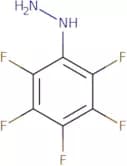
CAS:<p>Pentafluorophenyl hydrazine is an organic compound with the formula CHC(F)NH. It is a reactive species that participates in chemical reactions involving free radicals, such as oxidative DNA damage. Pentafluorophenyl hydrazine reacts with fatty acids to form trifluoroacetyl esters and pentafluorophenyl esters, which can be analyzed by gas chromatography-mass spectrometry. Pentafluorophenyl hydrazine is also used for the preparation of hydrochloric acid and carbonyl group derivatives. This compound can be prepared by reacting trifluoroacetic acid with phenol or phenol ethers under acidic conditions.</p>Fórmula:C6F5NHNH2Pureza:Min. 95%Cor e Forma:White PowderPeso molecular:198.09 g/mol1-Acetyl-2-phenylhydrazine
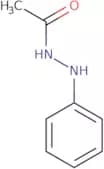
CAS:<p>Reacts with oxyhaemoglobin to form free radicals; induces haemolytic anaemia</p>Fórmula:C8H10N2OPureza:Min. 95%Cor e Forma:White PowderPeso molecular:150.18 g/mol3-Chlorophenylhydrazine sulphate
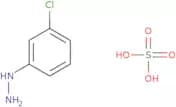
CAS:<p>3-Chlorophenylhydrazine sulphate is a chemical compound that is made by the reaction of 3-chlorophenol and hydrazine. It has been shown to be stable when mixed with other compounds, such as acetone. 3-Chlorophenylhydrazine sulphate has a reaction time of one hour when it is reacted with sodium hydrogen sulfate and zinc powder in a liquid chromatography column. The final product is detected using chromatography detection, which can detect the presence of sulfates. This chemical compound can be used to make other chemicals, such as thiosulfate or hydrochloric acid.</p>Fórmula:C12H14Cl2N4•H2O4SPureza:Min. 95%Cor e Forma:PowderPeso molecular:383.25 g/mol