Hidrazinas
As hidrazinas são compostos orgânicos caracterizados pela presença de um grupo hidrazina (N2H4). Estes compostos são usados em várias reações químicas, incluindo como intermediários em produtos farmacêuticos e agroquímicos. Na CymitQuimica, oferecemos uma ampla seleção de hidrazinas de alta qualidade para apoiar suas aplicações de pesquisa e industriais, garantindo resultados confiáveis e eficientes. Nossa seleção inclui hidrazinas adequadas para uma ampla gama de sínteses químicas e requisitos experimentais.
Foram encontrados 1360 produtos de "Hidrazinas"
Ordenar por
Pureza (%)
0
100
|
0
|
50
|
90
|
95
|
100
1-Methyl-1-phenylhydrazine
CAS:<p>1-Methyl-1-phenylhydrazine (MPH) is a chemical crosslinking agent that has been shown to be an efficient method for the production of hydrogels. It is a fast and efficient method for the production of hydrogels, which are three dimensional networks of macromolecules that form strong gels. MPH can react with aminosulfonyl groups on proteins to form a covalent bond, which leads to the formation of stable cross-links in hydrogels. It also has been shown to have immunosuppressive effects and may be used as an active substance in autoimmune diseases.</p>Fórmula:C7H10N2Pureza:Min. 95.0%Peso molecular:122.17 g/molN,N'-Dimethylhydrazine dihydrochloride
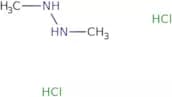
CAS:Produto Controlado<p>N,N'-Dimethylhydrazine dihydrochloride (DMHD) is a nonsteroidal anti-inflammatory drug that inhibits the production of prostaglandins by blocking cyclooxygenase-2 (COX-2). It works by inhibiting tumor growth and inducing apoptosis. DMHD has been shown to inhibit angiogenesis and induce apoptosis in liver cells. DMHD also inhibits the mitochondrial membrane potential, which is important for regulating cell function. The molecular docking analysis has shown that DMHD binds to COX-2 protein with high affinity and specificity. DMHD also inhibits fatty acid synthesis, which may be due to its inhibition of mitochondrial beta-oxidation enzymes. DMHD has been shown to have toxic effects on colon cells in rats. This agent can cause damage to the colon lining through a number of mechanisms, including causing DNA damage and increasing oxidative stress.</p>Fórmula:C2H8N2Pureza:Min. 95%Peso molecular:60.1 g/mol1,1-DimethylhydrazineHCl
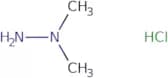
CAS:Produto Controlado<p>1,1-DimethylhydrazineHCl is a drug that inhibits the growth of cancer cells. It is an inhibitor drug for CDK4 and CDK6, which are enzymes essential for DNA replication. 1,1-DimethylhydrazineHCl has been shown to inhibit the growth of cervical cancer cells in mice by inhibiting the epidermal growth factor receptor (EGFR). This inhibition prevents the activation of EGFR and subsequent downstream signaling pathways. 1,1-DimethylhydrazineHCl also inhibits HIV infection by inhibiting viral reverse transcriptase activity. This inhibition prevents the synthesis of viral DNA, which is required for viral replication.</p>Fórmula:C2H9ClN2Pureza:Min. 95%Peso molecular:96.56 g/mol(1,1-Dioxidotetrahydro-3-thienyl)hydrazine hydrochloride
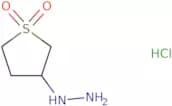
CAS:<p>Please enquire for more information about (1,1-Dioxidotetrahydro-3-thienyl)hydrazine hydrochloride including the price, delivery time and more detailed product information at the technical inquiry form on this page</p>Fórmula:C4H10N2O2SPureza:Min. 95%Peso molecular:150.2 g/mol2-Fluoro-5-hydrazinylpyridine
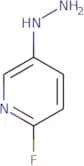
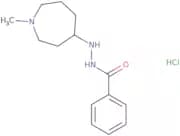
CAS:<p>Please enquire for more information about 2-Fluoro-5-hydrazinylpyridine including the price, delivery time and more detailed product information at the technical inquiry form on this page</p>Fórmula:C5H6FN3Pureza:Min. 95%Peso molecular:127.12 g/molN'-(1-Methylazepan-4-yl)benzohydrazine
CAS:<p>Please enquire for more information about N'-(1-Methylazepan-4-yl)benzohydrazine including the price, delivery time and more detailed product information at the technical inquiry form on this page</p>Fórmula:C14H22ClN3OPureza:Min. 95%Peso molecular:283.8 g/molEltrombopag olamine
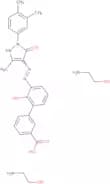
CAS:<p>Eltrombopag olamine is an orally active drug that belongs to the class of thiazolidinones. It has been used for the treatment of thrombocytopenia in patients with chronic liver disease and myelodysplastic syndrome. Eltrombopag olamine inhibits platelet aggregation by binding to glycoprotein IIb/IIIa receptors on the surface of platelets. The drug is a prodrug that is metabolized in vivo to its active form, eltrombopag. This conversion is catalysed by CYP3A4 and CYP2D6 enzymes and can be inhibited by drugs that inhibit these enzymes, such as trifluoroacetic acid and hydroxyl group-containing compounds. Eltrombopag olamine binds to erythrocytes, which may be due to its ability to form intramolecular hydrogen bonds with nitrogen atoms. The synthesis of elt</p>Fórmula:C25H22N4O4•(C2H7NO)2Pureza:Min. 95%Cor e Forma:PowderPeso molecular:564.63 g/mol4-Nitrophenylhydrazine hydrochloride
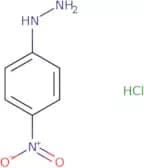
CAS:<p>4-Nitrophenylhydrazine hydrochloride is an organic compound that belongs to the class of hydrazines. It is a colorless solid that has a melting point of 202-204 °C. 4-Nitrophenylhydrazine hydrochloride is used in the synthesis of other compounds, such as trifluoroacetic acid and nucleophilic compounds. The chemical structure can be analyzed using nuclear magnetic resonance (NMR) spectroscopy, which shows that this compound contains amines and nitro groups. 4-Nitrophenylhydrazine hydrochloride is also soluble in water due to its acidic nature. This compound reacts with bases and alcohols to form salts, such as monosodium salt.</p>Fórmula:C6H7N3O2·HClPureza:Min. 95%Cor e Forma:PowderPeso molecular:189.6 g/mol7-Chloro-2-hydrazino-5-phenyl-3H-1,4-benzodiazepine
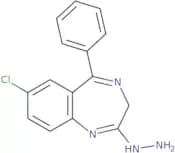
CAS:Produto Controlado<p>7-Chloro-2-hydrazino-5-phenyl-3H-1,4-benzodiazepine is a metabolically stable benzodiazepine that binds to the benzodiazepine receptor. It has been shown to have a higher affinity for this receptor than alprazolam and other related compounds. 7-Chloro-2-hydrazino-5-phenyl-3H-1,4-benzodiazepine has been used as an active ingredient in a number of pesticide products that are used against termites and ants. This compound has also been found to be an effective insecticide against mosquitoes. 7C2HDBZ has been shown to be stable in the environment and is not readily degraded by hydrolysis or pyrolysis.</p>Fórmula:C15H13ClN4Pureza:Min. 95%Peso molecular:284.74 g/molHydrazine acetate
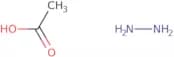
CAS:Produto Controlado<p>Hydrazine acetate is an organic solution that has a glycoconjugate. It is also found in uridine, hydrogen bond and serine protease. Hydrazine acetate has been shown to have a benzyl group and carbonyl group. Hydrazine acetate interacts with trifluoroacetic acid and particle. This drug can be used for the treatment of autoimmune diseases, such as rheumatoid arthritis, and infectious diseases such as HIV/AIDS. Hydrazine acetate has shown high values for growth factor activity, which may be due to its ability to inhibit the enzyme ns3 protease in the synthesis of proinflammatory cytokines.</p>Fórmula:C2H4O2·H4N2Pureza:Min. 95%Cor e Forma:White PowderPeso molecular:92.1 g/mol4-Hydrazino-3-nitroacetanilide
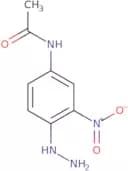
CAS:<p>4-Hydrazino-3-nitroacetanilide is a high quality reagent that can be used as an intermediate in the preparation of complex compounds. It is also a useful building block for the synthesis of fine chemicals, providing a versatile scaffold for chemical reactions. 4-Hydrazino-3-nitroacetanilide has been shown to react with various amines to produce useful products. This product is a speciality chemical and research chemicals, which is useful in the production of other substances.</p>Fórmula:C8H10N4O3Pureza:Min. 95%Cor e Forma:PowderPeso molecular:210.19 g/mol2-Hydroxyethyl hydrazine
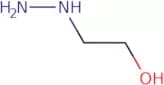
CAS:<p>2-Hydroxyethyl hydrazine is a plant hormone that is synthesized from ethanolamine and hydrazine. It has a pyrazole ring, which acts as the central heterocyclic structure in this molecule. 2-Hydroxyethyl hydrazine is relatively stable in water, but it will decompose at higher temperatures. The ph optimum for 2-hydroxyethyl hydrazine is between 4 and 8. This compound can be found in model systems such as plants and fungi. The x-ray data indicates that 2-hydroxyethyl hydrazine has coordination geometry of D2O2 (2 molecules) with a bond length of 1.8 Å. Synthesis methods for this chemical include hydrochloric acid, inorganic acid, or oxidation by sodium hypochlorite. Pharmacological agents that activate this chemical include activation energies of 100 to 250 kilocalories per mole (kcal/mol).</p>Fórmula:C2H8N2OPureza:Min. 97.0 Area-%Cor e Forma:Colorless Clear LiquidPeso molecular:76.1 g/mol3-Fluorophenylhydrazine hydrochloride
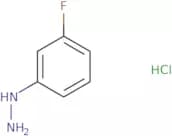
CAS:<p>3-Fluorophenylhydrazine HCl is a high quality, versatile building block that is useful for the synthesis of complex compounds. It can be used as a reactant or reagent in research and development projects. 3-Fluorophenylhydrazine HCl is also an important intermediate for the synthesis of fine chemicals and speciality chemicals, such as pharmaceuticals and pesticides. This chemical can be used as a building block to create various products, including pharmaceuticals, pesticides, and dyes. 3-Fluorophenylhydrazine HCl has been shown to react with anilines to produce tertiary amines.</p>Fórmula:C6H8ClFN2Pureza:Min. 95%Cor e Forma:PowderPeso molecular:162.59 g/mol2-Ethylphenylhydrazine hydrochloride
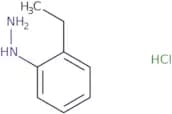
CAS:<p>2-Ethylphenylhydrazine hydrochloride is a diazonium salt that catalyzes the reaction of nitrite with acetonitrile to produce an organic solvent. This organic solvent can be used in the production of various products, such as anti-inflammatory drugs, which are generally made from organic solvents. 2-Ethylphenylhydrazine hydrochloride is not a non-steroidal drug, but it does have anti-inflammatory properties. The impurities in this product are mainly hydrochloric acid and 2-ethylphenol.</p>Fórmula:C8H12N2•HClPureza:Min. 95%Peso molecular:172.66 g/mol1,2-Diacetylhydrazine
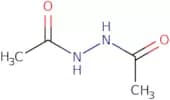
CAS:<p>1,2-Diacetylhydrazine (DAH) is a chemical used as an herbicide. It inhibits the enzyme hydrazine acetyltransferase in plants, which is required for the biosynthesis of nicotinic acid and nicotinamide adenine dinucleotide. DAH also inhibits the liver enzyme fatty acid synthase, which is responsible for synthesizing fatty acids from acetyl-CoA and malonyl-CoA. This inhibition leads to an accumulation of hydrogen bond, protocatechuic acid, and hydrochloric acid in plasma samples. The structural analysis of DAH has been done by NMR spectroscopy and X-ray crystallography. It has been found that DAH contains a hydroxyl group at position C1’ and three nitrogen atoms at positions C3’, C4’, and C5’. DAH can also produce drug interactions with isoniazid by inhibiting its metabolism</p>Fórmula:C4H8N2O2Peso molecular:116.12 g/mol4-(2'-N-Boc-hydrazino)benzoic acid
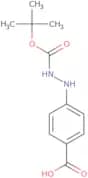
CAS:Please enquire for more information about 4-(2'-N-Boc-hydrazino)benzoic acid including the price, delivery time and more detailed product information at the technical inquiry form on this pageFórmula:C12H16N2O4Pureza:Min. 95%Peso molecular:252.27 g/mol4-(Fmoc-hydrazino)-benzoylaminomethyl resin (200-400 mesh)
Please enquire for more information about 4-(Fmoc-hydrazino)-benzoylaminomethyl resin (200-400 mesh) including the price, delivery time and more detailed product information at the technical inquiry form on this pagePureza:Min. 95%2-Hydrazinobenzoic acid hydrochloride - technical grade
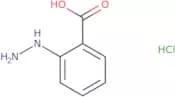
CAS:2-Hydrazinobenzoic acid hydrochloride is a synthetic compound that can be used as a ligand or substrate for the polymerase. It has been shown to interact with the NS5B polymerase, which is involved in viral replication and drug resistance. 2-Hydrazinobenzoic acid hydrochloride also produces reduction products and luminescence when combined with chloride. The luminescence is thought to be due to an interaction with the nucleophilic carbonyl group of 2-hydrazinobenzoic acid hydrochloride and a nucleophilic attack on the carbonyl oxygen atom by chloride ions. This reaction produces blue light at around 470 nm.Fórmula:C7H8N2O2·xHClPureza:(%) Min. 60%Cor e Forma:PowderPeso molecular:188.61 g/mol3-Trifluoromethyl phenylhydrazine hydrochloride
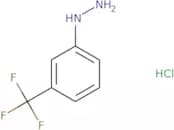
CAS:3-Trifluoromethyl phenylhydrazine HCl is a fine chemical that can be used as a versatile building block in the synthesis of complex compounds. It has been shown to be a useful intermediate for the preparation of research chemicals, reaction components and speciality chemicals. 3-Trifluoromethyl phenylhydrazine HCl belongs to CAS No. 3107-33-3 and can be used as a reagent in organic synthesis. The compound is high quality with a purity of over 99%.Fórmula:C7H8ClF3N2Pureza:Min. 95%Cor e Forma:PowderPeso molecular:212.6 g/mol1-(2,4-Dichlorobenzoyl)-2-(1-naphthoyl)hydrazine
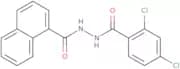
CAS:<p>Please enquire for more information about 1-(2,4-Dichlorobenzoyl)-2-(1-naphthoyl)hydrazine including the price, delivery time and more detailed product information at the technical inquiry form on this page</p>Fórmula:C18H12Cl2N2O2Pureza:Min. 95%Peso molecular:359.21 g/mol