Silanos
Os silanos são compostos à base de silício com um ou mais grupos orgânicos ligados a um átomo de silício. Eles servem como building blocks cruciais na síntese orgânica e inorgânica, especialmente na modificação de superfícies, promoção de adesão e produção de revestimentos e selantes. Os silanos são amplamente utilizados na indústria de semicondutores, no tratamento de vidro e como agentes de reticulação na química de polímeros. Na CymitQuimica, oferecemos uma vasta gama de silanos projetados para suas aplicações de pesquisa e industriais.
Subcategorias de "Silanos"
Foram encontrados 1235 produtos de "Silanos"
Ordenar por
Pureza (%)
0
100
|
0
|
50
|
90
|
95
|
100
CHLOROMETHYLTRIETHOXYSILANE
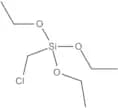
CAS:<p>Halogen Functional Trialkoxy Silane<br>Silane coupling agents have the ability to form a durable bond between organic and inorganic materials to generate desired heterogeneous environments or to incorporate the bulk properties of different phases into a uniform composite structure. The general formula has two classes of functionality. The hydrolyzable group forms stable condensation products with siliceous surfaces and other oxides such as those of aluminum, zirconium, tin, titanium, and nickel. The organofunctional group alters the wetting or adhesion characteristics of the substrate, utilizes the substrate to catalyze chemical transformations at the heterogeneous interface, orders the interfacial region, or modifies its partition characteristics, and significantly effects the covalent bond between organic and inorganic materials.<br>Chloromethyltriethoxysilane; triethoxy(chloromethyl)silane; (chloromethyl)triethoxysilane; (triethoxysilyl)methylchloride<br>Grignard reacts with chlorosilanes or intermolecularly to form carbosilanesUsed in microparticle surface modification<br></p>Fórmula:C7H17ClO3SiPureza:97%Cor e Forma:LiquidPeso molecular:212.75TETRA-s-BUTOXYSILANE
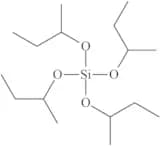
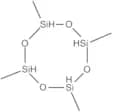
CAS:Fórmula:C16H36O4SiPureza:95%Cor e Forma:Light Amber LiquidPeso molecular:320.541,3,5,7-TETRAMETHYLCYCLOTETRASILOXANE
CAS:<p>Siloxane-Based Silane Reducing Agent<br>Organosilanes are hydrocarbon-like and possess the ability to serve as both ionic and free-radical reducing agents. These reagents and their reaction by-products are safer and more easily handled and disposed than many other reducing agents. The metallic nature of silicon and its low electronegativity relative to hydrogen lead to polarization of the Si-H bond yielding a hydridic hydrogen and a milder reducing agent compared to aluminum-, boron-, and other metal-based hydrides. A summary of some key silane reductions are presented in Table 1 of the Silicon-Based Reducing Agents brochure.<br>1,3,5,7-Tetramethylcyclotetrasiloxane; TMCTS; Methyl hydrogen cyclic tetramer<br>ΔHcomb: 5,308 kJ/molΔHvap: 177.9 kJ/molVapor pressure, 20 °C: 7.0 mmCritical temperature: 278 °CHigh molecular weight silane reducing agentIn presence of oxygen plasma generates SiO2 films for microelectronicsCyclic monomer- undergoes hydrosilylation reactionsForms hybrid inorganic-organic polymers with dienes suitable for circuit board resinsForms gate dielectrics by CVDExtensive review of silicon based reducing agents: Larson, G.; Fry, J. L. "Ionic and Organometallic-Catalyzed Organosilane Reductions", Wipf, P., Ed.; Wiley, 2007<br></p>Fórmula:C4H16O4Si4Pureza:97%Cor e Forma:Colourless LiquidPeso molecular:240.51N,N'-BIS[(3-TRIMETHOXYSILYL)PROPYL]ETHYLENEDIAMINE, 95%
CAS:<p>N,N'-bis[(3-trimethoxysilyl)propyl]ethylenediamine; bis(trimethoxysilylpropyl)ethylenediamine; 1,2-bis[(3-trimethoxysilyl)propylamino]ethane<br>Diamine functional dipodal silaneContains N,N-isomerCoupling agent for polyamides with enhanced hydrolytic stabilityForms thin film environments for metal ions<br></p>Fórmula:C14H36N2O6Si2Pureza:95%Cor e Forma:Straw LiquidPeso molecular:384.627-OCTENYLTRIMETHOXYSILANE, tech
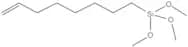
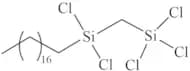
CAS:<p>Olefin Functional Trialkoxy Silane<br>Silane coupling agents have the ability to form a durable bond between organic and inorganic materials to generate desired heterogeneous environments or to incorporate the bulk properties of different phases into a uniform composite structure. The general formula has two classes of functionality. The hydrolyzable group forms stable condensation products with siliceous surfaces and other oxides such as those of aluminum, zirconium, tin, titanium, and nickel. The organofunctional group alters the wetting or adhesion characteristics of the substrate, utilizes the substrate to catalyze chemical transformations at the heterogeneous interface, orders the interfacial region, or modifies its partition characteristics, and significantly effects the covalent bond between organic and inorganic materials.<br>7-Octenyltrimethoxysilane; 8-(Trimethoxysilyl)octene<br>Contains 10-15% internal olefin isomersCoupling agent for "in situ" polymerization of acrylamide for capillary electrophoresisEmployed in stretched DNA fibers for fluorescent in situ hybridization (FISH)mappingSurface treatment for FISH and replication mapping on DNA fibersUsed in microparticle surface modification<br></p>Fórmula:C11H24O3SiPureza:97%Cor e Forma:Straw LiquidPeso molecular:232.391-n-OCTADECYL-1,1,3,3,3-PENTACHLORO-1,3-DISILAPROPANE, 95%
CAS:Fórmula:C19H39Cl5Si2Pureza:95%Cor e Forma:LiquidPeso molecular:500.95METHYLDIETHOXYSILANE
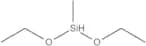
CAS:<p>Tri-substituted Silane Reducing Agent<br>Organosilanes are hydrocarbon-like and possess the ability to serve as both ionic and free-radical reducing agents. These reagents and their reaction by-products are safer and more easily handled and disposed than many other reducing agents. The metallic nature of silicon and its low electronegativity relative to hydrogen lead to polarization of the Si-H bond yielding a hydridic hydrogen and a milder reducing agent compared to aluminum-, boron-, and other metal-based hydrides. A summary of some key silane reductions are presented in Table 1 of the Silicon-Based Reducing Agents brochure.<br>Methyldiethoxysilane; Diethoxymethylsilane<br>ΔHcomb: 3,713 kJ/molWill form high-boiling polymeric by-products with aqueous work-upExtensive review of silicon based reducing agents: Larson, G.; Fry, J. L. "Ionic and Organometallic-Catalyzed Organosilane Reductions", Wipf, P., Ed.; Wiley, 2007<br></p>Fórmula:C5H14O2SiPureza:97%Cor e Forma:LiquidPeso molecular:134.25N-(6-AMINOHEXYL)AMINOPROPYLTRIMETHOXYSILANE, 95%
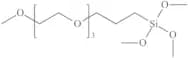
CAS:<p>N-(6-Aminohexyl)aminopropyltrimethoxysilane, N-[6-trimethoxysilyl)propyl]hexamethylethylenediamine, N-[3-(trimethoxysilyl)propyl]-1,6-hexanediamine<br>Diamino functional trialkoxy silanePrimary amine and an internal secondary amine coupling agent for UV cure and epoxy systemsUsed in microparticle surface modificationEmployed in immobilization of DNAEmployed for immobilization of PCR primers on beadsLong chain analog of SIA0590.5<br></p>Fórmula:C12H30N2O3SiPureza:95%Cor e Forma:Straw LiquidPeso molecular:278.47METHOXYTRIETHYLENEOXYPROPYLTRIMETHOXYSILANE
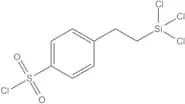
CAS:<p>Tipped PEG Silane (326.46 g/mol)<br>PEO, Trimethoxysilane termination utilized for hydrophilic surface modificationPEGylation reagentHydrogen bonding hydrophilic silaneForms polymeric proton-conducting electrolytes<br></p>Fórmula:C13H30O7SiPureza:92%Cor e Forma:Straw LiquidPeso molecular:326.462-(4-CHLOROSULFONYLPHENYL)ETHYLTRICHLOROSILANE, 50% in methylene chloride
CAS:Fórmula:C8H8Cl4O2SSiCor e Forma:Straw Amber LiquidPeso molecular:338.11TRIMETHOXYSILYLPROPYL MODIFIED (POLYETHYLENIMINE), 50% in isopropanol
CAS:<p>Trimethoxysilylpropyl modified (polyethylenimine)<br>Polyamino hydrophilic trialkoxysilaneViscosity: 125-175 cStEmployed as a coupling agent for polyamidesUsed in combination with glutaraldehyde immobilizes enzymes50% in isopropanol~20% of nitrogens substituted<br></p>Cor e Forma:Straw Yellow Amber LiquidPeso molecular:1500-1800VINYLMETHYLDIMETHOXYSILANE
CAS:<p>Olefin Functional Dialkoxy Silane<br>Silane coupling agents have the ability to form a durable bond between organic and inorganic materials to generate desired heterogeneous environments or to incorporate the bulk properties of different phases into a uniform composite structure. The general formula has two classes of functionality. The hydrolyzable group forms stable condensation products with siliceous surfaces and other oxides such as those of aluminum, zirconium, tin, titanium, and nickel. The organofunctional group alters the wetting or adhesion characteristics of the substrate, utilizes the substrate to catalyze chemical transformations at the heterogeneous interface, orders the interfacial region, or modifies its partition characteristics, and significantly effects the covalent bond between organic and inorganic materials.<br>Vinylmethyldimethoxysilane; Dimethoxymethylvinylsilane; (Dimethoxymethyl)silylethylene; Ethenylmethyldimethoxysilane<br>Viscosity: 0.7 cStVapor pressure, 20 °C: 38 mmAdditive to moisture-cure silane modified polyurethanes as a water scavenger to prevent premature cureUsed in microparticle surface modification<br></p>Fórmula:C5H12O2SiPureza:97%Cor e Forma:Colourless LiquidPeso molecular:132.23TRIMETHYLIODOSILANE
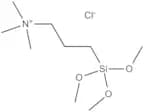
CAS:<p>Trimethylsilyl Blocking Agent<br>Used as a protecting group for reactive hydrogens in alcohols, amines, thiols, and carboxylic acids. Organosilanes are hydrogen-like, can be introduced in high yield, and can be removed under selective conditions. They are stable over a wide range of reaction conditions and can be removed in the presence of other functional groups, including other protecting groups. The tolerance of silylated alcohols to chemical transformations summary is presented in Table 1 of the Silicon-Based Blocking Agents brochure.<br>Trimethyliodosilane; Iodotrimethylsilane, Trimethylsilyl iodide; TMIS<br>Extremely reactive silylating agentUsed with HMDS for hindered alcoholsForms enol silyl ethers with ketones and SIT8620.0Nafion SAC-13 has been shown to be a recyclable catalyst for the trimethylsilylation of primary, secondary, and tertiary alcohols in excellent yields and short reaction timesSummary of selective deprotection conditions is provided in Table 7 through Table 20 of the Silicon-Based Blocking Agents brochure<br></p>Fórmula:C3H9ISiPureza:97%Cor e Forma:Straw To Pale Pink-Purple LiquidPeso molecular:200.1N-TRIMETHOXYSILYLPROPYL-N,N,N-TRIMETHYLAMMONIUM CHLORIDE, 50% in methanol
CAS:<p>N-Trimethoxysilylpropyl-N,N,N-trimethylammonium chloride; N,N,N-trimethyl-3-(trimethoxysilyl)-1-propanammonium chloride; trimethyl-3-(trimethoxysilyl)propylammonium chloride<br>Quaternary amino functional trialkoxy silanePrevents contact electrificationUsed to treat glass substrates employed in electroblottingAnti-static agentEmployed for bonded chromatographic phases50% in methanol<br></p>Fórmula:C9H24ClNO3SiCor e Forma:Straw LiquidPeso molecular:257.83(TRIDECAFLUORO-1,1,2,2-TETRAHYDROOCTYL)TRIETHOXYSILANE
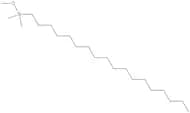
CAS:<p>(Tridecafluoro-1,1,2,2-tetrahydrooctyl)triethoxysilane; 1H,1H,2H,2H-Perfluorooctyltriethoxysilane; POTS<br></p>Fórmula:C14H19F13O3SiPureza:97%Cor e Forma:Straw LiquidPeso molecular:510.36n-OCTADECYLDIMETHYLMETHOXYSILANE
CAS:<p>Alkyl Silane - Conventional Surface Bonding<br>Aliphatic, fluorinated aliphatic or substituted aromatic hydrocarbon substituents are the hydrophobic entities which enable silanes to induce surface hydrophobicity. The organic substitution of the silane must be non-polar. The hydrophobic effect of the organic substitution can be related to the free energy of transfer of hydrocarbon molecules from an aqueous phase to a homogeneous hydrocarbon phase. A successful hydrophobic coating must eliminate or mitigate hydrogen bonding and shield polar surfaces from interaction with water by creating a non-polar interphase. Although silane and silicone derived coatings are in general the most hydrophobic, they maintain a high degree of permeability to water vapor. This allows coatings to breathe and reduce deterioration at the coating interface associated with entrapped water. Since ions are not transported through non-polar silane and silicone coatings, they offer protection to composite structures ranging from pigmented coatings to rebar reinforced concrete. A selection guide for hydrophobic silanes can be found on pages 22-31 of the Hydrophobicity, Hydrophilicity and Silane Surface Modification brochure.<br>n-Octadecyldimethylmethoxysilane; Methoxydimethyloctadecylsilane; Dimethylmethoxysilyloctadecane<br>Contains 5-10% C18 isomersEmployed in SAM resistMonoalkoxy silane<br></p>Fórmula:C21H46OSiPureza:97%Cor e Forma:LiquidPeso molecular:342.68n-OCTYLDIISOPROPYL(DIMETHYLAMINO)SILANE
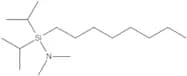
CAS:<p>Alkyl Silane - Conventional Surface Bonding<br>Aliphatic, fluorinated aliphatic or substituted aromatic hydrocarbon substituents are the hydrophobic entities which enable silanes to induce surface hydrophobicity. The organic substitution of the silane must be non-polar. The hydrophobic effect of the organic substitution can be related to the free energy of transfer of hydrocarbon molecules from an aqueous phase to a homogeneous hydrocarbon phase. A successful hydrophobic coating must eliminate or mitigate hydrogen bonding and shield polar surfaces from interaction with water by creating a non-polar interphase. Although silane and silicone derived coatings are in general the most hydrophobic, they maintain a high degree of permeability to water vapor. This allows coatings to breathe and reduce deterioration at the coating interface associated with entrapped water. Since ions are not transported through non-polar silane and silicone coatings, they offer protection to composite structures ranging from pigmented coatings to rebar reinforced concrete. A selection guide for hydrophobic silanes can be found on pages 22-31 of the Hydrophobicity, Hydrophilicity and Silane Surface Modification brochure.<br>n-Octyldiisopropyl(dimethylamino)silane; N,N-Dimethyl-1,1-bis(1-methylethyl)-1-octyl silanamine<br>Reagent for HPLC bonded phases without acidic byproducts<br></p>Fórmula:C16H37NSiPureza:97%Cor e Forma:Straw LiquidPeso molecular:271.57HEXAMETHYLDISILOXANE, 99.9% CYLINDER
CAS:Fórmula:C6H18OSi2Pureza:99.90%Cor e Forma:LiquidPeso molecular:162.38(3-ACRYLOXYPROPYL)TRIMETHOXYSILANE, 96%
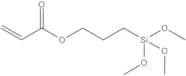
CAS:<p>Acrylate Functional Trialkoxy Silane<br>Silane coupling agents have the ability to form a durable bond between organic and inorganic materials to generate desired heterogeneous environments or to incorporate the bulk properties of different phases into a uniform composite structure. The general formula has two classes of functionality. The hydrolyzable group forms stable condensation products with siliceous surfaces and other oxides such as those of aluminum, zirconium, tin, titanium, and nickel. The organofunctional group alters the wetting or adhesion characteristics of the substrate, utilizes the substrate to catalyze chemical transformations at the heterogeneous interface, orders the interfacial region, or modifies its partition characteristics, and significantly effects the covalent bond between organic and inorganic materials.<br>3-Acryloxypropyltrimethoxysilane, 3-(trimethoxysilyl)propyl acrylate<br>Coupling agent for UV cure and epoxy systemsEmployed in optical fiber coatingsUsed in microparticle surface modification Comonomer for free-radical polymerizaitonAnalog of methacryloxypropyltrimethoxysilane (SIM6487.4)Used in combination with dipodal silane, Bis(3-trimethoxysilylproply)amine (SIB1833.0), to increase strength and hydrolytic stability of dental compositesInhibited with BHTBase silane in SIVATE™ A200<br></p>Fórmula:C9H18O5SiPureza:96%Cor e Forma:Straw LiquidPeso molecular:234.32

![N,N'-BIS[(3-TRIMETHOXYSILYL)PROPYL]ETHYLENEDIAMINE, 95%](/_next/image/?url=https%3A%2Fstatic.cymitquimica.com%2Fproducts%2F3H%2Fthumb-webp%2FSIB1834.1.webp&w=3840&q=75)