


Building Blocks
Esta seção contém produtos fundamentais para a síntese de compostos orgânicos e biológicos. Building blocks são os materiais de partida essenciais usados para construir moléculas complexas através de várias reações químicas. Eles desempenham um papel crítico na descoberta de medicamentos, ciência dos materiais e pesquisa química. Na CymitQuimica, oferecemos uma ampla gama de building blocks de alta qualidade para apoiar suas pesquisas inovadoras e projetos industriais, garantindo que você tenha os componentes essenciais para uma síntese bem-sucedida.
Subcategorias de "Building Blocks"
- Ácidos Borónicos e Derivados de Ácido Borónico(5.756 produtos)
- Building Blocks Quirais(1.242 produtos)
- Building Blocks Hidrocarbonetos(6.095 produtos)
- Building Blocks orgânicos(61.051 produtos)
Foram encontrados 199813 produtos de "Building Blocks"
Ordenar por
Pureza (%)
0
100
|
0
|
50
|
90
|
95
|
100
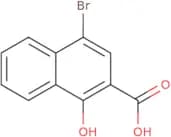
4-bromo-1-hydroxynaphthalene-2-carboxylic acid
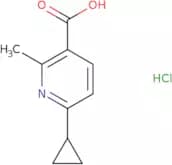
CAS:<p>4-Bromo-1-hydroxynaphthalene-2-carboxylic acid (4BHN) is a spectroscopic compound that has been used as a radioligand to study the binding of dopamine and dopamine D3 receptors. This compound binds to the d3 receptor with high affinity and specificity, but it does not interact with the d1 or d2 receptors. 4BHN has been shown to act as an agonist at the dopamine D3 receptor. It also acts as an antagonist at the piperidine site of the dopamine D2 receptor. The effects of 4BHN are reversible, which means that it can be displaced by unlabeled 4BHN or other compounds that bind to the same site on the receptor. This technique is useful for studying drug interactions and for determining whether drugs have a subtype selectivity profile.</p>Fórmula:C11H7BrO3Pureza:Min. 95%Peso molecular:267.1 g/mol6-Cyclopropyl-2-methylpyridine-3-carboxylic acid hydrochloride
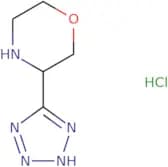
CAS:<p>Versatile small molecule scaffold</p>Fórmula:C10H12ClNO2Pureza:Min. 95%Peso molecular:213.66 g/mol3-(1H-1,2,3,4-Tetrazol-5-yl)morpholine hydrochloride
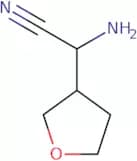
CAS:<p>Versatile small molecule scaffold</p>Fórmula:C5H10ClN5OPureza:Min. 95%Peso molecular:191.62 g/mol2-Amino-2-(oxolan-3-yl)acetonitrile
CAS:<p>Versatile small molecule scaffold</p>Fórmula:C6H10N2OPureza:Min. 95%Peso molecular:126.16 g/mol1-(1-Benzothiophen-2-yl)-2-methoxyethan-1-one
CAS:<p>Versatile small molecule scaffold</p>Fórmula:C11H10O2SPureza:Min. 95%Peso molecular:206.3 g/molRef: 3D-BPC71122
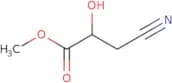
Produto descontinuadoMethyl 3-cyano-2-hydroxypropanoate
CAS:<p>Versatile small molecule scaffold</p>Fórmula:C5H7NO3Pureza:Min. 95%Peso molecular:129.11 g/molRef: 3D-QAA05576
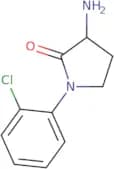
Produto descontinuado3-Amino-1-(2-chlorophenyl)pyrrolidin-2-one
CAS:<p>Versatile small molecule scaffold</p>Fórmula:C10H11ClN2OPureza:Min. 95%Peso molecular:210.66 g/moltert-Butyl N-[1-(1H-1,2,3,4-tetrazol-5-yl)propan-2-yl]carbamate
CAS:<p>Versatile small molecule scaffold</p>Fórmula:C9H17N5O2Pureza:Min. 95%Peso molecular:227.3 g/molQuinoline-5-carbonitrile
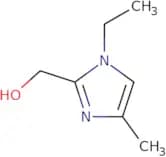
CAS:<p>Quinoline-5-carbonitrile is a cyanide compound that can be used in the synthesis of heterocyclic compounds. The reaction between quinoline and 5-cyanovaleric acid produces 6-nitroquinoline, which is then converted to dimethyl sulfoxide by alcoholysis. This reaction product can then be used to synthesize an amide or nucleophile. Quinoline-5-carbonitrile reacts with potassium in the presence of bifunctional hydrazide to produce a cyanide ion, which can be hydrolyzed by an acid to release hydrogen cyanide gas. This experiment has been shown as a model for reactions involving cyano compounds.</p>Fórmula:C10H6N2Pureza:Min. 95%Peso molecular:154.17 g/mol(1-Ethyl-4-methyl-1H-imidazol-2-yl)-methanol
CAS:<p>Versatile small molecule scaffold</p>Fórmula:C7H12N2OPureza:Min. 95%Peso molecular:140.18 g/molEthyl 3-(2-aminoethyl)-1H-indole-2-carboxylate hydrochloride
CAS:<p>Versatile small molecule scaffold</p>Fórmula:C13H17ClN2O2Pureza:Min. 95%Peso molecular:268.7 g/mol2-Bromo-3,3,3-trifluoro-1-propene
CAS:Produto Controlado<p>2-Bromo-3,3,3-trifluoro-1-propene is a chemical compound that has been synthesized in an asymmetric reaction. The reactant is bromopropane and the product is 2,2,2-trifluoropropene. The methylene group on the propene molecule is activated by the nucleophilic attack of a fluoride ion from hydrogen fluoride to form a cavity with a highly strained bond. The kinetic study of this reaction revealed that the activation energy for the reaction is 42 kJ/mol. Palladium-catalyzed coupling reactions are catalyzed by palladium and require nonpolar solvents such as toluene or dichloromethane. This type of reaction has been shown to be exothermic with an isolated yield of 1%.</p>Fórmula:C3H2BrF3Pureza:Min. 95%Cor e Forma:Colorless PowderPeso molecular:174.95 g/mol3-Boc-3-azabicyclo[3.2.1]octan-8-amine
CAS:<p>Versatile small molecule scaffold</p>Fórmula:C12H22N2O2Pureza:Min. 95%Peso molecular:226.32 g/mol

![tert-Butyl N-[1-(1H-1,2,3,4-tetrazol-5-yl)propan-2-yl]carbamate](/_next/image/?url=https%3A%2Fstatic.cymitquimica.com%2Fproducts%2F3D%2Fthumb-webp%2FJSD46898.webp&w=3840&q=75)


![3-Boc-3-azabicyclo[3.2.1]octan-8-amine](/_next/image/?url=https%3A%2Fstatic.cymitquimica.com%2Fproducts%2F3D%2Fthumb-webp%2FFDC76351.webp&w=3840&q=75)