Building Blocks
Subcategorias de "Building Blocks"
- Ácidos Borónicos e Derivados de Ácido Borónico(5.774 produtos)
- Building Blocks Quirais(1.237 produtos)
- Building Blocks Hidrocarbonetos(6.098 produtos)
- Building Blocks orgânicos(60.970 produtos)
Foram encontrados 205135 produtos de "Building Blocks"
3-(2,3-Dihydro-1H-inden-5-yl)piperidine
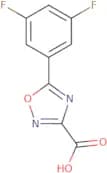
CAS:Versatile small molecule scaffoldFórmula:C14H19NPureza:Min. 95%Peso molecular:201.3 g/mol5-(3,5-Difluorophenyl)-1,2,4-oxadiazole-3-carboxylic acid
CAS:Versatile small molecule scaffold
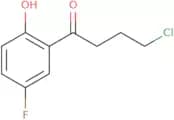
Fórmula:C9H4F2N2O3Pureza:Min. 95%Peso molecular:226.14 g/mol4-Chloro-1-(5-fluoro-2-hydroxyphenyl)butan-1-one
CAS:Versatile small molecule scaffold
Fórmula:C10H10ClFO2Pureza:Min. 95%Peso molecular:216.63 g/mol3-Chloro-[1,1'-biphenyl]-4-carbaldehyde
CAS:Versatile small molecule scaffold
Fórmula:C13H9ClOPureza:Min. 95%Peso molecular:216.66 g/mol3-Thia-6-azabicyclo[3.2.1]octan-7-one
CAS:Versatile small molecule scaffold
Fórmula:C6H9NOSPureza:Min. 95%Peso molecular:143.2 g/molRef: 3D-GGA59684
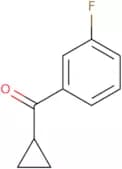
Produto descontinuadoCyclopropyl(3-fluorophenyl)methanone
CAS:Versatile small molecule scaffold
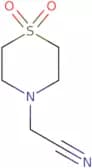
Fórmula:C10H9FOPureza:Min. 95%Peso molecular:164.18 g/mol2-(1,1-Dioxo-1λ⁶-thiomorpholin-4-yl)acetonitrile
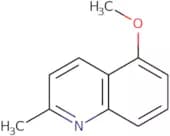
CAS:Versatile small molecule scaffoldFórmula:C6H10N2O2SPureza:Min. 95%Peso molecular:174.22 g/mol5-Methoxy-2-methylquinoline
CAS:5-Methoxy-2-methylquinoline is a condensation product of aniline and phenol. It is synthesized by the reaction of tio2 nanoparticles with ethanol solution in the presence of uv irradiation. The synthesis of 5-methoxy-2-methylquinoline may also be achieved through cyclization, which involves two steps: oxidation and reduction. This compound can be used for the preparation of photocatalysts, which are materials that absorb light and use it to produce chemical reactions. 5-Methoxy-2-methylquinoline has been shown to have antioxidant effects and this may be due to its ability to scavenge reactive oxygen species.
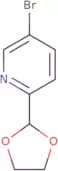
Fórmula:C11H11NOPureza:Min. 95%Peso molecular:173.21 g/mol5-Bromo-2-(1,3-dioxolan-2-yl)pyridine
CAS:Versatile small molecule scaffold
Fórmula:C8H8BrNO2Pureza:Min. 95%Peso molecular:230.06 g/mol(1S)-1-(2,5-Dimethoxyphenyl)ethan-1-ol
CAS:Versatile small molecule scaffold
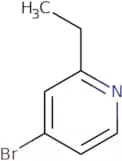
Fórmula:C10H14O3Pureza:Min. 95%Peso molecular:182.22 g/mol4-Bromo-2-(ethyl-d3)pyridine
CAS:4-Bromo-2-(ethyl-d3)pyridine is a pyridine compound that contains a bromine atom in the 2 position and an ethyl group in the 3 position. The chemical formula is C6H5BrN2, with a molecular mass of 169.07 g/mol. This compound has a melting point of 61 °C and boiling point of 143 °C. 4-Bromo-2-(ethyl-d3)pyridine is used as an intermediate to synthesize other compounds. It can also be used as a solvent for dyes, paints, lacquers, and other organic materials.
Fórmula:C7H5D3BrNPureza:Min. 95%Peso molecular:189.07 g/mol(2E)-3-(6-Nitro-1,3-dioxaindan-5-yl)prop-2-enoic acid
CAS:(2E)-3-(6-Nitro-1,3-dioxaindan-5-yl)prop-2-enoic acid is a high yield modification of the natural product taxol. It has been shown to enhance the anticancer activity of taxol in vitro and in vivo with modifications to the drug structure. This compound inhibits proliferation by binding to cell cycle regulators, such as cyclin D1 and CDK4, which are required for cell growth. (2E)-3-(6-Nitro-1,3-dioxaindan-5-yl)prop-2-enoic acid also inhibits the production of phenylpropanoid compounds and enhances the production of taxanes, two classes of plant cell growth regulators that have been shown to induce plant cell growth.
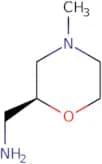
Fórmula:C10H7NO6Pureza:Min. 95%Peso molecular:237.17 g/mol(S)-4-Methyl-2-(aminomethyl)morpholine
CAS:Versatile small molecule scaffold
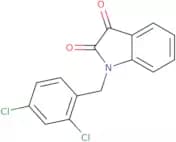
Fórmula:C6H14N2OPureza:Min. 95%Peso molecular:130.19 g/mol1-(2,4-Dichlorobenzyl)-1H-indole-2,3-dione
CAS:Versatile small molecule scaffold
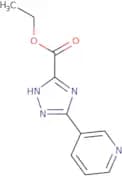
Fórmula:C15H9Cl2NO2Pureza:Min. 95%Peso molecular:306.1 g/molEthyl 3-(pyridin-3-yl)-1H-1,2,4-triazole-5-carboxylate
CAS:Versatile small molecule scaffold
Fórmula:C10H10N4O2Pureza:Min. 95%Peso molecular:218.21 g/mol2-Methyl-1,9-dioxa-4-azaspiro[5.5]undecane
CAS:Versatile small molecule scaffold
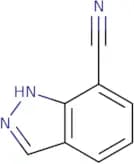
Fórmula:C9H17NO2Pureza:Min. 95%Peso molecular:171.24 g/mol1H-Indazole-7-carbonitrile
CAS:The indazoles are a group of heterocyclic compounds containing an indazole nucleus. The indazoles can be synthesized by the cycloaromatization of benzene derivatives, such as 1H-indazole-7-carbonitrile. This reaction is mediated by a variety of catalysts. It has been shown that the catalytic activity of these catalysts is due to the interaction between the substrate and the catalyst's active site. The first x-ray structure of an indazole synthase from Pseudomonas fluorescens was reported in 2009, and it was found that this enzyme has two different active sites: one for cycloaromatization reactions, which produces indazoles, and another for elimination reactions, which produce oxindoles.
Fórmula:C8H5N3Pureza:Min. 95%Peso molecular:143.15 g/mol(5,7-Dimethyl-[1,2,4]triazolo[1,5-a]pyrimidin-2-yl)-acetic acid
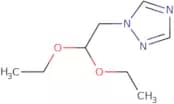
CAS:Versatile small molecule scaffoldFórmula:C9H10N4O2Pureza:Min. 95%Peso molecular:206.2 g/mol1-(2,2-Diethoxyethyl)-1H-1,2,4-triazole
CAS:Versatile small molecule scaffoldFórmula:C8H15N3O2Pureza:Min. 95%Peso molecular:185.22 g/mol6-Chloro-7-(4,4,5,5-tetramethyl-1,3,2-dioxaborolan-2-yl)quinoxaline
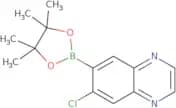
CAS:Versatile small molecule scaffoldFórmula:C14H16BClN2O2Pureza:Min. 95%Peso molecular:290.55 g/mol

![3-Chloro-[1,1'-biphenyl]-4-carbaldehyde](/_next/image/?url=https%3A%2Fstatic.cymitquimica.com%2Fproducts%2F3D%2Fthumb-webp%2FEDA21360.webp&w=3840&q=75)
![3-Thia-6-azabicyclo[3.2.1]octan-7-one](/_next/image/?url=https%3A%2Fstatic.cymitquimica.com%2Fproducts%2F3D%2Fthumb-webp%2FGGA59684.webp&w=3840&q=75)


![2-Methyl-1,9-dioxa-4-azaspiro[5.5]undecane](/_next/image/?url=https%3A%2Fstatic.cymitquimica.com%2Fproducts%2F3D%2Fthumb-webp%2FGJC96615.webp&w=3840&q=75)
![(5,7-Dimethyl-[1,2,4]triazolo[1,5-a]pyrimidin-2-yl)-acetic acid](/_next/image/?url=https%3A%2Fstatic.cymitquimica.com%2Fproducts%2F3D%2Fthumb-webp%2FGKA34841.webp&w=3840&q=75)