Building Blocks
Subcategorias de "Building Blocks"
- Ácidos Borónicos e Derivados de Ácido Borónico(5.784 produtos)
- Building Blocks Quirais(1.244 produtos)
- Building Blocks Hidrocarbonetos(6.105 produtos)
- Building Blocks orgânicos(61.076 produtos)
Foram encontrados 205454 produtos de "Building Blocks"
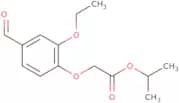
Isopropyl (2-ethoxy-4-formylphenoxy)acetate
CAS:Versatile small molecule scaffold
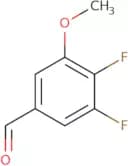
Fórmula:C14H18O5Pureza:Min. 95%Peso molecular:266.29 g/mol3,4-Difluoro-5-methoxybenzaldehyde
CAS:Versatile small molecule scaffold
Fórmula:C8H6F2O2Pureza:Min. 95%Peso molecular:172.13 g/mol5,5-Dimethyl-4,5,6,7-tetrahydro-1-benzofuran-4-one
CAS:Versatile small molecule scaffoldFórmula:C10H12O2Pureza:Min. 95%Peso molecular:164.2 g/molRef: 3D-GKB19007
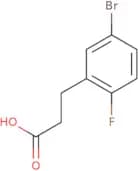
Produto descontinuado3-(5-Bromo-2-fluorophenyl)propionic acid
CAS:Versatile small molecule scaffoldFórmula:C9H8BrFO2Pureza:Min. 95%Peso molecular:247.06 g/mol6-Chloro-2-(3,4-dimethylphenyl)imidazo[1,2-a]pyridine-3-carbaldehyde
CAS:Versatile small molecule scaffoldFórmula:C16H13ClN2OPureza:Min. 95%Peso molecular:284.74 g/mol2-[4-(Propan-2-yl)phenyl]pyrrolidine
CAS:Versatile small molecule scaffold
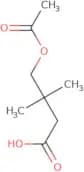
Fórmula:C13H19NPureza:Min. 95%Peso molecular:189.3 g/mol4-(Acetyloxy)-3,3-dimethylbutanoic acid
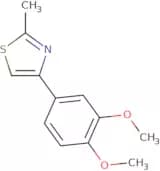
CAS:Versatile small molecule scaffoldFórmula:C8H14O4Pureza:Min. 95%Peso molecular:174.19 g/mol4-(3,4-Dimethoxyphenyl)-2-methyl-1,3-thiazole
CAS:Versatile small molecule scaffold
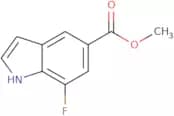
Fórmula:C12H13NO2SPureza:Min. 95%Peso molecular:235.3 g/molMethyl 7-fluoro-1H-indole-5-carboxylate
CAS:Versatile small molecule scaffold
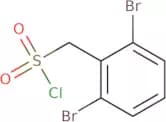
Fórmula:C10H8FNO2Pureza:Min. 95%Peso molecular:193.17 g/mol2,6-Dibromo-benzenemethanesulfonyl chloride
CAS:Versatile small molecule scaffold
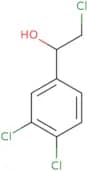
Fórmula:C7H5Br2ClO2SPureza:Min. 95%Peso molecular:348.44 g/mol(1S)-2-Chloro-1-(3,4-dichlorophenyl)ethan-1-ol
CAS:Versatile small molecule scaffoldFórmula:C8H7Cl3OPureza:Min. 95%Peso molecular:225.5 g/mol2-[3-(Methoxymethyl)phenyl]acetic acid
CAS:Versatile small molecule scaffold
Fórmula:C10H12O3Pureza:Min. 95%Peso molecular:180.2 g/mol(5,7-Dimethyl-[1,2,4]triazolo[1,5-a]pyrimidin-2-yl)-acetic acid
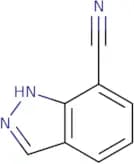
CAS:Versatile small molecule scaffoldFórmula:C9H10N4O2Pureza:Min. 95%Peso molecular:206.2 g/mol1H-Indazole-7-carbonitrile
CAS:The indazoles are a group of heterocyclic compounds containing an indazole nucleus. The indazoles can be synthesized by the cycloaromatization of benzene derivatives, such as 1H-indazole-7-carbonitrile. This reaction is mediated by a variety of catalysts. It has been shown that the catalytic activity of these catalysts is due to the interaction between the substrate and the catalyst's active site. The first x-ray structure of an indazole synthase from Pseudomonas fluorescens was reported in 2009, and it was found that this enzyme has two different active sites: one for cycloaromatization reactions, which produces indazoles, and another for elimination reactions, which produce oxindoles.
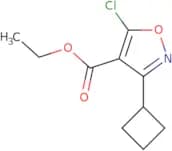
Fórmula:C8H5N3Pureza:Min. 95%Peso molecular:143.15 g/molEthyl 5-chloro-3-cyclobutyl-1,2-oxazole-4-carboxylate
CAS:Versatile small molecule scaffold
Fórmula:C10H12ClNO3Pureza:Min. 95%Peso molecular:229.66 g/mol2-Methyl-1,9-dioxa-4-azaspiro[5.5]undecane
CAS:Versatile small molecule scaffold
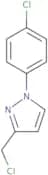
Fórmula:C9H17NO2Pureza:Min. 95%Peso molecular:171.24 g/mol3-(Chloromethyl)-1-(4-chlorophenyl)-1H-pyrazole
CAS:Versatile small molecule scaffoldFórmula:C10H8Cl2N2Pureza:Min. 95%Peso molecular:227.09 g/mol3-Amino-N,2,2-trimethylpropanamide
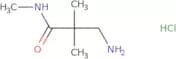
CAS:Versatile small molecule scaffold
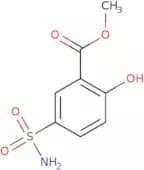
Fórmula:C6H15ClN2OPureza:Min. 95%Peso molecular:166.65 g/molMethyl 2-hydroxy-5-sulfamoylbenzoate
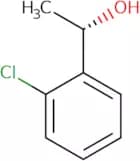
CAS:Versatile small molecule scaffoldFórmula:C8H9NO5SPureza:Min. 95%Peso molecular:231.23 g/mol(S)-1-(2-Chlorophenyl)ethanol
CAS:(S)-1-(2-Chlorophenyl)ethanol is a substrate for the enzyme dehydrogenase, which catalyzes the conversion of (R)-1-(2-chlorophenyl)ethanol to (R)-1-(2-chlorophenyl)propanol. The reaction time for this reaction is dependent on the concentration of the substrate, with high concentrations of (S)-1-(2-chlorophenyl)ethanol requiring a longer reaction time. The product, (R)-1-(2-chlorophenyl)propanol, is an organic chemical that can be used as a model system for studying other reactions involving alcohols. This compound has been shown to be reactive in biological systems and has been found to have symptoms similar to those of Parkinson's disease in mice.
Fórmula:C8H9ClOPureza:Min. 95%Peso molecular:156.61 g/mol


![6-Chloro-2-(3,4-dimethylphenyl)imidazo[1,2-a]pyridine-3-carbaldehyde](/_next/image/?url=https%3A%2Fstatic.cymitquimica.com%2Fproducts%2F3D%2Fthumb-webp%2FGKB04115.webp&w=3840&q=75)
![2-[4-(Propan-2-yl)phenyl]pyrrolidine](/_next/image/?url=https%3A%2Fstatic.cymitquimica.com%2Fproducts%2F3D%2Fthumb-webp%2FGKB04001.webp&w=3840&q=75)
![2-[3-(Methoxymethyl)phenyl]acetic acid](/_next/image/?url=https%3A%2Fstatic.cymitquimica.com%2Fproducts%2F3D%2Fthumb-webp%2FGKA38237.webp&w=3840&q=75)
![(5,7-Dimethyl-[1,2,4]triazolo[1,5-a]pyrimidin-2-yl)-acetic acid](/_next/image/?url=https%3A%2Fstatic.cymitquimica.com%2Fproducts%2F3D%2Fthumb-webp%2FGKA34841.webp&w=3840&q=75)
![2-Methyl-1,9-dioxa-4-azaspiro[5.5]undecane](/_next/image/?url=https%3A%2Fstatic.cymitquimica.com%2Fproducts%2F3D%2Fthumb-webp%2FGJC96615.webp&w=3840&q=75)