Building Blocks
Subcategorias de "Building Blocks"
- Ácidos Borónicos e Derivados de Ácido Borónico(5.784 produtos)
- Building Blocks Quirais(1.244 produtos)
- Building Blocks Hidrocarbonetos(6.105 produtos)
- Building Blocks orgânicos(61.076 produtos)
Foram encontrados 205454 produtos de "Building Blocks"
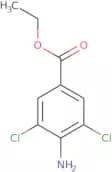
Ethyl 3,5-dichloro-4-aminobenzoate
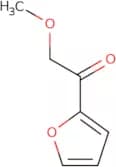
CAS:Ethyl 3,5-dichloro-4-aminobenzoate is a benzyl amine that has been shown to be an effective inhibitor of nitrile synthesis. It is used as a precursor in the production of dyes and pharmaceuticals. Ethyl 3,5-dichloro-4-aminobenzoate is stable in acidic and alkaline solutions, but decomposes when heated or exposed to cyanide ion. This compound can also react with ethylene diamine to form 2,4-diaminoanisole.Fórmula:C9H9Cl2NO2Pureza:Min. 95%Cor e Forma:PowderPeso molecular:234.08 g/mol1-(Furan-2-yl)-2-methoxyethan-1-one
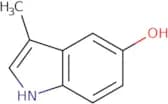
CAS:Versatile small molecule scaffoldFórmula:C7H8O3Pureza:Min. 95%Cor e Forma:Clear LiquidPeso molecular:140.14 g/mol5-Hydroxy-3-methylindole
CAS:5-Hydroxy-3-methylindole (5HMI) is a metabolite of the drug tamoxifen, which is used for the treatment of breast cancer. It is also found in urine samples and has been shown to be reactive with cytochrome P450 2E1 (CYP2E1). 5HMI has been shown to inhibit the activity of CYP2E1 in humans, rats, and mice. 5HMI has also been shown to have anti-epileptic properties in epileptics. This active form is metabolized by adipose tissue or liver cells through oxidation and conjugation with glucuronic acid. The human liver cells show constitutive androstane receptor (CAR) activation, which may be due to its ability to act as an agonist or partial agonist.
Fórmula:C9H9NOPureza:Min. 96%Cor e Forma:PowderPeso molecular:147.17 g/mol4D-Hydroxysphinganine
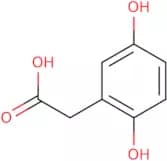
CAS:Sphingolipid; cell membrane component; anti-inflammatory agentFórmula:C18H39NO3Pureza:Min. 97 Area-%Cor e Forma:White PowderPeso molecular:317.51 g/molHomogentisic acid
CAS:Precursor of melanine synthesis in bacteriaFórmula:C8H8O4Pureza:Min 96%Cor e Forma:White PowderPeso molecular:168.15 g/molD,L-Homotryptophan
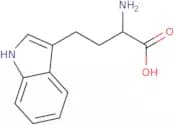
CAS:D,L-Homotryptophan is a fine chemical that is used as a building block in the synthesis of complex compounds. It has been used as a reagent, speciality chemical, and intermediate. D,L-Homotryptophan is also versatile in its use as a building block for the synthesis of various chemicals. This compound has been shown to react with other chemicals to form useful scaffolds.Fórmula:C12H14N2O2Pureza:Min. 95%Cor e Forma:PowderPeso molecular:218.25 g/molHomovanillic acid
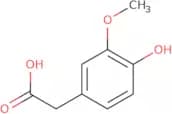
CAS:Homovanillic acid is widely used as a fluorogenic substrate of peroxidase. The reaction is however not specific and has been shown to react also with soybean lipoxygenase in the presence of hydrogen peroxide. Excitation and emission wavelengths for homovanillic acid are 312 and 420 nm, respectively.
Fórmula:C9H10O4Pureza:Min. 97.5 Area-%Cor e Forma:Red PowderPeso molecular:182.17 g/mol3-Hydroxybenzaldehyde
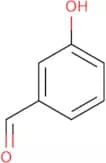
CAS:3-Hydroxybenzaldehyde (3HBA) is an organic molecule that belongs to the group of substituted benzaldehydes. It has been shown to induce muscle cell proliferation in vitro and in vivo, as well as increased levels of activated caspase-3 in vitro. 3HBA also has a high resistance to hydrochloric acid, hydrogen bond, and chemical structures. It also shows properties of intramolecular hydrogen bonding and aldehyde groups. 3HBA has been shown to be active against malonic acid-induced pulmonary edema in rats, which may be due to its ability to inhibit the release of erythrocytes from the bone marrow into the circulation.Fórmula:C7H6O2Pureza:Min. 96 Area-%Cor e Forma:Off-White PowderPeso molecular:122.12 g/molcis-4-Hydroxycinnamic acid
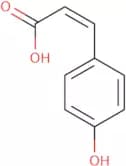
CAS:Cis-4-Hydroxycinnamic acid is a phenolic acid that is found in plants and is a natural compound. It has been shown to be an inhibitor of cell proliferation. Cis-4-Hydoxycinnamic acid inhibits the synthesis of DNA and RNA, which may inhibit the growth of bacteria and fungi. This compound can be extracted from plant materials by acetate extract or preparative high-performance liquid chromatography (HPLC). Cis-4-Hydoxycinnamic acid also has anti-inflammatory properties, which may be due to its inhibition of prostaglandin synthesis.
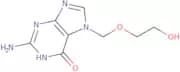
Fórmula:C9H8O3Pureza:Min. 95%Cor e Forma:PowderPeso molecular:164.16 g/molN7-((2-Hydroxyethoxy)methyl)guanine
CAS:N7-((2-Hydroxyethoxy)methyl)guanine is a reagent, a complex compound, and a useful intermediate that is used in the manufacture of speciality chemicals. N7-((2-Hydroxyethoxy)methyl)guanine is also a versatile building block that has been shown to be effective in reactions involving the synthesis of N-heterocyclic carbene ligands.Fórmula:C8H11N5O3Pureza:(%) Min. 95%Cor e Forma:Off-White PowderPeso molecular:225.2 g/mol3-(1-Hydroxyethyl)benzophenone
CAS:Benzophenone is a chemical compound that is used as a photosensitizer. Benzophenone absorbs ultraviolet radiation and undergoes a photochemical reaction to produce reactive oxygen species, which can in turn damage cells. The production of these reactive oxygen species is the key to benzophenone's toxicity. Benzophenone has been shown to inhibit the growth of many different microorganisms, including those that are resistant to antibiotics. Benzophenone is also able to cause death in some organisms, such as algae and bacteria, by stimulating the production of hydrogen peroxide. Benzophenone can be applied topically or taken orally for treatment of conditions such as psoriasis, vitiligo, atopic dermatitis, and other skin problems. It can also be used to treat infections caused by Gram-negative bacteria.Fórmula:C15H14O2Pureza:Min. 95%Cor e Forma:PowderPeso molecular:226.27 g/mol4-Hydroxyindole
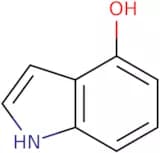
CAS:4-Hydroxyindole is an inorganic acid that is produced by the oxidation of 4-hydroxyphenylacetic acid. It is a metabolite of the synthetic cannabinoids, JWH-018 and JWH-073. The production of 4-hydroxyindole has been shown to be dependent on the presence of a nucleophilic attack on the diazonium salt, which leads to protonation. The fluorescence properties of this molecule are dependent on its hydroxyl group, which allows for detection using magnetic resonance spectroscopy. Hydrochloric acid can be used as an alternate solvent to produce 4-hydroxyindole from 4-hydroxyphenylacetic acid. 4-Hydroxyindole has been shown to have pharmacokinetic properties that are similar to those of THC, but it does not bind well to cannabinoid receptors or activate them.br> br> The structure of this molecule can be seen belowFórmula:C8H7NOCor e Forma:White PowderPeso molecular:133.15 g/mol1-Hydroxyisoquinoline
CAS:1-Hydroxyisoquinoline is a molecule with a carbonyl group and is found in heart tissue. It has been proposed as a treatment for herpes simplex virus, but no studies have been done to confirm this. 1-Hydroxyisoquinoline can be prepared by reacting hydrochloric acid with sodium salts. This molecule also has the ability to inhibit cancer cells and may have potential as an anticancer agent. It also has anti-inflammatory properties, which may be due to its inhibition of prostaglandin synthesis. The mechanism of action for 1-hydroxyisoquinoline is not yet fully understood, but it inhibits the replication of DNA and RNA in cancer cells.Fórmula:C9H7NOPureza:Min. 98 Area-%Cor e Forma:White PowderPeso molecular:145.16 g/mol2-Hydroxyisoquinoline-1,3(2H,4H)-dione
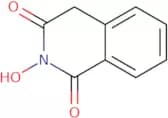
CAS:2-Hydroxyisoquinoline-1,3(2H,4H)-dione (2HIQ) is a potent anti-viral agent that has been shown to inhibit the replication of viruses in cell cultures. 2HIQ inhibits viral replication by binding to the enzyme reverse transcriptase and inhibiting its ability to synthesize DNA from RNA. This drug also has inhibitory properties against human immunodeficiency virus type 1 (HIV-1) and hepatitis C virus (HCV). 2HIQ binds to the active site of the enzyme HIV reverse transcriptase, which is a key enzyme in viral replication. It also binds to HCV NS5B polymerase, which is an essential protein in HCV replication. These interactions lead to inhibition of viral replication and thus prevention of disease progression.Fórmula:C9H7NO3Pureza:Min. 95%Cor e Forma:Off-White To Brown SolidPeso molecular:177.16 g/mol5-Hydroxymethyl-2-furancarboxylic acid
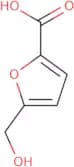
CAS:5-Hydroxymethylfurfural (5-HMF) is a structural analysis of the high values obtained in the reaction solution. 5-HMF is a polymerase chain reaction product that is obtained from p-hydroxybenzoic acid and malonic acid during the enzymatic conversion of carbohydrates. It can be used as a biocompatible polymer. The reaction mechanism for this process has been proposed to be through the formation of pyrazinoic acid, followed by an elimination reaction with chlorogenic acids. This mechanism is supported by modeling studies, which show that pyrazinoic acid is a key intermediate in the conversion of glucose to 5-HMF.Fórmula:C6H6O4Pureza:Min. 95%Cor e Forma:White PowderPeso molecular:142.11 g/mol5'-Hydroxy-2'-methoxyacetophenone
CAS:5'-Hydroxy-2'-methoxyacetophenone is a versatile precursor for the synthesis of ruthenium complexes. It is used in the hydroarylation reaction to form aryl ethers from alcohols and olefins. 5'-Hydroxy-2'-methoxyacetophenone has been shown to be an effective antioxidant with greater activity than vitamin C. This compound also releases oxygen, which helps to accelerate the rate of catalytic reactions. The hydroarylation and reductive deprotection of 5'-hydroxy-2'-methoxyacetophenone are regioselective, giving rise to phenols as the only by-products. The skeleton of 5'-hydroxy-2'-methoxyacetophenone is aglyconic, which means that it can be used as a building block or starting material for other organic compounds without any further modifications.Fórmula:C9H10O3Pureza:Min. 95%Cor e Forma:PowderPeso molecular:166.17 g/mol4'-Hydroxy-2'-methoxyacetophenone
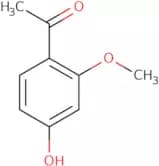
CAS:4'-Hydroxy-2'-methoxyacetophenone is a terpene that can be found in the genus Tripterygium. It has been shown to have lymphocyte transformation activity and shows antioxidant, anticancerous, and anti-inflammatory properties. It has also been shown to inhibit the growth of certain cancer cells by inducing apoptosis. 4'-Hydroxy-2'-methoxyacetophenone has been observed to have immunosuppressant effects on the immune system by inhibiting lymphocyte transformation, as well as being able to suppress the production of inflammatory cytokines such as TNF-α. This compound is used in clinical settings for its ability to treat autoimmune diseases such as rheumatoid arthritis and psoriasis.Fórmula:C9H10O3Pureza:Min. 95%Cor e Forma:Off-White PowderPeso molecular:166.17 g/mol3-Hydroxy-5-nitrobenzaldehyde
CAS:3-Hydroxy-5-nitrobenzaldehyde is a solvent that has been used as a probe to measure chloride concentration in multimedia. It can be used as a sensor and an algorithm to detect the colorimetric change of 3-hydroxy-5-nitrobenzaldehyde in the presence of chloride ions. This probe is also used in colorimetric tests for linker, nonpolar, and surfactant compounds. The 3-hydroxy-5-nitrobenzaldehyde oxime can be cleaved by UV light to produce an unstable nitronium ion that reacts with metal ions such as copper(II) or silver(I) to form an insoluble precipitate.Fórmula:C7H5NO4Pureza:Min. 95%Cor e Forma:PowderPeso molecular:167.12 g/mol3-Hydroxybenzylamine hydrochloride
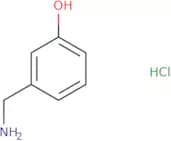
CAS:3-Hydroxybenzylamine hydrochloride (3HBH) is a chemical compound that has been used as a reagent and in the synthesis of other compounds. It is also known to be a useful scaffold for complex compounds, and can be used as a building block for the synthesis of fine chemicals. 3HBH has been found to have many applications in research, such as being an intermediate for pharmaceuticals, pesticides, dyes, and agrochemicals. 3HBH is also useful in organic syntheses where it has been found to react with nitriles and amides to form esters and amides respectively.
Fórmula:C7H9NO·HClPureza:Min. 95%Cor e Forma:PowderPeso molecular:159.61 g/mol(3-Hydroxy-4-methoxyphenyl)acetone
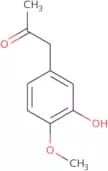
CAS:(3-Hydroxy-4-methoxyphenyl)acetone is a versatile building block that can be used as a reagent or in the synthesis of complex compounds. It is a useful intermediate in the synthesis of pharmaceuticals, agrochemicals, and other specialty chemicals. This compound also has the potential to serve as a scaffold for drug discovery.Fórmula:C10H12O3Pureza:(%) Min. 85%Cor e Forma:PowderPeso molecular:180.2 g/mol