Building Blocks
Esta seção contém produtos fundamentais para a síntese de compostos orgânicos e biológicos. Building blocks são os materiais de partida essenciais usados para construir moléculas complexas através de várias reações químicas. Eles desempenham um papel crítico na descoberta de medicamentos, ciência dos materiais e pesquisa química. Na CymitQuimica, oferecemos uma ampla gama de building blocks de alta qualidade para apoiar suas pesquisas inovadoras e projetos industriais, garantindo que você tenha os componentes essenciais para uma síntese bem-sucedida.
Subcategorias de "Building Blocks"
- Ácidos Borónicos e Derivados de Ácido Borónico(5.756 produtos)
- Building Blocks Quirais(1.242 produtos)
- Building Blocks Hidrocarbonetos(6.095 produtos)
- Building Blocks orgânicos(61.051 produtos)
Foram encontrados 199813 produtos de "Building Blocks"
Ordenar por
Pureza (%)
0
100
|
0
|
50
|
90
|
95
|
100
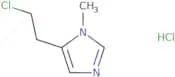
5-(2-Chloroethyl)-1-methyl-1H-imidazole hydrochloride
CAS:<p>Versatile small molecule scaffold</p>Fórmula:C6H10Cl2N2Pureza:Min. 95%Peso molecular:181.06 g/mol{2-[4-(Benzyloxy)phenyl]ethyl}(methyl)amine hydrochloride
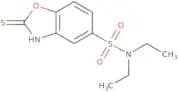
CAS:<p>Versatile small molecule scaffold</p>Fórmula:C16H20ClNOPureza:Min. 95%Peso molecular:277.79 g/molN,N-Diethyl-2-sulfanyl-1,3-benzoxazole-5-sulfonamide
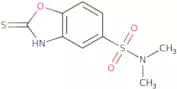
CAS:<p>Versatile small molecule scaffold</p>Fórmula:C11H14N2O3S2Pureza:Min. 95%Peso molecular:286.4 g/molN,N-Dimethyl-2-sulfanyl-1,3-benzoxazole-5-sulfonamide
CAS:Produto Controlado<p>2-sulfanyl-1,3-benzoxazole-5-sulfonamide is a research tool and activator that binds to the receptor. It has been shown to have high purity and can be used as a ligand in cell biology research. 2-sulfanyl-1,3-benzoxazole-5-sulfonamide inhibits ion channels and protein interactions. In addition, 2SBA can be used as an antibody for immunohistochemistry or Western blotting experiments. This chemical is also useful for pharmacology studies because it is an inhibitor of peptides and proteins that are responsible for diseases like Alzheimer's disease.</p>Fórmula:C9H10N2O3S2Pureza:Min. 95%Peso molecular:258.3 g/mol2-Amino-4-(piperidine-1-sulfonyl)phenol
CAS:<p>Versatile small molecule scaffold</p>Fórmula:C11H16N2O3SPureza:Min. 95%Peso molecular:256.32 g/molTriethyl Orthobutyrate
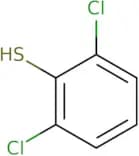
CAS:<p>Triethyl Orthobutyrate is a versatile compound with various applications. It is commonly used as a benzylic protecting group in organic synthesis and as an alkaloid precursor. Triethyl Orthobutyrate has been found to exhibit superoxide scavenging activity, making it potentially useful in antioxidant formulations. Additionally, it can serve as a glucuronic acid derivative and has been studied for its potential therapeutic effects on coumarins-induced liver injury. In the medical field, Triethyl Orthobutyrate has shown promise as an additive to atosiban formulations, which are used to inhibit premature labor. It can also be utilized in electrode coatings and antibody immobilization processes due to its ability to form stable complexes with l-lysine. Furthermore, Triethyl Orthobutyrate has been investigated for its role in enhancing the transdermal delivery of drugs like zolmitriptan. Its nuclear magnetic resonance (NMR) properties make it useful for analyzing complex biological extracts, while its magnesium</p>Fórmula:C10H22O3Pureza:Min. 95%Peso molecular:190.28 g/mol2,6-Dichlorobenzenethiol
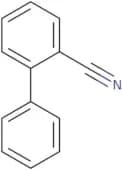
CAS:<p>Versatile small molecule scaffold</p>Fórmula:C6H4Cl2SPureza:Min. 95%Peso molecular:179.07 g/mol2-Cyanobiphenyl
CAS:<p>2-Cyanobiphenyl is a versatile research chemical that has various applications in the field of chemistry. It is a biphenyl compound that is commonly used as a fluorescent probe in scientific experiments. The chemical structure of 2-Cyanobiphenyl makes it an ideal candidate for studying phase transitions and solid-state NMR (Nuclear Magnetic Resonance). Researchers often use this compound to investigate the phase transition temperature and properties of different materials, such as nematic liquid crystals.</p>Fórmula:C13H9NPureza:Min. 95%Peso molecular:179.22 g/mol4-(2-Chloroacetamido)butanoic acid
CAS:<p>Versatile small molecule scaffold</p>Fórmula:C6H10ClNO3Pureza:Min. 95%Peso molecular:179.6 g/molEthyl 4-(4-cyanophenyl)-2,4-dioxobutanoate
CAS:<p>Versatile small molecule scaffold</p>Fórmula:C13H11NO4Pureza:Min. 95%Peso molecular:245.23 g/mol2-Chloro-N-(3-cyclopropyl-1-phenyl-1H-pyrazol-5-yl)acetamide
CAS:<p>Versatile small molecule scaffold</p>Fórmula:C14H14ClN3OPureza:Min. 95%Peso molecular:275.73 g/molMethyl 2-amino-4-(propan-2-yl)-1,3-thiazole-5-carboxylate
CAS:Versatile small molecule scaffoldFórmula:C8H12N2O2SPureza:Min. 95%Peso molecular:200.26 g/mol2-(4-Methoxyphenoxy)ethane-1-thiol
CAS:<p>Versatile small molecule scaffold</p>Fórmula:C9H12O2SPureza:Min. 95%Peso molecular:184.26 g/mol(3S)-3-({[(tert-Butoxy)carbonyl]amino}methyl)-5-methylhexanoic acid
CAS:<p>Versatile small molecule scaffold</p>Fórmula:C13H25NO4Pureza:Min. 95%Peso molecular:259.34 g/mol1-[(2-Aminoethyl)amino]-3-(3,4-dichlorophenoxy)propan-2-ol
CAS:<p>Versatile small molecule scaffold</p>Fórmula:C11H16Cl2N2O2Pureza:Min. 95%Peso molecular:279.16 g/molN-(Oxan-4-ylmethyl)-3-(1,3-thiazol-2-yl)aniline
CAS:<p>Versatile small molecule scaffold</p>Fórmula:C15H18N2OSPureza:Min. 95%Peso molecular:274.4 g/mol(4-Acetyl-[1,4]diazepan-1-yl)-acetic acid
CAS:<p>Versatile small molecule scaffold</p>Fórmula:C9H16N2O3Pureza:Min. 95%Peso molecular:200.23 g/molEthyl 1-benzyl-3-hydroxypyrrolidine-3-carboxylate
CAS:Versatile small molecule scaffoldFórmula:C14H19NO3Pureza:Min. 95%Peso molecular:249.3 g/mol4-[(5-Ethyl-1,2,4-oxadiazol-3-yl)methoxy]benzoic acid
CAS:<p>Versatile small molecule scaffold</p>Fórmula:C12H12N2O4Pureza:Min. 95%Peso molecular:248.23 g/mol1-(4-Methyl-2-phenyl-1,3-thiazol-5-yl)ethan-1-ol
CAS:Versatile small molecule scaffoldFórmula:C12H13NOSPureza:Min. 95%Peso molecular:219.3 g/mol

![{2-[4-(Benzyloxy)phenyl]ethyl}(methyl)amine hydrochloride](/_next/image/?url=https%3A%2Fstatic.cymitquimica.com%2Fproducts%2F3D%2Fthumb-webp%2FZAA95841.webp&w=3840&q=75)



![(3S)-3-({[(tert-Butoxy)carbonyl]amino}methyl)-5-methylhexanoic acid](/_next/image/?url=https%3A%2Fstatic.cymitquimica.com%2Fproducts%2F3D%2Fthumb-webp%2FZAB74809.webp&w=3840&q=75)
![1-[(2-Aminoethyl)amino]-3-(3,4-dichlorophenoxy)propan-2-ol](/_next/image/?url=https%3A%2Fstatic.cymitquimica.com%2Fproducts%2F3D%2Fthumb-webp%2FZAC00155.webp&w=3840&q=75)

![(4-Acetyl-[1,4]diazepan-1-yl)-acetic acid](/_next/image/?url=https%3A%2Fstatic.cymitquimica.com%2Fproducts%2F3D%2Fthumb-webp%2FZAC04850.webp&w=3840&q=75)

![4-[(5-Ethyl-1,2,4-oxadiazol-3-yl)methoxy]benzoic acid](/_next/image/?url=https%3A%2Fstatic.cymitquimica.com%2Fproducts%2F3D%2Fthumb-webp%2FZAC12256.webp&w=3840&q=75)