Building Blocks
Esta seção contém produtos fundamentais para a síntese de compostos orgânicos e biológicos. Building blocks são os materiais de partida essenciais usados para construir moléculas complexas através de várias reações químicas. Eles desempenham um papel crítico na descoberta de medicamentos, ciência dos materiais e pesquisa química. Na CymitQuimica, oferecemos uma ampla gama de building blocks de alta qualidade para apoiar suas pesquisas inovadoras e projetos industriais, garantindo que você tenha os componentes essenciais para uma síntese bem-sucedida.
Subcategorias de "Building Blocks"
- Ácidos Borónicos e Derivados de Ácido Borónico(5.778 produtos)
- Building Blocks Quirais(1.242 produtos)
- Building Blocks Hidrocarbonetos(6.098 produtos)
- Building Blocks orgânicos(61.034 produtos)
Foram encontrados 199601 produtos de "Building Blocks"
Ordenar por
Pureza (%)
0
100
|
0
|
50
|
90
|
95
|
100
1-Benzyl-4-bromobenzene
CAS:<p>1-Benzyl-4-bromobenzene is a cyclic compound that contains the elements of carbon, hydrogen, and bromine. It is used as an intermediate for pharmaceuticals and industrial chemicals. The trifluoroacetic acid (TFA) was added to the solution in order to remove water from the compound. This reaction helps to prepare covid-19 which is a potential pandemic vaccine against influenza A virus. 1-Benzyl-4-bromobenzene can be used as a reagent in preparative methods such as volumetric analysis or hypophosphorous acid preparation. It has also been shown to have reactive properties when heated with naphthalene or heated in the presence of phosphorus pentoxide.<br>1-Benzyl-4-bromobenzene can be recrystallized by adding solvents such as ethyl ether, acetone, or benzene.</p>Fórmula:C13H11BrPureza:Min. 95%Peso molecular:247.13 g/mol1-(4-Chlorophenyl)-3-methoxy-2-methylpropan-2-ol
CAS:<p>Versatile small molecule scaffold</p>Fórmula:C11H15ClO2Pureza:Min. 95%Peso molecular:214.69 g/mol1-(tert-Butoxy)-4-nitrobenzene
CAS:<p>Versatile small molecule scaffold</p>Fórmula:C10H13NO3Pureza:Min. 95%Peso molecular:195.22 g/mol(2-Methylcyclohexyl)methanol
CAS:<p>Versatile small molecule scaffold</p>Fórmula:C8H16OPureza:Min. 95%Peso molecular:128.21 g/mol4-(4-Methylphenyl)-2,3-dihydro-1,3-thiazol-2-one
CAS:Versatile small molecule scaffoldFórmula:C10H9NOSPureza:Min. 95%Peso molecular:191.25 g/mol1-Azido-4-bromobenzene ~0.5M solution in t-butyl methyl ether
CAS:<p>1-Azido-4-bromobenzene is a fine chemical that is used as a building block in organic synthesis. 1-Azido-4-bromobenzene is also used as a speciality chemical and research chemical for the production of other compounds. One of its applications is to be used as a reagent in organic synthesis, and it can be reacted with other compounds to form new structures. 1-Azido-4-bromobenzene can also be used as an intermediate or scaffold for the production of complex molecules. 1-Azido-4-bromobenzene has been assigned CAS No. 21018842.</p>Fórmula:C6H4BrN3Pureza:Min. 95%Cor e Forma:Clear LiquidPeso molecular:198.02 g/mol4-Azidotoluene solution
CAS:<p>4-Azidotoluene solution is a coordination complex that consists of four nitrogen atoms and two amido groups. When it is in the presence of a nucleophile, such as water, the nitrogen atoms are eliminated from the solution as ammonia and azide ions. This reaction occurs through an elimination reaction with a redox potential of -0.2 volts. The nitrogen atoms coordinate to form a complex with another molecule, which can then be used as an efficient method for corrosion inhibition. 4-Azidotoluene solution has been shown to protect against corrosion by forming coordination complexes with metals such as copper, zinc, and aluminum. Crystallography studies have shown that 4-azidotoluene molecules are planar in shape and possess two N-H bonds and two amido groups per molecule.</p>Fórmula:C7H7N3Pureza:Min. 95%Peso molecular:133.15 g/mol2-Methyl-N-(propan-2-yl)aniline
CAS:<p>Versatile small molecule scaffold</p>Fórmula:C10H15NPureza:Min. 95%Peso molecular:149.23 g/mol3-Iodo-1,2,4,5-tetramethylbenzene
CAS:<p>3-Iodo-1,2,4,5-tetramethylbenzene is an organic compound that is a salt of a chlorinating agent and an organic solvent. It can be used as a chlorinating agent in the production of chloropropane. 3-Iodo-1,2,4,5-tetramethylbenzene is reactive and has been used in the synthesis of methylbenzenes. It can also be used for the synthesis of sodium trifluoroacetate with chlorine gas. 3-Iodo-1,2,4,5-tetramethylbenzene is soluble in water and has been shown to exhibit nature activity towards chlorine atom to form chloride. The molecular orbitals are electron orbitals that surround the nucleus of an atom and can be easily visualized in 3D space when they are plotted on a graph with energy increasing from left to right.<br>3-Iodo-1,2,</p>Fórmula:C10H13IPureza:Min. 95%Peso molecular:260.12 g/mol4-Pentenal
CAS:<p>4-Pentenal is an anticancer agent that has been shown to inhibit kinases in human cancer cells. It is a protein analog of oseltamivir, which is commonly used to treat influenza. 4-Pentenal induces apoptosis in cancer cells and has been found in the urine of Chinese patients with tumors. This compound inhibits the activity of several kinases, including protein kinase C (PKC), which plays a key role in cell growth and proliferation. Inhibiting PKC activity leads to decreased tumor growth and increased apoptosis in cancer cells. 4-Pentenal may be a promising candidate for developing new anticancer drugs that target kinases involved in tumor growth and progression.</p>Fórmula:C5H8OPureza:Min. 95%Peso molecular:84.12 g/mol6-Chloro-3,4-dimethoxypyridazine
CAS:<p>Versatile small molecule scaffold</p>Fórmula:C6H7ClN2O2Pureza:Min. 95%Peso molecular:174.58 g/mol3,5-Dimethoxypyridazine
CAS:<p>Versatile small molecule scaffold</p>Fórmula:C6H8N2O2Pureza:Min. 95%Peso molecular:140.14 g/molMethyl[3-(phenylamino)propyl]amine
CAS:Versatile small molecule scaffoldFórmula:C10H16N2Pureza:Min. 95%Peso molecular:164.25 g/molMethyl[3-(10H-phenothiazin-10-yl)propyl]amine
CAS:<p>Methyl[3-(10H-phenothiazin-10-yl)propyl]amine is a reuptake inhibitor that is classified as a psychotherapeutic drug. It inhibits the reuptake of noradrenaline and dopamine, and has been shown to modulate serotonin release. Methyl[3-(10H-phenothiazin-10-yl)propyl]amine is an enantiomer of methyl[2-(10H-phenothiazin-10-yl)ethyl]amine, which inhibits the reuptake of dopamine. Methyl[3-(10H-phenothiazin-10-yl)propyl]amine is also a geometric isomer of methyl[2-(5H-phenothiazin-5-yl)ethyl]amine, which inhibits the reuptake of serotonin. The polymorphs of methyl[3-(10H-phenothiazin 10 yl)propyl]amine are active</p>Fórmula:C16H18N2SPureza:Min. 95%Peso molecular:270.4 g/molEthyl 2-(2-aminoacetamido)-4-methylpentanoate hydrochloride
CAS:Versatile small molecule scaffoldFórmula:C10H21ClN2O3Pureza:Min. 95%Peso molecular:252.7 g/mol[2-(2-Methoxyphenoxy)ethyl](methyl)amine hydrochloride
CAS:<p>Versatile small molecule scaffold</p>Fórmula:C10H16ClNO2Pureza:Min. 95%Peso molecular:217.69 g/mol2-(2-Bromoethyl)naphthalene
CAS:<p>2-(2-Bromoethyl)naphthalene is a tetrahydropyridin that has an aromatic ring containing two bromine atoms. This compound is used as a reagent to make other compounds in organic synthesis. Hydrobromic acid and hydrobromic acid react with 2-(2-bromoethyl)naphthalene to produce hydrogen bromide and 2-bromoethylbenzene, respectively.</p>Fórmula:C12H11BrPureza:Min. 95%Peso molecular:235.11 g/mol2-Phenylpropylene Oxide
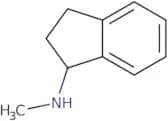
CAS:<p>2-Phenylpropylene Oxide is a chemical compound that belongs to the epoxide group. It is an activated monomer, which means it has a hydroxyl group. 2-Phenylpropylene Oxide is used in cationic polymerization reactions as well as alpha-methyl styrene, which produces polymers with high molecular weights and excellent mechanical properties. The reaction mechanism of 2-phenylpropylene oxide is oxidation of the phenyl ring to produce free radicals that react with the double bond of the epoxide ring to form an epoxy group. This process results in a mixture of products that depend on the rate and extent of the reaction. Health effects have not been fully evaluated.</p>Fórmula:C9H10OPureza:Min. 95%Peso molecular:134.18 g/molN-2,3-Dihydro-1H-inden-1-yl-N-methylamine
CAS:Produto ControladoVersatile small molecule scaffoldFórmula:C10H13NPureza:Min. 95%Peso molecular:147.22 g/moltrans-Ethyl 4-aminocyclohexanecarboxylate hydrochloride
CAS:<p>Versatile small molecule scaffold</p>Fórmula:C9H18ClNO2Pureza:Min. 95%Peso molecular:207.7 g/mol


![Methyl[3-(phenylamino)propyl]amine](/_next/image/?url=https%3A%2Fstatic.cymitquimica.com%2Fproducts%2F3D%2Fthumb-webp%2FCAA09573.webp&w=3840&q=75)
![Methyl[3-(10H-phenothiazin-10-yl)propyl]amine](/_next/image/?url=https%3A%2Fstatic.cymitquimica.com%2Fproducts%2F3D%2Fthumb-webp%2FCAA09520.webp&w=3840&q=75)

amine hydrochloride](/_next/image/?url=https%3A%2Fstatic.cymitquimica.com%2Fproducts%2F3D%2Fthumb-webp%2FCAA08735.webp&w=3840&q=75)