Building Blocks
Esta seção contém produtos fundamentais para a síntese de compostos orgânicos e biológicos. Building blocks são os materiais de partida essenciais usados para construir moléculas complexas através de várias reações químicas. Eles desempenham um papel crítico na descoberta de medicamentos, ciência dos materiais e pesquisa química. Na CymitQuimica, oferecemos uma ampla gama de building blocks de alta qualidade para apoiar suas pesquisas inovadoras e projetos industriais, garantindo que você tenha os componentes essenciais para uma síntese bem-sucedida.
Subcategorias de "Building Blocks"
- Ácidos Borónicos e Derivados de Ácido Borónico(5.778 produtos)
- Building Blocks Quirais(1.243 produtos)
- Building Blocks Hidrocarbonetos(6.097 produtos)
- Building Blocks orgânicos(61.052 produtos)
Foram encontrados 201390 produtos de "Building Blocks"
Ordenar por
Pureza (%)
0
100
|
0
|
50
|
90
|
95
|
100
3-Methyl-5-oxocyclohexane-1,2-dicarboxylic acid
CAS:Versatile small molecule scaffoldFórmula:C9H12O5Pureza:Min. 95%Peso molecular:200.19 g/molRel-2-amino-N-[(1R,4R)-4-hydroxycyclohexyl]benzamide
CAS:Versatile small molecule scaffoldFórmula:C13H18N2O2Pureza:Min. 95%Peso molecular:234.29 g/mol7-chloro-1,8-naphthyridin-2-amine
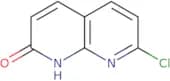
CAS:<p>Versatile small molecule scaffold</p>Fórmula:C8H6ClN3Pureza:Min. 95%Peso molecular:179.6 g/mol7-Chloro-1,8-naphthyridin-2-ol
CAS:7-Chloro-1,8-naphthyridin-2-ol is a nucleic acid that stabilizes duplexes and triplexes. It has an affinity for adenine bases in DNA, RNA, or triplexes. 7-Chloro-1,8-naphthyridin-2-ol also binds to mismatched nucleobases in the sequence of nucleic acids. This compound is a potent inhibitor of HIV replication and has been shown to inhibit the growth of cancer cells by targeting the enzyme topoisomerase II alpha.Fórmula:C8H5ClN2OPureza:Min. 95%Peso molecular:180.59 g/mol2-Chloro-5-(methylsulfanyl)aniline
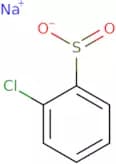
CAS:<p>2-Chloro-5-(methylsulfanyl)aniline is a sulfoxide that can inhibit the n-methyl-d-aspartate (NMDA) receptor, which is an ion channel that plays a key role in neuronal excitability. 2-Chloro-5-(methylsulfanyl)aniline has been shown to be neuroprotective against glutamate toxicity in rats and mice. This drug also blocks the NMDA receptor by binding to it, preventing glutamate from activating it. 2-Chloro-5-(methylsulfanyl)aniline has been shown to have neuroprotective effects in animal models of stroke, cerebral ischemia, and traumatic brain injury.</p>Fórmula:C7H8ClNSPureza:Min. 95%Peso molecular:173.66 g/mol2-Chlorobenzenesulfinic acid sodium
CAS:<p>Versatile small molecule scaffold</p>Fórmula:C6H4ClNaO2SPureza:Min. 95%Peso molecular:198.6 g/molSodium 3-chlorobenzene-1-sulfinate
CAS:<p>Versatile small molecule scaffold</p>Fórmula:C6H4ClNaO2SPureza:Min. 95%Peso molecular:198.6 g/mol2,3,4-Trichlorophenol
CAS:<p>2,3,4-Trichlorophenol (2,3,4-TCP) is a water-soluble compound that is used as an analytical reagent. 2,3,4-TCP is also an antimicrobial agent found in household cleaners and disinfectants. It is used to remove bacteria from equipment and surfaces in hospitals and other healthcare facilities. The acidic aqueous solution of 2,3,4-TCP has been shown to adsorb triclosan and p-hydroxybenzoic acid from wastewater treatment systems. The reaction mechanism for the adsorption process is not well understood but may involve the formation of hydrogen bonds between the polar hydroxyl groups on 2,3,4-TCP and the carboxyl groups on triclosan or p-hydroxybenzoic acid. Anhydrous sodium can be used as an alternative to water for this process.</p>Fórmula:Cl3C6H2OHPureza:Min. 95%Peso molecular:197.45 g/mol3-Chloro-N,N-diethylbenzamide
CAS:Versatile small molecule scaffoldFórmula:C11H14ClNOPureza:Min. 95%Peso molecular:211.69 g/mol3-(4-Fluorophenyl)butanoic acid
CAS:3-(4-Fluorophenyl)butanoic acid is an analog of butanoic acid. It has been shown to have properties similar to carbamates and to be an intermediate in the synthesis of a number of other compounds. 3-(4-Fluorophenyl)butanoic acid is used as an oral dosage form, which is converted into its active form (2-chloro-N-[3-(4-fluorophenyl)propionyl]acetamide). This drug has been shown to be effective for the treatment of reflux disease, with a lower incidence of side effects than some other drugs used for this purpose.Fórmula:C10H11FO2Pureza:Min. 95%Peso molecular:182.19 g/mol1-(1,4-Dioxan-2-yl)ethan-1-one
CAS:1-(1,4-Dioxan-2-yl)ethan-1-one is a nucleophilic compound that can be used as a catalyst for the conversion of carbinols and ketonitriles to their corresponding esters. It has been shown to have stereoselective properties in its reaction with substituted phenols. 1-(1,4-Dioxan-2-yl)ethan-1-one is also able to form coordination complexes with metals. The molecule is chiral and the enantiomers have different reactivities. This product has been shown to be useful in coatings, such as those applied to paper or textiles.Fórmula:C6H10O3Pureza:Min. 95%Peso molecular:130.14 g/molN-(4-Hydroxyphenyl)-3,4,5-trimethoxybenzamide
CAS:<p>N-(4-Hydroxyphenyl)-3,4,5-trimethoxybenzamide is a biomolecule that is found in nature. It has a square shape and is hydrophobic. The molecule consists of an amide group and a benzene ring. The molecule has been shown to have dose-dependent effects on ligands. Nonpolar molecules are attracted by the hydrophobic interactions between the benzene ring and the amide group. This molecule has also been cocrystallized with a nonpolar ligand. In this conformation, it is an anionic species with a dihedral angle of 90 degrees.</p>Fórmula:C16H17NO5Pureza:Min. 95%Peso molecular:303.31 g/molSodium 4-nitrobenzene-1-sulfinate
CAS:Sodium 4-nitrobenzenesulfinate is a sulfonylating agent that is used in organic chemistry to synthesize dihydronaphthalene, which is an intermediate in the synthesis of naphthalenes. It can be prepared by the ring-opening reaction of sodium nitrobenzenesulfinate with a suitable nucleophile such as methylenecyclopropanes. Sodium 4-nitrobenzenesulfinate reacts with sulfur to form sulfones, which are important intermediates for the synthesis of thiazoles and benzothiazoles. This reagent has been shown to be effective for the synthesis of biomolecules, such as proteins and peptides.Fórmula:C6H4NNaO4SPureza:Min. 95%Peso molecular:209.16 g/molN-Phenylaminosulfonamide
CAS:<p>N-Phenylaminosulfonamide is a prodrug that is metabolized in the body to release oxadiazole. It has been shown to lower intracellular calcium levels by targeting response elements and hydrogen bonds in the cell. N-Phenylaminosulfonamide also inhibits fatty acid synthesis, which may be due to its ability to inhibit 3t3-l1 preadipocytes. The drug has been shown to have an anti-obesity effect by inhibiting energy metabolism through inhibition of hydroxyl group oxidation, leading to reduced glucose uptake and glycolysis.</p>Fórmula:C6H8N2O2SPureza:Min. 95%Peso molecular:172.21 g/mol2-Phenyl-2-propanamidoacetic acid
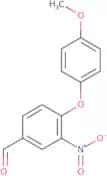
CAS:Versatile small molecule scaffoldFórmula:C11H13NO3Pureza:Min. 95%Peso molecular:207.23 g/mol4-(4-Methoxyphenoxy)-3-nitrobenzaldehyde
CAS:<p>Versatile small molecule scaffold</p>Fórmula:C14H11NO5Pureza:Min. 95%Peso molecular:273.24 g/molMethyl 3-methylenecyclobutanecarboxylate
CAS:<p>Methyl 3-methylenecyclobutanecarboxylate is an organic compound with the chemical formula CH3C(O)CH2CH2COOCH3. It is a colorless liquid that is soluble in organic solvents. Methyl 3-methylenecyclobutanecarboxylate has been studied for its use as a precursor to potassium salts, which are used as catalysts in industrial processes. Methyl 3-methylenecyclobutanecarboxylate has also been identified as a structural factor for the elimination of potassium from cyclopentanone and benzene, factors that contribute to its elimination from the body. This compound can be brominated using potassium tert-butoxide and reactions with other reagents such as lithium chloride or sodium hydroxide to form methyl 3-bromocyclobutanecarboxylate, which can then be dehydrobrominated to form methyl 3-</p>Fórmula:C7H10O2Pureza:Min. 95%Peso molecular:126.15 g/mol(3-Chlorocyclobutyl)methanol
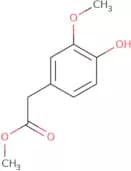
CAS:<p>Versatile small molecule scaffold</p>Fórmula:C5H9ClOPureza:Min. 95%Peso molecular:120.58 g/molMethyl 4-hydroxy-3-methoxyphenylacetate
CAS:Methyl 4-hydroxy-3-methoxyphenylacetate (HMPAA) is a natural compound, which can be detected by mass spectrometric detection. It is an evaporative and has been shown to have inhibitory effects on the growth of ganglion cells in culture. HMPAA also inhibits phosphotungstic acid precipitation assays and crth2 expression. HMPAA has been shown to interact with other proteins, such as protein–protein interactions or functional groups. This compound is also involved in chemical reactions, such as the hydroxyl group or the methyl group. The detectable concentration of HMPAA ranges from 1 ng/mL to 1 μM and it is found in monomers or organic acids.Fórmula:C10H12O4Pureza:Min. 95%Peso molecular:196.2 g/mol1-Methyl-4-phenyl-1H-1,2,3-triazole
CAS:<p>1-Methyl-4-phenyl-1H-1,2,3-triazole is a ligand that interacts with copper. It is used in the synthesis of pyridine complexes and as a reagent for the preparation of other organometallic compounds. 1-Methyl-4-phenyl-1H-1,2,3-triazole has been shown to be able to replace azide or chloride ligands in some metal coordination complexes. It has been observed in spectra of copper and rhenium complexes with axially coordinated ligands. The X ray crystal structures of 1 methyl 4 phenyl 1H 1 2 3 triazole have revealed that it can be either a luminescent or nonluminescent compound depending on the type of solvent used during its preparation.</p>Fórmula:C9H9N3Pureza:Min. 95%Peso molecular:159.19 g/mol


![Rel-2-amino-N-[(1R,4R)-4-hydroxycyclohexyl]benzamide](/_next/image/?url=https%3A%2Fstatic.cymitquimica.com%2Fproducts%2F3D%2Fthumb-webp%2FQAA94211.webp&w=3840&q=75)