Building Blocks
Esta seção contém produtos fundamentais para a síntese de compostos orgânicos e biológicos. Building blocks são os materiais de partida essenciais usados para construir moléculas complexas através de várias reações químicas. Eles desempenham um papel crítico na descoberta de medicamentos, ciência dos materiais e pesquisa química. Na CymitQuimica, oferecemos uma ampla gama de building blocks de alta qualidade para apoiar suas pesquisas inovadoras e projetos industriais, garantindo que você tenha os componentes essenciais para uma síntese bem-sucedida.
Subcategorias de "Building Blocks"
- Ácidos Borónicos e Derivados de Ácido Borónico(5.778 produtos)
- Building Blocks Quirais(1.243 produtos)
- Building Blocks Hidrocarbonetos(6.098 produtos)
- Building Blocks orgânicos(61.046 produtos)
Foram encontrados 203857 produtos de "Building Blocks"
Ordenar por
Pureza (%)
0
100
|
0
|
50
|
90
|
95
|
100
N-Boc Palbociclib-d4
CAS:<p>Versatile small molecule scaffold</p>Fórmula:C29H33D4N7O4Pureza:Min. 95%Peso molecular:551.67 g/mol3-Methylbenzo[b]thiophene-2-carboxylic acid
CAS:<p>3-Methylbenzo[b]thiophene-2-carboxylic acid (MBTCA) is a heterocyclic compound that is an intermediate in the synthesis of 3-methylthiophene-2-carboxylic acid, a precursor to other drugs. MBTCA is an aerobic, nonpolar compound that has shown antimicrobial activity against some bacteria and fungi. It also has been shown to have practicality as a biomolecular probe for methyl groups in organic solvents. MBTCA can be synthesized by nitration of benzene in the presence of sulfur and sulfoxides. This reaction produces nitrobenzene, which can then be oxidized by potassium permanganate or hydrogen peroxide to produce MBTCA. The most common isomer of MBTCA is 2-(3,5-dimethoxybenzylidene)tetrahydrofuran, with three methyl groups on the</p>Fórmula:C10H8O2SPureza:Min. 95%Peso molecular:192.23 g/mol4-Formylbenzoic acid
CAS:<p>4-Formylbenzoic acid is an organic compound with the molecular formula CH2=C(O)CH=CHCO2H. It is a white solid that is soluble in water and has a strong, unpleasant odor. 4-Formylbenzoic acid has been shown to have affinity for binding to odorous molecules such as sulfur compounds, amines, and mercaptans. The binding of these molecules to the 4-formylbenzoic acid leads to a decrease in their odor concentration. This process can be done using electrochemical impedance spectroscopy or optical sensors. The oxidation of 4-formylbenzoic acid by trifluoroacetic acid produces 2-formylphenol and formaldehyde, which are themselves volatile compounds with an unpleasant odor. These reactions may be used as wastewater treatment methods. Langmuir adsorption isotherm may be used as an analytical method for measuring the concentration of 4-formylbenzoic acid</p>Fórmula:C8H6O3Pureza:Min. 98 Area-%Cor e Forma:White Yellow PowderPeso molecular:150.13 g/molRef: 3D-FF23577
Produto descontinuadotert-Butyl 3-(trifluoromethyl)piperazine-1-carboxylate
CAS:<p>Versatile small molecule scaffold</p>Fórmula:C10H17F3N2O2Pureza:Min. 95%Peso molecular:254.25 g/molH-Ser-Ala-Glu-Glu-Tyr-Glu-Tyr-Pro-Ser OH trifluoroacetate
CAS:<p>Please enquire for more information about H-Ser-Ala-Glu-Glu-Tyr-Glu-Tyr-Pro-Ser OH trifluoroacetate including the price, delivery time and more detailed product information at the technical inquiry form on this page</p>Fórmula:C47H63N9O20•(C2HF3O2)xPureza:Min. 95%Ref: 3D-FS183525
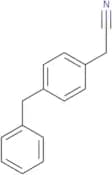
Produto descontinuado4-Benzylphenylacetonitrile
CAS:<p>Versatile small molecule scaffold</p>Fórmula:C15H13NPureza:Min. 95%Peso molecular:207.28 g/molGivinostat hydrochloride
CAS:<p>Givinostat hydrochloride is a research chemical that has shown potential in various fields. It is a molybdenum-based compound that has been studied for its effects on dopamine release and hydrogen evolution. Givinostat hydrochloride has also been investigated as an osteoclast inhibitor, which may be beneficial in the treatment of bone-related disorders such as osteoporosis. Additionally, it has shown promise as a retinoid and calpain inhibitor, suggesting its potential use in dermatological conditions and neurodegenerative diseases. The compound contains fluorine atoms, making it suitable for imaging studies using fluorine MRI techniques. Givinostat hydrochloride has been tested on MDA-MB-231 cells and has shown inhibitory effects on their growth, indicating its potential as an anticancer agent.</p>Fórmula:C24H27N3O4·HClPureza:Min. 95%Peso molecular:457.95 g/mol


![3-Methylbenzo[b]thiophene-2-carboxylic acid](/_next/image/?url=https%3A%2Fstatic.cymitquimica.com%2Fproducts%2F3D%2Fthumb-webp%2FDAA13378.webp&w=3840&q=75)