Building Blocks
Subcategorias de "Building Blocks"
- Ácidos Borónicos e Derivados de Ácido Borónico(5.778 produtos)
- Building Blocks Quirais(1.243 produtos)
- Building Blocks Hidrocarbonetos(6.099 produtos)
- Building Blocks orgânicos(61.038 produtos)
Foram encontrados 205376 produtos de "Building Blocks"
2-Benzoyl-2-azabicyclo[2.1.1]hexane-1-carboxylic acid
CAS:Versatile small molecule scaffold
Fórmula:C13H13NO3Pureza:Min. 95%Peso molecular:231.25 g/mol3'-Methyl-[1,1'-biphenyl]-2-carboxylic acid
CAS:Versatile small molecule scaffold
Fórmula:C14H12O2Pureza:Min. 95%Peso molecular:212.24 g/mol5-Cyclopropyl-7-oxa-5-azaspiro[3.4]octane-6,8-dione
CAS:Versatile small molecule scaffold
Fórmula:C9H11NO3Pureza:Min. 95%Peso molecular:181.19 g/mol2-[(2-Methyl-1H-indol-3-yl)sulfanyl]ethan-1-amine
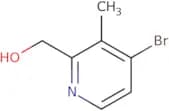
CAS:Versatile small molecule scaffoldFórmula:C11H14N2SPureza:Min. 95%Peso molecular:206.31 g/mol(4-Bromo-3-methylpyridin-2-yl)methanol
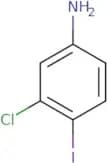
CAS:Versatile small molecule scaffoldFórmula:C7H8BrNOPureza:Min. 95%Peso molecular:202.05 g/mol3-Chloro-4-iodoaniline
CAS:3-Chloro-4-iodoaniline is an activated, synthetic chemical that is used in the preparation of a variety of chemicals. 3-Chloro-4-iodoaniline can be prepared by the reaction of chloroacetic acid with nitrobenzene and hydrochloric acid. The compound may be purified by vacuum filtration and recrystallization from water. It is also a precursor to other chemicals that are used in the production of polyhalogenated aromatic compounds. 3-Chloro-4-iodoaniline has been found to react with amines and form the corresponding amides, which may be useful for chemical synthesis.
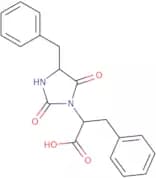
Fórmula:C6H5ClINPureza:Min. 95%Peso molecular:253.47 g/mol2-(4-Benzyl-2,5-dioxoimidazolidin-1-yl)-3-phenylpropanoic acid
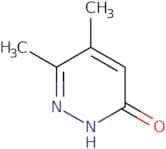
CAS:Versatile small molecule scaffoldFórmula:C19H18N2O4Pureza:Min. 95%Peso molecular:338.4 g/mol5,6-Dimethylpyridazin-3(2H)-one
CAS:Versatile small molecule scaffold
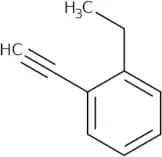
Fórmula:C6H8N2OPureza:Min. 95%Peso molecular:124.14 g/mol1-Ethyl-2-ethynylbenzene
CAS:1-Ethyl-2-ethynylbenzene is an indene that can be synthesized by the reaction of 1-ethylbenzene with ethynylmagnesium bromide and trifluoroacetyl chloride. 1-Ethyl-2-ethynylbenzene reacts as a nucleophile with electrophiles, such as phenylsulfonyl and acetylene compounds, to form sulfones and acetylenes. It can also react with tetrafluoroborates to form indenes.
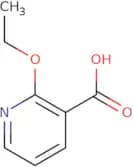
Fórmula:C10H10Pureza:Min. 95%Peso molecular:130.19 g/mol2-Ethoxy-nicotinic acid
CAS:2-Ethoxy-nicotinic acid is an inorganic compound that contains oxygen and hydrogen. It has been shown to interact with amines, carboxylates, and other inorganic compounds. 2-Ethoxy-nicotinic acid is a supramolecular complex consisting of naphthyridine and ethoxy groups. The hydrogen bonding interactions between the ethoxy groups and the amine groups are what make this molecule magnetic. The isomers of this compound have been synthesized and diffraction experiments have shown that it has a cyclic structure. Compounds similar to 2-Ethoxy-nicotinic acid include malonate, which has two carboxylate groups. This molecule also reacts with hydrogen gas at high temperatures to produce hydrogen gas and carbon dioxide.
Fórmula:C8H9NO3Pureza:Min. 95%Peso molecular:167.16 g/mol2-Bromo-4-tert-butyl-1-methyl-benzene
CAS:2-Bromo-4-tert-butyl-1-methyl-benzene (2BTMB) is a congener of polychlorinated biphenyls (PCBs). It is an oily liquid that is insoluble in water. 2BTMB is metabolized by the liver, and has been found in the blood, adipose tissue, and eggs of salmonids. 2BTMB has shown to have physicochemical properties that are similar to other PCB congeners. The toxicity of 2BTMB is largely unknown because it has not been extensively studied. 2BTMB can magnify up the food chain through bioaccumulation and biomagnification.
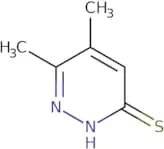
Fórmula:C11H15BrPureza:Min. 95%Cor e Forma:PowderPeso molecular:227.14 g/mol5,6-Dimethylpyridazine-3-thiol
CAS:Versatile small molecule scaffold
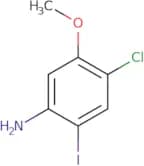
Fórmula:C6H8N2SPureza:Min. 95%Peso molecular:140.2 g/mol4-Chloro-2-iodo-5-methoxyaniline
CAS:Versatile small molecule scaffold
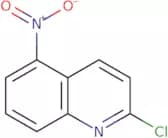
Fórmula:C7H7ClINOPureza:Min. 95%Peso molecular:283.49 g/mol2-Chloro-5-nitroquinoline
CAS:2-Chloro-5-nitroquinoline is an oxidized aminoquinoline that is synthesized from nitric acid and benzene. It contains a nitro group, which makes it susceptible to oxidation. 2-Chloro-5-nitroquinoline is used as a solvent for rubber, plastics, and waxes. It can also be used as a solvent in the production of quinolines and other nitrogen compounds. Nitration of this compound produces 2-chloroquinoline, which can be transformed into 2-chloroquinolinium hydroxide by reaction with sodium hydroxide. The substituent on the ortho position can be determined by oleum or bromine water.
Fórmula:C9H5ClN2O2Pureza:Min. 95%Peso molecular:208.6 g/mol8-Phenyl-1-oxa-3-azaspiro[4.5]dec-2-en-2-amine
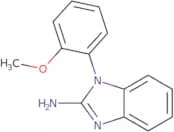
CAS:Versatile small molecule scaffoldFórmula:C14H18N2OPureza:Min. 95%Peso molecular:230.31 g/mol1-(2-Methoxyphenyl)-1H-1,3-benzodiazol-2-amine
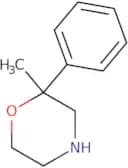
CAS:Versatile small molecule scaffoldFórmula:C14H13N3OPureza:Min. 95%Peso molecular:239.27 g/mol2-Methyl-2-phenylmorpholine
CAS:2-Methyl-2-phenylmorpholine is an industrial chemical that has a c1-c4 alkyl group. It can be used in the production of antidepressants, such as Tofranil, and other drugs. 2-Methyl-2-phenylmorpholine is also used in the industrial production of polymers.
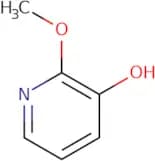
Fórmula:C11H15NOPureza:Min. 95%Peso molecular:177.24 g/mol2-Methoxypyridin-3-ol
CAS:2-Methoxypyridin-3-ol is a nitro compound that can be used as a lead compound to produce an inhibitor of oxime reductase. It can also be used as a pyridine ring, which is an important functional group in many organic compounds. 2-Methoxypyridin-3-ol has the ability to inhibit the enzyme oxime reductase, which catalyzes the formation of hydroxyl radicals from nitrosating agents and hydroxylamine, leading to their detoxification. This substance has been shown to be efficient in the orientation of nitro groups and ethers.
Fórmula:C6H7NO2Pureza:Min. 95%Peso molecular:125.13 g/molN-[(Quinolin-8-yl)methyl]methanesulfonamide
CAS:Versatile small molecule scaffold
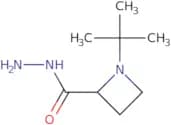
Fórmula:C11H12N2O2SPureza:Min. 95%Peso molecular:236.29 g/mol1-tert-Butylazetidine-2-carbohydrazide
CAS:Versatile small molecule scaffoldFórmula:C8H17N3OPureza:Min. 95%Peso molecular:171.24 g/mol
![2-Benzoyl-2-azabicyclo[2.1.1]hexane-1-carboxylic acid](/_next/image/?url=https%3A%2Fstatic.cymitquimica.com%2Fproducts%2F3D%2Fthumb-webp%2FJBD33608.webp&w=3840&q=75)

![3'-Methyl-[1,1'-biphenyl]-2-carboxylic acid](/_next/image/?url=https%3A%2Fstatic.cymitquimica.com%2Fproducts%2F3D%2Fthumb-webp%2FHEA41271.webp&w=3840&q=75)
![5-Cyclopropyl-7-oxa-5-azaspiro[3.4]octane-6,8-dione](/_next/image/?url=https%3A%2Fstatic.cymitquimica.com%2Fproducts%2F3D%2Fthumb-webp%2FJBD33609.webp&w=3840&q=75)
![2-[(2-Methyl-1H-indol-3-yl)sulfanyl]ethan-1-amine](/_next/image/?url=https%3A%2Fstatic.cymitquimica.com%2Fproducts%2F3D%2Fthumb-webp%2FLCA02166.webp&w=3840&q=75)

![8-Phenyl-1-oxa-3-azaspiro[4.5]dec-2-en-2-amine](/_next/image/?url=https%3A%2Fstatic.cymitquimica.com%2Fproducts%2F3D%2Fthumb-webp%2FIJC02845.webp&w=3840&q=75)
![N-[(Quinolin-8-yl)methyl]methanesulfonamide](/_next/image/?url=https%3A%2Fstatic.cymitquimica.com%2Fproducts%2F3D%2Fthumb-webp%2FLJC51797.webp&w=3840&q=75)