Building Blocks
Esta seção contém produtos fundamentais para a síntese de compostos orgânicos e biológicos. Building blocks são os materiais de partida essenciais usados para construir moléculas complexas através de várias reações químicas. Eles desempenham um papel crítico na descoberta de medicamentos, ciência dos materiais e pesquisa química. Na CymitQuimica, oferecemos uma ampla gama de building blocks de alta qualidade para apoiar suas pesquisas inovadoras e projetos industriais, garantindo que você tenha os componentes essenciais para uma síntese bem-sucedida.
Subcategorias de "Building Blocks"
- Ácidos Borónicos e Derivados de Ácido Borónico(5.756 produtos)
- Building Blocks Quirais(1.242 produtos)
- Building Blocks Hidrocarbonetos(6.095 produtos)
- Building Blocks orgânicos(61.038 produtos)
Foram encontrados 196817 produtos de "Building Blocks"
Ordenar por
Pureza (%)
0
100
|
0
|
50
|
90
|
95
|
100
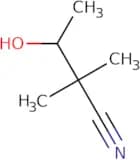
3-Hydroxy-2,2-dimethylbutanenitrile
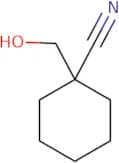
CAS:<p>Versatile small molecule scaffold</p>Fórmula:C6H11NOPureza:Min. 95%Peso molecular:113.16 g/mol1-(Hydroxymethyl)cyclohexane-1-carbonitrile
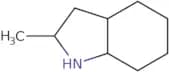
CAS:<p>Versatile small molecule scaffold</p>Fórmula:C8H13NOPureza:Min. 95%Peso molecular:139.19 g/mol2-Methyl-octahydro-1H-indole
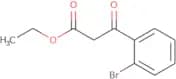
CAS:<p>Versatile small molecule scaffold</p>Fórmula:C9H17NPureza:Min. 95%Peso molecular:139.24 g/molethyl 3-(2-bromophenyl)-3-oxopropanoate
CAS:<p>Ethyl 3-(2-bromophenyl)-3-oxopropanoate is an ester that has been synthesized by condensation and transesterification of ethyl diazoacetate with benzylic alcohols. Zeolites have been used as catalysts in the synthesis of this compound. The yields obtained were 74%.</p>Fórmula:C11H11BrO3Pureza:Min. 95%Peso molecular:271.11 g/mol4-Bromo-1-napthaldehyde
CAS:<p>4-Bromo-1-napthaldehyde is a chemical compound that belongs to the group of formyl compounds. It has a formyl group, which can be easily alkylated. 4-Bromo-1-napthaldehyde has been used in the industrial preparation of pharmaceuticals and agrochemicals as well as in the synthesis of other compounds. This molecule can be synthesized by reacting formic acid with bromine and sodium hydroxide. In some cases, this reaction may require heating at higher temperatures or using more than one equivalent of sodium hydroxide. The efficiency and reaction time depend on the technique used to perform the synthesis, such as Grignard reagent or hybridization.</p>Fórmula:C11H7BrOPureza:Min. 95%Peso molecular:235.08 g/mol(2,2-Dimethyltetrahydro-2H-pyran-4-yl)methanol
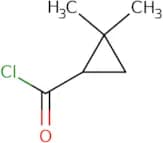
CAS:<p>Versatile small molecule scaffold</p>Fórmula:C8H16O2Pureza:Min. 95%Peso molecular:144.21 g/mol2,2-Dimethylcyclopropane-1-carbonyl chloride
CAS:<p>2,2-Dimethylcyclopropane-1-carbonyl chloride is a diastereomeric mixture of two diastereoisomers. It is soluble in chloroform and diethyl ether and crystallizes from acetone. 2,2-Dimethylcyclopropane-1-carbonyl chloride is used as a feedstock to produce cyhalothrin, an insecticide that acts by contact. The insecticide is made by esterification of the 2,2-dimethylcyclopropane-1-carbonyl chloride with 3-phenoxybenzaldehyde and then chlorination of the ester.<br>A mixture of two diastereoisomers can be separated using chromatography techniques such as gas chromatography or high performance liquid chromatography (HPLC). In this case it would be possible to use HPLC to separate the two diastereoisomers.</p>Fórmula:C6H9ClOPureza:Min. 95%Peso molecular:132.59 g/molN'-(2-Chloroacetyl)benzohydrazide
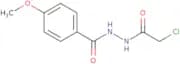
CAS:<p>Versatile small molecule scaffold</p>Fórmula:C9H9ClN2O2Pureza:Min. 95%Peso molecular:212.63 g/molN'-(2-Chloroacetyl)-4-methoxybenzohydrazide
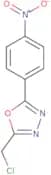
CAS:<p>Versatile small molecule scaffold</p>Fórmula:C10H11ClN2O3Pureza:Min. 95%Peso molecular:242.66 g/mol2-(Chloromethyl)-5-(4-nitrophenyl)-1,3,4-oxadiazole
CAS:<p>Versatile small molecule scaffold</p>Fórmula:C9H6ClN3O3Pureza:Min. 95%Peso molecular:239.62 g/molN-Methyl-1-azabicyclo[2.2.2]octan-3-amine
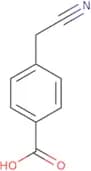
CAS:<p>Versatile small molecule scaffold</p>Fórmula:C8H16N2Pureza:Min. 95%Peso molecular:140.23 g/mol4-(Cyanomethyl)benzoic acid
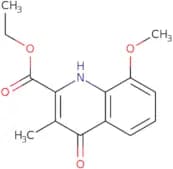
CAS:<p>4-(Cyanomethyl)benzoic acid is a photocurrent generating molecule that has been shown to be an efficient acceptor in organic photovoltaic devices. It is also used as a sensitizer for the production of benzothiadiazole. The functional theory behind this reaction is that 4-(Cyanomethyl)benzoic acid first acts as an electron acceptor and then becomes a proton donor by accepting hydrogen from benzonitrile, which leads to the formation of benzothiadiazole. The bathochromic shift of the absorption spectrum of 4-(Cyanomethyl)benzoic acid was observed due to the presence of benzothiadiazole. This molecule can be used for solar cells because it contains a dipole, which facilitates charge separation and recombination in solar cells.</p>Fórmula:C9H7NO2Pureza:Min. 95%Peso molecular:161.16 g/molEthyl 4-hydroxy-8-methoxy-3-methylquinoline-2-carboxylate
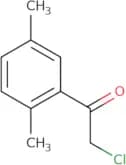
CAS:<p>Versatile small molecule scaffold</p>Fórmula:C14H15NO4Pureza:Min. 95%Peso molecular:261.27 g/mol2-Chloro-1-(2,5-dimethylphenyl)ethanone
CAS:<p>2-Chloro-1-(2,5-dimethylphenyl)ethanone is a synthetic intermediate for the production of a variety of pharmaceuticals. This product can be used in phase chromatography, mass spectrometry detection, and miniaturised techniques such as ring-opening. 2-Chloro-1-(2,5-dimethylphenyl)ethanone can also be used in on-line electrochemical methods and guanosine synthesis techniques. This product has been shown to inhibit the growth of bacteria that cause tuberculosis and anthrax. 2-Chloro-1-(2,5-dimethylphenyl)ethanone has also been found to have affinity for DNA bases guanosine.</p>Fórmula:C10H11ClOPureza:Min. 95%Peso molecular:182.65 g/mol2-[4-(Propan-2-yloxy)phenyl]acetonitrile
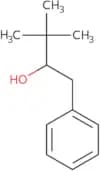
CAS:<p>Versatile small molecule scaffold</p>Fórmula:C11H13NOPureza:Min. 95%Peso molecular:175.23 g/mol3,3-Dimethyl-1-phenylbutan-2-ol
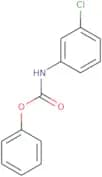
CAS:<p>3,3-Dimethyl-1-phenylbutan-2-ol is an aliphatic alcohol that is a chiral molecule. It is used in the synthesis of other chemicals, such as pharmaceuticals. 3,3-Dimethyl-1-phenylbutan-2-ol has a purity of 99.8% and is an enantiomer of the related compound 2,2-dimethylpropaneol. 3,3-Dimethyl-1-phenylbutan-2-ol can be analyzed by gas chromatography to determine its concentration and find out if it is racemic or enantiomeric.</p>Fórmula:C12H18OPureza:Min. 95%Peso molecular:178.27 g/molPhenyl (3-Chlorophenyl)carbamate
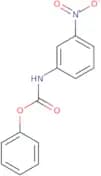
CAS:<p>Versatile small molecule scaffold</p>Fórmula:C13H10ClNO2Pureza:Min. 95%Peso molecular:247.68 g/molPhenyl N-(3-nitrophenyl)carbamate
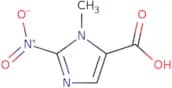
CAS:<p>Versatile small molecule scaffold</p>Fórmula:C13H10N2O4Pureza:Min. 95%Peso molecular:258.23 g/mol1-Methyl-2-nitro-1H-imidazole-5-carboxylic acid
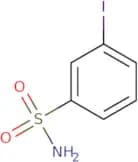
CAS:Versatile small molecule scaffoldFórmula:C5H5N3O4Pureza:Min. 95%Peso molecular:171.1 g/mol3-Iodobenzene-1-sulfonamide
CAS:<p>Versatile small molecule scaffold</p>Fórmula:C6H6INO2SPureza:Min. 95%Peso molecular:283.09 g/mol




![N-Methyl-1-azabicyclo[2.2.2]octan-3-amine](/_next/image/?url=https%3A%2Fstatic.cymitquimica.com%2Fproducts%2F3D%2Fthumb-webp%2FACA68424.webp&w=3840&q=75)
![2-[4-(Propan-2-yloxy)phenyl]acetonitrile](/_next/image/?url=https%3A%2Fstatic.cymitquimica.com%2Fproducts%2F3D%2Fthumb-webp%2FACA69053.webp&w=3840&q=75)