Building Blocks
Esta seção contém produtos fundamentais para a síntese de compostos orgânicos e biológicos. Building blocks são os materiais de partida essenciais usados para construir moléculas complexas através de várias reações químicas. Eles desempenham um papel crítico na descoberta de medicamentos, ciência dos materiais e pesquisa química. Na CymitQuimica, oferecemos uma ampla gama de building blocks de alta qualidade para apoiar suas pesquisas inovadoras e projetos industriais, garantindo que você tenha os componentes essenciais para uma síntese bem-sucedida.
Subcategorias de "Building Blocks"
- Ácidos Borónicos e Derivados de Ácido Borónico(5.778 produtos)
- Building Blocks Quirais(1.242 produtos)
- Building Blocks Hidrocarbonetos(6.098 produtos)
- Building Blocks orgânicos(61.098 produtos)
Foram encontrados 199594 produtos de "Building Blocks"
Ordenar por
Pureza (%)
0
100
|
0
|
50
|
90
|
95
|
100
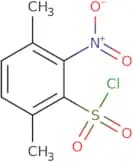
3,6-Dimethyl-2-nitrobenzene-1-sulfonyl chloride
CAS:<p>Versatile small molecule scaffold</p>Fórmula:C8H8ClNO4SPureza:Min. 95%Peso molecular:249.67 g/mol5-Amino-1-methyl-1H-pyrazole-4-carbaldehyde
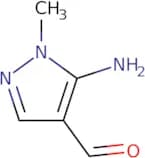
CAS:<p>5-Amino-1-methyl-1H-pyrazole-4-carbaldehyde (5AMPC) is a catalyst that activates alkyl groups. It is generated by the reaction of formaldehyde with cyanide. The cyanide group is then replaced by aminomethyl and cyano groups, which can be used in the synthesis of other organic compounds. 5AMPC has been extensively studied for its application as a catalyst in the production of nitriles from carbonyl compounds.</p>Fórmula:C5H7N3OPureza:Min. 95%Peso molecular:125.13 g/mol5-Amino-1-phenyl-1H-pyrazole-4-carbaldehyde
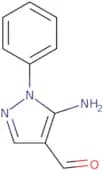
CAS:<p>Versatile small molecule scaffold</p>Fórmula:C10H9N3OPureza:Min. 95%Peso molecular:187.2 g/mol2-Methyl-3-(methylsulfanyl)propanoic acid
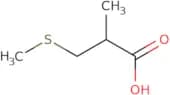
CAS:<p>Versatile small molecule scaffold</p>Fórmula:C5H10O2SPureza:Min. 95%Peso molecular:134.2 g/mol2-Aminoquinoline-3-carbothioamide
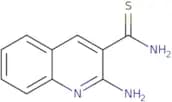
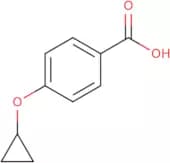
CAS:<p>Versatile small molecule scaffold</p>Fórmula:C10H9N3SPureza:Min. 95%Peso molecular:203.27 g/mol4-Cyclopropoxybenzoic acid
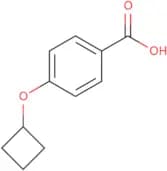
CAS:<p>Versatile small molecule scaffold</p>Fórmula:C10H10O3Pureza:Min. 95%Peso molecular:178.18 g/mol4-Cyclobutoxybenzoic acid
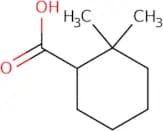
CAS:<p>Versatile small molecule scaffold</p>Fórmula:C11H12O3Pureza:Min. 95%Peso molecular:192.21 g/mol2,2-Dimethylcyclohexane-1-carboxylic acid
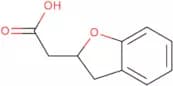
CAS:<p>Versatile small molecule scaffold</p>Fórmula:C9H16O2Pureza:Min. 95%Peso molecular:156.22 g/mol2-(2,3-Dihydro-1-benzofuran-2-yl)acetic acid
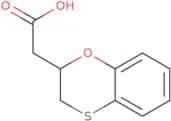
CAS:<p>Versatile small molecule scaffold</p>Fórmula:C10H10O3Pureza:Min. 95%Peso molecular:178.18 g/mol2-(2,3-Dihydro-1,4-benzoxathiin-2-yl)acetic acid
CAS:<p>Versatile small molecule scaffold</p>Fórmula:C10H10O3SPureza:Min. 95%Peso molecular:210.25 g/molN-{[4-(Aminomethyl)phenyl]methyl}acetamide
CAS:<p>Versatile small molecule scaffold</p>Fórmula:C10H14N2OPureza:Min. 95%Peso molecular:178.23 g/molUndec-10-en-1-amine
CAS:<p>Undec-10-en-1-amine is a chemical compound with the molecular formula C11H23N. It has a reactive chemical structure that can undergo reactions with other molecules. Undec-10-en-1-amine is used as a model system in carbohydrate chemistry and biological studies. It is also used in silicon polymerizations, glycopolymer synthesis, and primary amino acid synthesis. Undec-10-en-1-amine has been shown to be cytotoxic, which may be due to its ability to deaminate cytidine residues on DNA. This reaction results in the formation of uracil, which blocks RNA synthesis and leads to cell death.</p>Fórmula:C11H23NPureza:Min. 95%Peso molecular:169.31 g/mol5,5-dimethylazepan-2-one
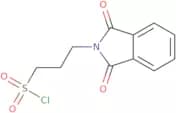
CAS:<p>Versatile small molecule scaffold</p>Fórmula:C8H15NOPureza:Min. 95%Peso molecular:141.21 g/mol3-(1,3-dioxo-1,3-dihydro-2H-isoindol-2-yl)propane-1-sulfonyl chloride
CAS:<p>Versatile small molecule scaffold</p>Fórmula:C11H10ClNO4SPureza:Min. 95%Peso molecular:287.71 g/mol3-Methanesulfonyl-5-methoxyaniline
CAS:<p>Versatile small molecule scaffold</p>Fórmula:C8H11NO3SPureza:Min. 95%Peso molecular:201.25 g/molBicyclo[4.1.0]heptane-1-carbaldehyde
CAS:<p>Versatile small molecule scaffold</p>Fórmula:C8H12OPureza:Min. 95%Peso molecular:124.18 g/mol{Bicyclo[4.1.0]heptan-1-yl}methanol
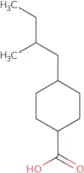
CAS:<p>Versatile small molecule scaffold</p>Fórmula:C8H14OPureza:Min. 95%Peso molecular:126.2 g/mol4-(2-Methylbutyl)cyclohexane-1-carboxylic acid
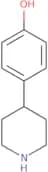
CAS:Versatile small molecule scaffoldFórmula:C12H22O2Pureza:Min. 95%Peso molecular:198.3 g/mol4-(Piperidin-4-yl)phenol
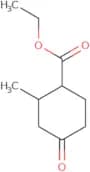
CAS:<p>4-(Piperidin-4-yl)phenol is a potent antipsychotic drug that belongs to the group of piperidines. It has been shown to be active in animal models and as an antipsychotic agent in humans. 4-(Piperidin-4-yl)phenol binds to alpha and beta adrenergic receptors, serotonin receptors, dopamine receptors, and histamine H1 receptors. It has been shown to have high potency and affinity for these receptors. This drug is also cloned from human brain tissue and has acted as a subtype-selective antagonist at cloned human alpha 1A-adrenergic receptor.</p>Fórmula:C11H15NOPureza:Min. 95%Peso molecular:177.25 g/molEthyl 2-methyl-4-oxocyclohexane-1-carboxylate
CAS:<p>Versatile small molecule scaffold</p>Fórmula:C10H16O3Pureza:Min. 95%Peso molecular:184.23 g/mol

![N-{[4-(Aminomethyl)phenyl]methyl}acetamide](/_next/image/?url=https%3A%2Fstatic.cymitquimica.com%2Fproducts%2F3D%2Fthumb-webp%2FMCA59205.webp&w=3840&q=75)



![Bicyclo[4.1.0]heptane-1-carbaldehyde](/_next/image/?url=https%3A%2Fstatic.cymitquimica.com%2Fproducts%2F3D%2Fthumb-webp%2FMCA60934.webp&w=3840&q=75)
![{Bicyclo[4.1.0]heptan-1-yl}methanol](/_next/image/?url=https%3A%2Fstatic.cymitquimica.com%2Fproducts%2F3D%2Fthumb-webp%2FMCA60935.webp&w=3840&q=75)