Building Blocks
Subcategorias de "Building Blocks"
- Ácidos Borónicos e Derivados de Ácido Borónico(5.783 produtos)
- Building Blocks Quirais(1.242 produtos)
- Building Blocks Hidrocarbonetos(6.105 produtos)
- Building Blocks orgânicos(61.055 produtos)
Foram encontrados 205383 produtos de "Building Blocks"
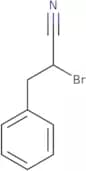
2-Bromo-3-phenylpropanenitrile
CAS:Versatile small molecule scaffold
Fórmula:C9H8BrNPureza:Min. 95%Peso molecular:210.07 g/mol2-Thiaspiro[3.5]nonan-7-amine 2,2-dioxide hydrochloride
CAS:Versatile small molecule scaffold
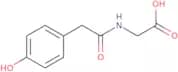
Fórmula:C8H16ClNO2SPureza:Min. 95%Peso molecular:225.74 g/molp-Hydroxyphenylacetylglycine
CAS:p-Hydroxyphenylacetylglycine (PHPAG) is a metabolite of creatine, which is found in urine samples. It can be detected through chemical analysis of tissue and food composition. The detection sensitivity is determined by the type of sample and the analytical method used. PHPAG has been shown to have diagnostic value for the diagnosis of certain diseases, such as liver cirrhosis, kidney disease, and fatty acid metabolism disorders. PHPAG has also been shown to be an indicator for intracellular levels of fatty acids and polyunsaturated fatty acids (PUFA).
Fórmula:C10H11NO4Pureza:Min. 95%Peso molecular:209.2 g/molN-[1-(2H-1,2,3,4-Tetrazol-5-yl)cyclopentyl]benzamide
CAS:Versatile small molecule scaffold
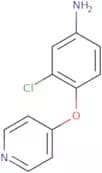
Fórmula:C13H15N5OPureza:Min. 95%Peso molecular:257.3 g/mol3-Chloro-4-(pyridin-4-yloxy)aniline
CAS:Versatile small molecule scaffold
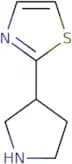
Fórmula:C11H9ClN2OPureza:Min. 95%Peso molecular:220.65 g/mol2-(Pyrrolidin-3-yl)-1,3-thiazole
CAS:Versatile small molecule scaffold
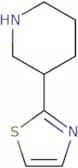
Fórmula:C7H10N2SPureza:Min. 95%Peso molecular:154.24 g/mol2-(Piperidin-3-yl)thiazole
CAS:Versatile small molecule scaffold
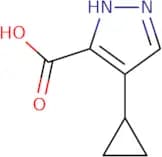
Fórmula:C8H12N2SPureza:Min. 95%Peso molecular:168.26 g/mol4-Cyclopropyl-1H-pyrazole-5-carboxylic acid
CAS:Versatile small molecule scaffold
Fórmula:C7H8N2O2Pureza:Min. 95%Peso molecular:152.15 g/mol2-{[2-(Trifluoromethyl)phenyl]formamido}acetic acid
CAS:Versatile small molecule scaffold
Fórmula:C10H8F3NO3Pureza:Min. 95%Peso molecular:247.17 g/mol4-{[(2-Methoxyethyl)amino]methyl}benzonitrile hydrochloride
CAS:Versatile small molecule scaffold
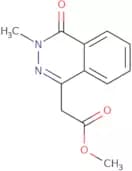
Fórmula:C11H15ClN2OPureza:Min. 95%Peso molecular:226.7 g/molMethyl 2-(3-methyl-4-oxo-3,4-dihydrophthalazin-1-yl)acetate
CAS:Versatile small molecule scaffold
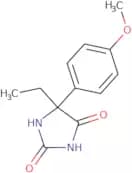
Fórmula:C12H12N2O3Pureza:Min. 95%Peso molecular:232.23 g/mol5-Ethyl-5-(4-methoxyphenyl)imidazolidine-2,4-dione
CAS:Versatile small molecule scaffold
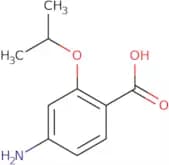
Fórmula:C12H14N2O3Pureza:Min. 95%Peso molecular:234.25 g/mol4-Amino-2-(propan-2-yloxy)benzoic acid
CAS:Versatile small molecule scaffold
Fórmula:C10H13NO3Pureza:Min. 95%Peso molecular:195.21 g/mol4-Amino-2-ethylbenzoic acid
CAS:4-Amino-2-ethylbenzoic acid is a naturally occurring amino acid. It is a vasopressin analog that has been shown to lower blood pressure in vivo. 4-Amino-2-ethylbenzoic acid binds to the receptor for arginine vasotocin, which is the natural ligand for this receptor and activates the receptor. It also has a high lipophilicity and extracellular Ca2+ binding capacity. 4-Amino-2-ethylbenzoic acid may act as an estrogen antagonist by competing with estradiol for binding to estrogen receptors on cells.
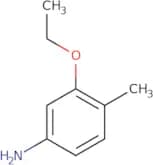
Fórmula:C9H11NO2Pureza:Min. 95%Peso molecular:165.19 g/mol3-Ethoxy-4-methylaniline
CAS:Versatile small molecule scaffold
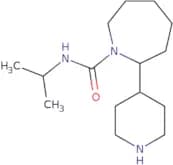
Fórmula:C9H13NOPureza:Min. 95%Peso molecular:151.21 g/mol2-(Piperidin-4-yl)-N-(propan-2-yl)azepane-1-carboxamide
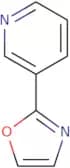
CAS:Versatile small molecule scaffoldFórmula:C15H29N3OPureza:Min. 95%Peso molecular:267.41 g/mol3-(1,3-Oxazol-2-yl)pyridine
CAS:Versatile small molecule scaffold
Fórmula:C8H6N2OPureza:Min. 95%Peso molecular:146.15 g/molRef: 3D-FAA99885
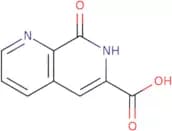
Produto descontinuado8-Hydroxy-1,7-naphthyridine-6-carboxylic acid
CAS:Versatile small molecule scaffold
Fórmula:C9H6N2O3Pureza:Min. 95%Peso molecular:190.16 g/molRef: 3D-JCD54195
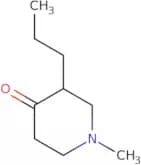
Produto descontinuado1-Methyl-3-propylpiperidin-4-one
CAS:Versatile small molecule scaffold
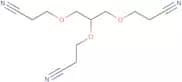
Fórmula:C9H17NOPureza:Min. 95%Peso molecular:155.24 g/mol1,2,3-Tris(2-cyanoethoxy)propane
CAS:1,2,3-Tris(2-cyanoethoxy)propane is a contaminant that has low detection limits and can be detected on-line. It has been shown to interact with oxygenated solutes in the chromatographic method used to analyze silicone. 1,2,3-Tris(2-cyanoethoxy)propane has also been shown to be an injectable solute that can desorb from silicone during the chromatographic analysis. This contaminant is not expressed by S. pneumoniae or S. pyogenes, but is expressed by E. coli and Streptococcus sp.
Fórmula:C12H17N3O3Pureza:Min. 95%Peso molecular:251.29 g/mol

![2-Thiaspiro[3.5]nonan-7-amine 2,2-dioxide hydrochloride](/_next/image/?url=https%3A%2Fstatic.cymitquimica.com%2Fproducts%2F3D%2Fthumb-webp%2FNKD13458.webp&w=3840&q=75)
![N-[1-(2H-1,2,3,4-Tetrazol-5-yl)cyclopentyl]benzamide](/_next/image/?url=https%3A%2Fstatic.cymitquimica.com%2Fproducts%2F3D%2Fthumb-webp%2FQCC36627.webp&w=3840&q=75)
![2-{[2-(Trifluoromethyl)phenyl]formamido}acetic acid](/_next/image/?url=https%3A%2Fstatic.cymitquimica.com%2Fproducts%2F3D%2Fthumb-webp%2FFAB11794.webp&w=3840&q=75)
![4-{[(2-Methoxyethyl)amino]methyl}benzonitrile hydrochloride](/_next/image/?url=https%3A%2Fstatic.cymitquimica.com%2Fproducts%2F3D%2Fthumb-webp%2FBAC92340.webp&w=3840&q=75)