


Building Blocks
Esta seção contém produtos fundamentais para a síntese de compostos orgânicos e biológicos. Building blocks são os materiais de partida essenciais usados para construir moléculas complexas através de várias reações químicas. Eles desempenham um papel crítico na descoberta de medicamentos, ciência dos materiais e pesquisa química. Na CymitQuimica, oferecemos uma ampla gama de building blocks de alta qualidade para apoiar suas pesquisas inovadoras e projetos industriais, garantindo que você tenha os componentes essenciais para uma síntese bem-sucedida.
Subcategorias de "Building Blocks"
- Ácidos Borónicos e Derivados de Ácido Borónico(5.778 produtos)
- Building Blocks Quirais(1.243 produtos)
- Building Blocks Hidrocarbonetos(6.098 produtos)
- Building Blocks orgânicos(61.057 produtos)
Foram encontrados 200716 produtos de "Building Blocks"
Ordenar por
Pureza (%)
0
100
|
0
|
50
|
90
|
95
|
100
ethyl 6-benzyl-2-oxa-6-azaspiro[3.4]octane-8-carboxylate
CAS:<p>Versatile small molecule scaffold</p>Fórmula:C16H21NO3Pureza:Min. 95%Peso molecular:275.35 g/molMethyl 5-bromo-2-fluoro-4-methylbenzoate
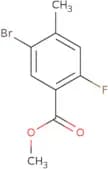
CAS:Versatile small molecule scaffoldFórmula:C9H8BrFO2Pureza:Min. 95%Peso molecular:247.06 g/mol2-(Bromomethyl)-6-fluorobenzonitrile
CAS:Versatile small molecule scaffoldFórmula:C8H5BrFNPureza:Min. 95%Peso molecular:214.04 g/mol3-chloro-4-cyanobenzoic acid
CAS:Versatile small molecule scaffoldFórmula:C8H4ClNO2Pureza:Min. 95%Peso molecular:181.58 g/mol2,4,6-Trichloronicotinaldehyde
CAS:<p>Versatile small molecule scaffold</p>Fórmula:C6H2Cl3NOPureza:Min. 95%Peso molecular:210.45 g/mol(e)-(2-(1-(tert-butoxycarbonyl)piperidin-4-yl)vinyl)boronic acid pinacol ester
CAS:<p>Versatile small molecule scaffold</p>Fórmula:C18H32BNO4Pureza:Min. 95%Peso molecular:337.27 g/moltert-butyl 4-(4,4,5,5-tetramethyl-1,3,2-dioxaborolan-2-yl)phenethylcarbamate
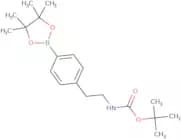
CAS:<p>Versatile small molecule scaffold</p>Fórmula:C19H30BNO4Pureza:Min. 95%Peso molecular:347.26 g/moltert-Butyl 1,8-diazaspiro[4.5]decane-1-carboxylate
CAS:Versatile small molecule scaffoldFórmula:C13H24N2O2Pureza:Min. 95%Peso molecular:240.3 g/mol2-[5-(4,4,5,5-Tetramethyl-1,3,2-dioxaborolan-2-yl)pyrimidin-2-yl]propan-2-ol
CAS:<p>Versatile small molecule scaffold</p>Fórmula:C13H21BN2O3Pureza:Min. 95%Peso molecular:264.13 g/molMethyl 2-chloro-5-iodonicotinate
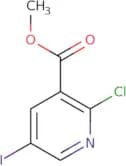
CAS:<p>Methyl 2-chloro-5-iodonicotinate is a basic and yields a radioligand for use in imaging studies. It is used as a specific activity and solid-phase extraction. Methyl 2-chloro-5-iodonicotinate has been shown to be effective for radiolabeling studies of the brain following intravenous administration.</p>Fórmula:C7H5ClINO2Pureza:Min. 95%Peso molecular:297.48 g/mol2-Bromothieno[3,2-c]pyridin-4(5H)-one
CAS:Versatile small molecule scaffoldFórmula:C7H4BrNOSPureza:Min. 95%Peso molecular:230.08 g/mol5-Bromo-2-(2,2,2-trifluoroethyl)pyridine
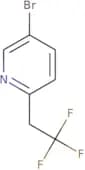
CAS:<p>Versatile small molecule scaffold</p>Fórmula:C7H5BrF3NPureza:Min. 95%Peso molecular:240.02 g/mol(2R)-2-Acetamido-3,3-dimethylbutanoic acid
CAS:Versatile small molecule scaffoldFórmula:C8H15NO3Pureza:Min. 95%Peso molecular:173.21 g/molGlycidyltrimethylammonium Chloride
CAS:<p>Glycidyltrimethylammonium chloride is a quaternary ammonium compound that has been widely used as a disinfectant and in wastewater treatment. It is mainly used to kill bacteria and viruses, although it can also be used to remove hazardous material from water. Glycidyltrimethylammonium chloride has the ability to inhibit bacterial growth by causing cell membrane damage. This compound is also able to inhibit the synthesis of DNA, RNA, and protein in cells by binding to their respective building blocks. In addition, glycidyltrimethylammonium chloride has cytotoxic effects on human cells and significantly inhibits the replication of oral pathogens.</p>Fórmula:C6H14ClNOPureza:Min. 95%Cor e Forma:Clear LiquidPeso molecular:151.63 g/mol1-(4-Chloro-2,6-dimethylphenyl)ethanone
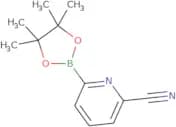
CAS:Versatile small molecule scaffoldFórmula:C10H11ClOPureza:Min. 95%Peso molecular:182.64 g/mol6-Cyanopyridine-2-boronic Acid Pinacol Ester
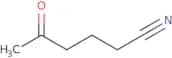
CAS:Versatile small molecule scaffoldFórmula:C12H15BN2O2Pureza:Min. 95%Peso molecular:230.07 g/mol5-Ketohexanenitrile
CAS:<p>5-Ketohexanenitrile is a liquid that is used in the production of medicine. The compound has been shown to be an effective inhibitor of the enzyme, dehydrogenase, which catalyzes the conversion of 5-ketohexanoic acid to hexadecanoic acid. This reaction is important for the oxidation of fatty acids and can be found in all living organisms. 5-Ketohexanenitrile has also been shown to inhibit the enzyme, hydrogen peroxide oxidase, which catalyzes the conversion of hydrogen peroxide to water and oxygen gas. 5-Ketohexanenitrile is also an intermediate in acrylonitrile production. It can be produced by vaporizing hexadecanoic acid with a catalyst such as trimethylpyridine or acetic acid. 5-Ketohexanenitrile can exist as two isomers: cis and trans. It is a primary amine that reacts with alkali metals such as</p>Fórmula:C6H9NOPureza:Min. 95%Peso molecular:111.14 g/mol2-Cyclopropylphenol
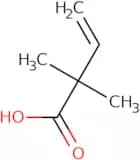
CAS:<p>2-Cyclopropylphenol is a hydrogen chloride derivative of 2-cyclohexen-1-one. It has been shown to have high affinity for the α receptor, which is a functional group in the integrin receptor that mediates cell adhesion. 2-Cyclopropylphenol has been shown to be effective for the treatment of hepatitis. 2-Cyclopropylphenol also forms an organometallic complex with platinum, which can be used as an anticancer agent and shows good antiviral activity against hepatitis C virus (HCV). The molecular modeling of this compound was done by using quantum chemical calculations and NMR spectra. The synthesis of this compound was developed from benzene and ethynylbenzene. The photochemical properties of this compound were investigated by methane monooxygenase reconstitution studies.</p>Fórmula:C9H10OPureza:Min. 95%Peso molecular:134.18 g/mol2,2-Dimethylbut-3-enoic acid
CAS:<p>2,2-Dimethylbut-3-enoic acid is a bioactive compound that is used to synthesize other compounds. It has been shown to have a number of functions, such as being an electrolyte and having an electron deficient group in its structure. 2,2-Dimethylbut-3-enoic acid reacts with electrophilic functional groups at high temperatures to form allylation products. This reaction is called cheletropic and has been shown to be reversible.</p>Fórmula:C6H10O2Pureza:Min. 95%Peso molecular:114.14 g/mol[(Trimethylsilyl)ethynyl]boronic acid, pinacol ester
CAS:<p>Versatile small molecule scaffold</p>Fórmula:C11H21BO2SiPureza:Min. 95%Peso molecular:224.2 g/mol
![ethyl 6-benzyl-2-oxa-6-azaspiro[3.4]octane-8-carboxylate](/_next/image/?url=https%3A%2Fstatic.cymitquimica.com%2Fproducts%2F3D%2Fthumb-webp%2FLBC69289.webp&w=3840&q=75)



![tert-Butyl 1,8-diazaspiro[4.5]decane-1-carboxylate](/_next/image/?url=https%3A%2Fstatic.cymitquimica.com%2Fproducts%2F3D%2Fthumb-webp%2FKKB27992.webp&w=3840&q=75)
![2-[5-(4,4,5,5-Tetramethyl-1,3,2-dioxaborolan-2-yl)pyrimidin-2-yl]propan-2-ol](/_next/image/?url=https%3A%2Fstatic.cymitquimica.com%2Fproducts%2F3D%2Fthumb-webp%2FUCC25587.webp&w=3840&q=75)
![2-Bromothieno[3,2-c]pyridin-4(5H)-one](/_next/image/?url=https%3A%2Fstatic.cymitquimica.com%2Fproducts%2F3D%2Fthumb-webp%2FDBA94860.webp&w=3840&q=75)



![[(Trimethylsilyl)ethynyl]boronic acid, pinacol ester](/_next/image/?url=https%3A%2Fstatic.cymitquimica.com%2Fproducts%2F3D%2Fthumb-webp%2FJGA08746.webp&w=3840&q=75)