Ciano-, Nitrilo-
Os compostos ciano e nitrilo são moléculas orgânicas que contêm grupos ciano (C≡N) ou nitrilo em sua estrutura, caracterizadas pela presença de nitrogênio. Esses grupos desempenham papéis importantes em várias reações químicas e aplicações industriais. Nesta categoria, você encontrará uma ampla gama de compostos ciano e nitrilo, variando de estruturas simples a complexas. Na CymitQuimica, oferecemos compostos ciano e nitrilo de alta qualidade adaptados para atender às necessidades de pesquisa e industriais. Nossos compostos são adequados para uma variedade de aplicações de síntese e análise.
Foram encontrados 9624 produtos de "Ciano-, Nitrilo-"
Ordenar por
Pureza (%)
0
100
|
0
|
50
|
90
|
95
|
100
Ethyl 3-amino-2-(((2'-cyano-[1,1'-biphenyl]-4-yl)methyl)amino)benzoate
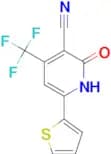
CAS:Pureza:95.0%Peso molecular:371.440002441406252-Oxo-6-thiophen-2-yl-4-trifluoromethyl-1,2-dihydropyridine-3-carbonitrile
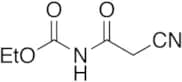
CAS:Fórmula:C11H5F3N2OSPureza:97%Cor e Forma:SolidPeso molecular:270.23N-Cyanoacetylurethane
CAS:<p>Applications N-Cyanoacetylurethane is used in the synthesis of inhibitors targetting the PDZ domain of PICK1, which is a potential target for brain ischemia, pain and addiction illnesses. Also it is used in the synthesis of cathespin K inhibitors.<br>References Bach, A. et al.: Org. Biomol. Chem., 8, 4281 (2010); Rankovic, Z. et al.: Bioorg. Med. Chem. Lett., 20, 1488 (2010);<br></p>Fórmula:C6H8N2O3Cor e Forma:NeatPeso molecular:156.142-((7-(5-(Di-p-tolylamino)thiophen-2-yl)benzo[c][1,2,5]thiadiazol-4-yl)methylene)malononitrile
CAS:Pureza:97%Peso molecular:489.6199951171875Ethyl 2-(((2'-cyano-[1,1'-biphenyl]-4-yl)methyl)amino)-3-nitrobenzoate
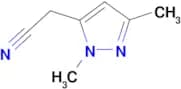
CAS:Pureza:98%Peso molecular:401.4219970703125(1,3-dimethyl-1H-pyrazol-5-yl)acetonitrile
CAS:Fórmula:C7H9N3Pureza:97%Cor e Forma:SolidPeso molecular:135.17Isocyanomethane
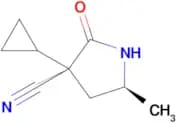
CAS:Produto Controlado<p>Applications isocyanomethane (cas# 593-75-9) is a useful research chemical.<br></p>Fórmula:C2H3NCor e Forma:NeatPeso molecular:41.05(3r,5s)-3-Cyclopropyl-5-methyl-2-oxo-pyrrolidine-3-carbonitrile
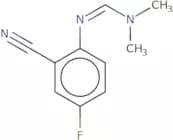
CAS:Pureza:98%Peso molecular:164.20799255371094N'-(2-Cyano-4-fluorophenyl)-N,N-dimethylimidoformamide
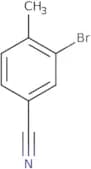
CAS:<p>N'-(2-Cyano-4-fluorophenyl)-N,N-dimethylimidoformamide is a high quality, reagent that is useful for the synthesis of complex compounds. It can be used as a fine chemical and speciality chemical in research and development. The CAS number for this compound is 1017082-62-0. N'-(2-Cyano-4-fluorophenyl)-N,N-dimethylimidoformamide has shown to be a versatile building block for the synthesis of novel compounds that are not commercially available. This product is suitable for use in reaction components as well as being an intermediate for the synthesis of other compounds.</p>Fórmula:C10H10FN3Pureza:Min. 95%Cor e Forma:PowderPeso molecular:191.21 g/mol2-Bromo-4-cyanotoluene
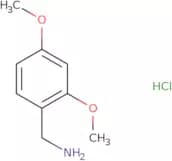
CAS:<p>2-Bromo-4-cyanotoluene is a ligand that is used in cross-coupling reactions. It is used to form complexes with metals, such as palladium and nickel, for the preparation of organometallic reagents. 2-Bromo-4-cyanotoluene has been shown to inhibit secretory phospholipase A2 (sPLA2) and PLA2 activity in a fluorimetric assay. This compound also inhibits the catalytic activity of spla2, which is an enzyme involved in the biosynthesis of arachidonic acid. 2-Bromo-4-cyanotoluene also inhibits piperazine synthesis by reacting with the nitrogen atom on the piperazine ring.</p>Fórmula:C8H6BrNPureza:Min. 95%Peso molecular:196.04 g/mol2,4-Dimethoxybenzylamine hydrochloride
CAS:<p>2,4-Dimethoxybenzylamine hydrochloride is a substrate for glutathione reductase and a competitive inhibitor of dithioerythritol. The reaction mechanism is the same as that of triflic acid, which is generated by the reaction between triflic acid and glutathione. The inhibitory effect of 2,4-dimethoxybenzylamine hydrochloride on glutathione reductase has been studied computationally using molecular docking simulations. It was found that 2,4-dimethoxybenzylamine hydrochloride binds to the active site of glutathione reductase with an affinity comparable to that of triflic acid. This computational study also revealed that 2,4-dimethoxybenzylamine hydrochloride can be converted into triflic acid in vivo.</p>Fórmula:C9H13NO2HClPureza:Min. 95%Cor e Forma:PowderPeso molecular:203.67 g/mol(4-Hydroxy-3-methoxyphenyl)acetonitrile
CAS:<p>Lobetyolin is a phenolic compound that has been found to be an inhibitor of monoamine oxidase. Lobetyolin is an acetylated derivative of 4-hydroxy-3-methoxyphenylacetonitrile. It has been shown to inhibit bacterial growth in vitro, with the exception of Mycobacterium tuberculosis and Mycobacterium avium complex. The optimal reaction time for lobetyolin is 3 hours at a pH between 7 and 8, with a yield of 66% at room temperature. Lobetyolin reacts rapidly with amines, alkylating them as it undergoes oxidation by hydrogen peroxide. Lobetyolin also reacts slowly with dopamine and aldehydes, but more readily with chlorides, yielding lobetyrine and chloroacetaldehyde respectively.</p>Fórmula:C9H9NO2Pureza:Min. 95%Cor e Forma:PowderPeso molecular:163.17 g/mol

![Ethyl 3-amino-2-(((2'-cyano-[1,1'-biphenyl]-4-yl)methyl)amino)benzoate](/_next/image/?url=https%3A%2Fstatic.cymitquimica.com%2Fproducts%2F10%2Fthumb-webp%2FF321113.webp&w=3840&q=75)
![3-Formyl-1H-pyrrolo[2,3-b]pyridine-4-carbonitrile](/_next/image/?url=https%3A%2Fstatic.cymitquimica.com%2Fproducts%2F10%2Fthumb-webp%2FF721875.webp&w=3840&q=75)

![2-((7-(5-(Di-p-tolylamino)thiophen-2-yl)benzo[c][1,2,5]thiadiazol-4-yl)methylene)malononitrile](/_next/image/?url=https%3A%2Fstatic.cymitquimica.com%2Fproducts%2F10%2Fthumb-webp%2FF762873.webp&w=3840&q=75)
![Ethyl 2-(((2'-cyano-[1,1'-biphenyl]-4-yl)methyl)amino)-3-nitrobenzoate](/_next/image/?url=https%3A%2Fstatic.cymitquimica.com%2Fproducts%2F10%2Fthumb-webp%2FF768958.webp&w=3840&q=75)