Éteres
Foram encontrados 40904 produtos de "Éteres"
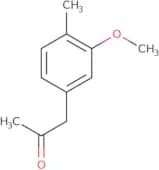
3-Methoxy-4-methylphenylacetone
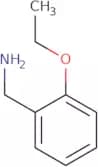
CAS:3-Methoxy-4-methylphenylacetone is a reagent that can be used as a useful intermediate for the synthesis of complex organic compounds. It is soluble in water, but insoluble in most organic solvents. 3-Methoxy-4-methylphenylacetone is also a fine chemical with CAS No. 51814-28-9 and has been shown to be an effective building block for synthetic chemistry. It is used in the synthesis of speciality chemicals and research chemicals, such as pharmaceuticals and agrochemicals. This compound can be used as a versatile building block in many reactions and has been shown to react with epoxide, nitrile, amine, thioether, amide, alcohols, carboxylic acids or esters.Fórmula:C11H14O2Pureza:Min. 95%Cor e Forma:PowderPeso molecular:178.23 g/mol2-Ethoxybenzylamine
CAS:2-Ethoxybenzylamine is a hydrophobic organic compound. It is an amine that is used as a reagent for the oxidation of primary, secondary, and tertiary amines to their corresponding aldehydes, ketones, and quinones. 2-Ethoxybenzylamine is used in the synthesis of glycopeptides and has been shown to be effective as a surrogate for benzylamine derivatives. This compound may also be an optimised enzyme complex with chloride ions that can activate certain oxidases.
Fórmula:C9H13NOPureza:Min. 95%Cor e Forma:Clear LiquidPeso molecular:151.21 g/mol3,4-Dimethoxyaniline
CAS:3,4-Dimethoxyaniline is a reactive compound that is used as an inhibitor in chemical reactions to prevent unwanted side-reactions. 3,4-Dimethoxyaniline inhibits the enzyme diazonium salt from binding to biological receptors by reacting with it and converting it into a harmless product. 3,4-Dimethoxyaniline has been shown to inhibit epidermal growth factor (EGF) receptor binding in rat liver microsomes. This inhibition can be reversed by adding redox potential. The presence of malonic acid in the reaction solution increases the production of 3,4-dimethoxyaniline. It also has been shown that this compound enhances congestive heart failure and has properties similar to those of malonic acid.
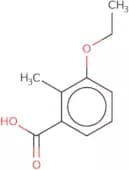
Fórmula:C8H11NO2Pureza:Min. 95%Cor e Forma:PowderPeso molecular:153.18 g/mol3-Ethoxy-2-methylbenzoic acid - 90%
CAS:3-Ethoxy-2-methylbenzoic acid is a white solid that is soluble in organic solvents. It has a molecular weight of 192.3 and an empirical formula of C9H11O3. 3-Ethoxy-2-methylbenzoic acid can be used as a building block for diverse chemical reactions and processes, including the synthesis of pharmaceuticals, pesticides, and other fine chemicals. This compound is also used as a research chemical, reaction component, or speciality chemical in various experiments and projects. 3-Ethoxy-2-methylbenzoic acid provides high quality reagents to scientists for use in research.br>br>Fórmula:C10H12O3Pureza:Min. 95%Cor e Forma:PowderPeso molecular:180.2 g/mol3'-Fluoro-4'-methoxyacetophenone
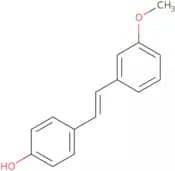
CAS:3'-Fluoro-4'-methoxyacetophenone is a chalcone that has been shown to have vibrational frequencies of 3.1, 3.2, and 3.3 cm-1. The conformation of this molecule is in the cis form with a 2,6-diisopropylphenyl group on the cyclohexane ring. This molecule has two functional groups: a hydroxyl and a methoxy group. These molecules are soluble in organic solvents such as benzene and chloroform, but not in water or ethanol due to their high polarity. The crystal structure of this molecule was determined by x-ray diffraction experiments at room temperature and found to be monoclinic with space group C2/c with lattice constants a = 5.853 Å, b = 12.638 Å, c = 6.225 Å and β = 120° ± 10° at 25 °CFórmula:C9H9FO2Pureza:Min. 95%Cor e Forma:PowderPeso molecular:168.16 g/mol4-Hydroxy-3'-methoxystilbene
CAS:4-Hydroxy-3'-methoxystilbene is a chemical that is used as a reaction component or reagent in the synthesis of other compounds. It can be used as a building block for the synthesis of complex molecules and fine chemicals. 4-Hydroxy-3'-methoxystilbene is an intermediate for the production of high quality research chemicals. It has been reported to be useful in the synthesis of pharmaceuticals, agrochemicals, and pesticides.Fórmula:C15H14O2Pureza:Min. 95%Cor e Forma:White PowderPeso molecular:226.27 g/mol1,3-Dimethoxy-2-methylimidazoliumbis(trifluoromethylsulfonyl)imide
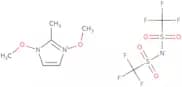
CAS:Please enquire for more information about 1,3-Dimethoxy-2-methylimidazoliumbis(trifluoromethylsulfonyl)imide including the price, delivery time and more detailed product information at the technical inquiry form on this pageFórmula:C8H11F6N3O6S2Pureza:Min. 95%Cor e Forma:PowderPeso molecular:423.31 g/mol3-Ethoxybenzyl alcohol
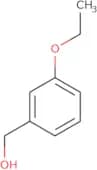
CAS:3-Ethoxybenzyl alcohol is a lead compound that has been shown to be carcinogenic in mice. It has also been shown to have strong anti-inflammatory properties, as it inhibits the production of prostaglandins. This chemical is also able to inhibit sulfation and may be used as an analyte for high-throughput analysis in order to identify novel drugs for the treatment of asthma or other inflammatory diseases. 3-Ethoxybenzyl alcohol has a number of biological effects, including inhibition of protein synthesis and cell division, which are due to its ability to bind with sulfate ions.Fórmula:C9H12O2Pureza:Min. 95%Cor e Forma:Clear LiquidPeso molecular:152.19 g/mol3,5,7,4'-Tetramethoxyflavone
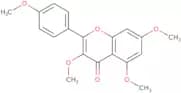
CAS:3,5,7,4'-Tetramethoxyflavone is a flavonoid that has been shown to have antidiabetic effects in animal studies. The mechanism of action of 3,5,7,4'-tetramethoxyflavone is not clear; however it is thought to involve the regulation of insulin sensitivity and energy metabolism. This compound has also been shown to inhibit the growth of Mycobacterium tuberculosis and other bacteria by interacting with their adenosine receptors. 3,5,7,4'-Tetramethoxyflavone binds to the basophilic leukemia cell line and inhibits its uptake of adenosine through the ccaat/enhancer-binding protein complex.
Fórmula:C19H18O6Pureza:Min. 95%Peso molecular:342.34 g/mol2-Ethoxy-5-fluoro-1H-pyrimidin-4-one
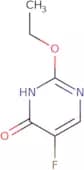
CAS:2-Ethoxy-5-fluoro-1H-pyrimidin-4-one is a chemical compound that can be synthesized in ethanol, ether, and ethyl formate. It is a white crystalline solid with a melting point of 164°C. The impurities are filtered out using filtration. This compound reacts with substance to produce crystallization. 2-Ethoxy-5-fluoro-1H-pyrimidin-4-one can also be synthesized by reacting trimethylamine and isourea.
Fórmula:C6H7FN2O2Pureza:Min. 95%Cor e Forma:PowderPeso molecular:158.13 g/mol2-Methoxyresorcinol
CAS:2-Methoxyresorcinol is a metabolite that is formed by the oxidation of resorcinol. It has two methoxy groups, which are functional groups that are usually found in organic compounds. 2-Methoxyresorcinol has been shown to inhibit the growth of tumour cells in vitro and in vivo. It also inhibits cell growth by decreasing protein synthesis and cell division. This compound is an analytical method for measuring hematocrit levels and can be used as a natural compound for the treatment of chronic kidney disease.
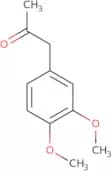
Fórmula:C7H8O3Pureza:Min. 95%Cor e Forma:PowderPeso molecular:140.14 g/mol(3,4-Dimethoxyphenyl)acetone
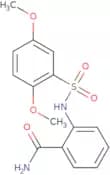
CAS:(3,4-Dimethoxyphenyl)acetone is a compound that has been used in the synthesis of chiral drugs. It is a reactive carbonyl group with an alcohol group and a methyl ethyl acylation reaction. The biological properties of this compound are not known, but it can be used in the synthesis of amines. This chemical can also be found in urine samples and is commonly used as a testicular marker.Fórmula:C11H14O3Pureza:Min. 97 Area-%Cor e Forma:Clear LiquidPeso molecular:194.23 g/mol2-(((2,5-dimethoxyphenyl)sulfonyl)amino)benzamide
CAS:Please enquire for more information about 2-(((2,5-dimethoxyphenyl)sulfonyl)amino)benzamide including the price, delivery time and more detailed product information at the technical inquiry form on this page
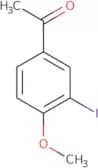
Pureza:Min. 95%3'-Iodo-4'-methoxyacetophenone
CAS:3'-Iodo-4'-methoxyacetophenone is a chemical compound that is used in the synthesis of other organic compounds. It is a byproduct of the reaction between acetophenone and iodomethane. 3'-Iodo-4'-methoxyacetophenone is soluble in most solvents, such as ethanol, ether, chloroform, and acetone. The compound has a CAS number of 79324-77-9.
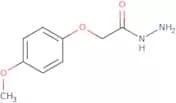
Fórmula:C9H9IO2Pureza:Min. 95%Cor e Forma:PowderPeso molecular:276.07 g/mol2-(4-Methoxyphenoxy)acetohydrazide
CAS:2-(4-Methoxyphenoxy)acetohydrazide is a coumarin derivative that has been synthesized for use in the detection of salicylaldehyde in air. The emissions are detected by means of luminescence and fluorescence spectroscopy, with the emission intensity measured by a dihedral angle detector. The compound also produces europium ions, which can be used to detect and quantify it. The elemental analysis gives the yields as 0.25 grams per mole, while the spectral data show 2-(4-methoxyphenoxy)acetohydrazide to have a fluorescence maximum at 489 nm and an excitation maximum at 320 nm. 2-(4-Methoxyphenoxy)acetohydrazide is fluorescent and luminescent, with a wavelength maximum of 489 nm and an excitation maximum of 320 nm. It reacts with benzene to produce nitro compounds, which can be detected using an electron spin resonanceFórmula:C9H12N2O3Pureza:Min. 95%Peso molecular:196.2 g/mol6-Methoxypyrimidine-2,4(1H,3H)-dione
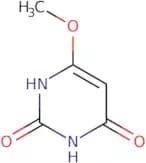
CAS:Produto Controlado6-Methoxypyrimidine-2,4(1H,3H)-dione is a nucleophilic compound that is formed by the reaction of an electron with a carbon atom in an organic molecule. It is used as a reagent in organic synthesis. 6-Methoxypyrimidine-2,4(1H,3H)-dione can be synthesized from 2-amino-5-methoxybenzaldehyde and chloroacetic acid in three steps. The chloride ion reacts with the 6-methoxypyridine to form the desired product. 6-Methoxypyrimidine-2,4(1H,3H)-dione can also be used as a reagent to catalyze chemical reactions such as alkylation and allylation reactions. 6-Methoxypyrimidine-2,4(1H,3H)-dione has been shown to have barbiturate activityFórmula:C5H6N2O3Pureza:Min. 95%Peso molecular:142.11 g/mol1-Chloro-3,5-dimethoxybenzene
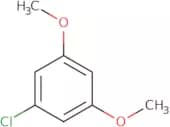
CAS:1-Chloro-3,5-dimethoxybenzene is an organic chemical compound that is used for the synthesis of other chemicals. It is a cross-coupling agent and a ligand in coordination chemistry. 1-Chloro-3,5-dimethoxybenzene has been shown to be unreactive in reactions with thionyl chloride or sulfuric acid. The chloro group on the benzoic acid derivative can be replaced by bromine or iodine to give 1,4-dibromobenzene and 3,5-diiodobenzene respectively. 1-Chloro-3,5-dimethoxybenzene can also be used as an analogously reactive but less toxic replacement for 1,2,4,5,-tetrachlorobenzene. This chemical has been isolated in yields of up to 97% when reacted with boronic acids or sulfinyle compounds.Fórmula:C8H9ClO2Pureza:Min. 95%Cor e Forma:PowderPeso molecular:172.61 g/mol5-Bromo-2-ethoxybenzoic acid
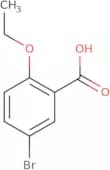
CAS:5-Bromo-2-ethoxybenzoic acid is a versatile building block that can be used as a reagent, speciality chemical, or a useful scaffold. It is used in the synthesis of complex compounds that include pharmaceuticals, agrochemicals, and research chemicals. 5-Bromo-2-ethoxybenzoic acid is also a useful intermediate and reaction component in organic synthesis. This compound has high quality and is listed on the Chemical Abstract Service (CAS) registry number 60783-90-6.Fórmula:C9H9BrO3Pureza:Min. 95%Cor e Forma:SolidPeso molecular:245.07 g/mol5-Methoxy-2,3-dihydroindoline
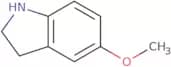
CAS:5-Methoxy-2,3-dihydroindoline is a methoxy compound that is substituted with a methyl group. It has been shown to be an effective hydrogen transfer agent in cyclopentenone reactions, and can also be used as a sensor for nitroaromatic compounds. 5-Methoxy-2,3-dihydroindoline can be synthesized by the reaction of methoxylated aniline with sodium ethoxide in acetonitrile. This reaction produces the desired product in high yield (70%), and it can also be used for the methylation of secondary amines in good yield (80%). 5-Methoxy-2,3-dihydroindoline is potently active when titrated against benzo[a]pyrene.
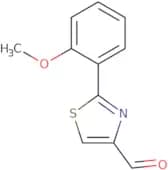
Fórmula:C9H11NOPureza:Min. 95%Cor e Forma:PowderPeso molecular:149.19 g/mol2-(2-Methoxyphenyl)thiazole-4-carbaldehyde
CAS:Please enquire for more information about 2-(2-Methoxyphenyl)thiazole-4-carbaldehyde including the price, delivery time and more detailed product information at the technical inquiry form on this pageFórmula:C11H9NO2SPureza:Min. 95%Cor e Forma:PowderPeso molecular:219.26 g/mol