Cetonas
As cetonas são compostos orgânicos caracterizados pela presença de um grupo carbonilo (C=O) ligado a dois átomos de carbono. Esses compostos são altamente versáteis e desempenham um papel crucial em várias reações químicas, incluindo oxidação, redução e condensação. As cetonas são intermediários essenciais na síntese de produtos farmacêuticos, fragrâncias e polímeros. Na CymitQuimica, oferecemos uma ampla gama de cetonas de alta qualidade para apoiar suas aplicações de pesquisa e industriais.
Foram encontrados 18809 produtos de "Cetonas"
Ordenar por
Pureza (%)
0
100
|
0
|
50
|
90
|
95
|
100
H-Ala-Ala-Pro-Val-chloromethylketone
CAS:<p>H-Ala-Ala-Pro-Val-chloromethylketone is a hydrogen peroxide prodrug that is activated by the enzyme chloromethyl ketone. This drug has been shown to be active against schistosoma and pancreatic cancer cells, as well as in activating peroxide. HAPV may also have an effect on immunity and leukocytes, which could be due to its ability to sensitize these cells to damage caused by other agents, or through the hydrolytic enzymes it generates.</p>Fórmula:C17H29ClN4O4Pureza:Min. 95%Peso molecular:388.89 g/molAc-Tyr-Val-Lys(biotinyl)-Asp-2,6-dimethylbenzoyloxymethylketone
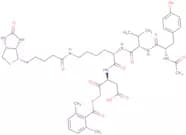
CAS:<p>Ac-Tyr-Val-Lys(biotinyl)-Asp-2,6-dimethylbenzoyloxymethylketone belongs to a group of active compounds and is a cleavage product of the caspase family. It has been shown to induce apoptosis in kidney cells by cleaving the polymeric form of the protein caspase 3, which is induced by viral infection or bacterial infection. This compound is used for coinfection with HIV and HCV. Ac-Tyr-Val-Lys(biotinyl)-Asp-2,6-dimethylbenzoyloxymethylketone can also be used for detecting apoptosis in other types of cells such as erythrocytes and neutrophils.</p>Fórmula:C46H63N7O12SPureza:Min. 95%Peso molecular:938.1 g/mol1-(2,4-Dichlorophenyl)-1H-pyrrole-2,5-dione
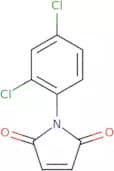
CAS:<p>Maleimide is a chemical compound with the molecular formula CH2=C(O)NHC(=O)CH2-CO2H. It is a reactive monomer that polymerizes in the presence of an initiator to form polymers. Maleimides are also used as cross-linking agents, and have been shown to be thermostable and stable at high temperatures. This particular maleimide is a colorless solid that has been shown to copolymerize with methyl methacrylate and other monomers to form thermally stable, hydrophobic polymers.</p>Fórmula:C10H5Cl2NO2Pureza:Min. 95%Peso molecular:242.06 g/mol3,6-Di(2-thienyl)-2,5-dihydropyrrolo[3,4-c]pyrrole-1,4-dione
CAS:<p>3,6-Di(2-thienyl)-2,5-dihydropyrrolo[3,4-c]pyrrole-1,4-dione is a hyaluronic acid derivative that is being studied as a possible treatment for cancer. It has been shown to have tumor suppressive effects on human breast and prostate cancer cells in vitro. The mechanism of action is thought to be related to the redox potentials of the molecule. 3,6-Di(2-thienyl)-2,5-dihydropyrrolo[3,4-c]pyrrole-1,4-dione can be used as an optical probe for studying interactions between molecules in solution. It can also be used in optical absorption spectroscopy to measure changes in tumor tissue and as an acceptor for potentials.</p>Pureza:Min. 95%(2S)-2-Amino-4-methyl-1-[(2R)-2-methyloxiranyl]-1-pentanone trifluoroacetate
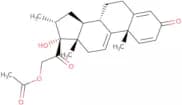
CAS:Produto Controlado<p>Please enquire for more information about (2S)-2-Amino-4-methyl-1-[(2R)-2-methyloxiranyl]-1-pentanone trifluoroacetate including the price, delivery time and more detailed product information at the technical inquiry form on this page</p>Fórmula:C9H17NO2•C2HF3O2Pureza:Min. 95%Cor e Forma:PowderPeso molecular:285.26 g/mol17-α,21-Dihydroxy-16-a-methylpregna-1,4,9(11)-triene-3,20-dione 21-acetate
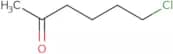
CAS:Produto Controlado<p>Please enquire for more information about 17-alpha,21-Dihydroxy-16-a-methylpregna-1,4,9(11)-triene-3,20-dione 21-acetate including the price, delivery time and more detailed product information at the technical inquiry form on this page</p>Fórmula:C24H30O5Pureza:Min. 95%Peso molecular:398.49 g/mol6-Chloro-2-hexanone
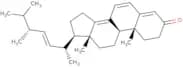
CAS:<p>6-Chloro-2-hexanone is an organic compound that is a methylcyclopentane with a carbonyl group. It can be synthesized by reacting hexamethylenetetramine, chloral hydrate, and 2-chlorobenzimidazole in the presence of ozone. 6-Chloro-2-hexanone has been used as a reagent for normalizing the content of methyl ketones in oil samples. The reaction products are chloride and 2-chlorobenzaldehyde. 6-Chloro-2-hexanone reacts with fatty acids to produce 3,6,9,12 octadecatrienoic acid. This product also has an analytical method that uses GC and flame ionization detection (FID) to measure the amount of chlorine atoms present in a sample. 6-Chloro-2-hexanone also has biological functions such as regulating the activity of enzymes involved in lipid metabolism and</p>Fórmula:C6H11ClOPureza:Min. 97%Cor e Forma:Clear LiquidPeso molecular:134.6 g/molErgosta-4,6,8(14),22-tetraen-3-one
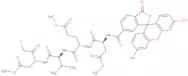
CAS:Produto Controlado<p>Ergosta-4,6,8(14),22-tetraen-3-one is a fatty acid that occurs naturally in the acetate extract of the kidney of sheep. It has been shown to induce apoptosis in cervical cancer cells and inhibit growth of bacteria by inhibiting energy metabolism. Ergosta-4,6,8(14),22-tetraen-3-one can be used as an antimicrobial agent because it has broad-spectrum activity against bacteria and fungi. This compound also has been found to be effective in treating kidney fibrosis. It has been shown to inhibit tubulointerstitial injury and plasma concentration–time curve by binding to human serum albumin.</p>Fórmula:C28H40OPureza:Min. 95%Peso molecular:392.62 g/molFluorescein-6-carbonyl-Asp(OMe)-Glu(OMe)-Val-DL-Asp(OMe)-fluoromethylketone
CAS:<p>Please enquire for more information about Fluorescein-6-carbonyl-Asp(OMe)-Glu(OMe)-Val-DL-Asp(OMe)-fluoromethylketone including the price, delivery time and more detailed product information at the technical inquiry form on this page</p>Fórmula:C43H45FN4O16Pureza:Min. 95%Peso molecular:892.83 g/molZ-Val-Asp(OMe)-Val-Ala-DL-Asp(OMe)-fluoromethylketone
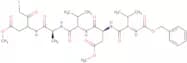
<p>Please enquire for more information about Z-Val-Asp(OMe)-Val-Ala-DL-Asp(OMe)-fluoromethylketone including the price, delivery time and more detailed product information at the technical inquiry form on this page</p>Fórmula:C32H46FN5O11Pureza:Min. 95%Peso molecular:695.73 g/mol4-(2-Bromoethyl)-1,3-dihydro-2H-indolin-2-one
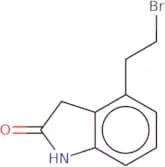
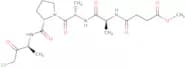
CAS:<p>Please enquire for more information about 4-(2-Bromoethyl)-1,3-dihydro-2H-indolin-2-one including the price, delivery time and more detailed product information at the technical inquiry form on this page</p>Fórmula:C10H10BrNOPureza:Min. 95%Cor e Forma:PowderPeso molecular:240.1 g/molMeOSuc-Ala-Ala-Pro-Val-chloromethylketone
CAS:<p>MeOSuc-Ala-Ala-Pro-Val-chloromethylketone is a serine protease inhibitor that has been shown to be effective against influenza virus and HIV. It was found to be active against a number of serine proteases, such as trypsin, chymotrypsin, and elastase. MeOSuc-Ala-Ala-Pro-Val-chloromethylketone also has chemotactic activity in thp1 cells and lung fibroblasts. It is activated by the addition of water and has been shown to inhibit the growth of soybean trypsin. However, it does not have any effect on human trypsin.</p>Fórmula:C22H35ClN4O7Pureza:Min. 95%Peso molecular:502.99 g/molZ-Phe-Ala-diazomethylketone
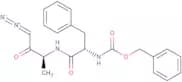
CAS:<p>Z-Phe-Ala-diazomethylketone is a molecule that belongs to the class of hydrolase inhibitors. It has been shown to have inhibitory properties against trichomonas vaginalis and proteolytic activity against liver cells. Z-Phe-Ala-diazomethylketone also has a kinetic energy of 11.2 kcal/mol, which is higher than most protease inhibitors. This molecule has been shown to be effective as a cell vaccine in wild-type mice and as a protease inhibitor in brain cells. The optimal ph for this molecule is 7.5, which corresponds to its pKa value of 5.1.</p>Fórmula:C21H22N4O4Pureza:Min. 95%Peso molecular:394.42 g/mol1-(3-Chloro-4-methoxyphenyl)acetone
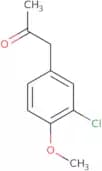
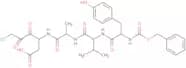
CAS:<p>1-(3-Chloro-4-methoxyphenyl)acetone is a white solid with a melting point of 60-61°C. It is a versatile building block that can be used in the synthesis of complex compounds and as a reaction component for the preparation of speciality chemicals. 1-(3-Chloro-4-methoxyphenyl)acetone has been studied extensively as an intermediate for the synthesis of pharmaceuticals, including acetaminophen and amoxicillin. This compound also has uses in research laboratories and as a reagent in organic synthesis.</p>Fórmula:C10H11ClO2Pureza:Min. 95%Peso molecular:198.65 g/molZ-Tyr-Val-Ala-Asp-chloromethylketone
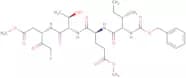
CAS:<p>Z-Tyr-Val-Ala-Asp-chloromethylketone is a fluorescent probe that can be used for the detection of phosphatidic acid. It is also an apoptosis inducer, which means that it promotes cell death. Z-Tyr-Val-Ala-Asp-chloromethylketone induces apoptosis by binding to the kinases and causing their activation, leading to phosphatidic acid production. This process is activated by the presence of ethylene, which binds to Z-Tyr-Val-Ala-Asp chloromethylketone and stabilizes its structure.</p>Fórmula:C30H37ClN4O9Pureza:Min. 95%Peso molecular:633.09 g/molZ-Ile-Glu(OMe)-Thr-DL-Asp(OMe)-fluoromethylketone
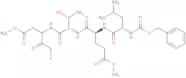
CAS:<p>Z-Ile-Glu(OMe)-Thr-DL-Asp(OMe)-fluoromethylketone is an apoptosis inducer that belongs to the category of small molecules. It has been shown to induce apoptosis in cells by binding to DNA and inhibiting transcription, leading to DNA fragmentation and the activation of caspase-8. Z-Ile-Glu(OMe)-Thr-DL-Asp(OMe)-fluoromethylketone has also been shown to have a synergistic effect on cells when combined with other potent inducers of apoptosis. This drug binds to toll receptors (TLR) and IL2 receptors, which are important for cell signaling pathways.</p>Fórmula:C30H43FN4O11Pureza:Min. 95%Peso molecular:654.68 g/molMeOSuc-Ala-Ala-Pro-Ala-chloromethylketone
CAS:<p>MeOSuc-Ala-Ala-Pro-Ala-chloromethylketone is a peptidyl substrate for the enzyme carboxypeptidase A. This substrate has a high specificity for carboxypeptidase A and does not bind to other enzymes such as carboxypeptidase B, D, or L. The hydrophobic nature of this substrate has been shown in both hamsters and macaques. MeOSuc-Ala-Ala-Pro-Ala-chloromethylketone also shows cardiovascular effects in both animal models. It is possible that this effect is due to the proteolytic activity of the enzyme. More research needs to be done to identify the sequence of this peptide and how it may affect humans.</p>Fórmula:C20H31ClN4O7Pureza:Min. 95%Peso molecular:474.94 g/molFluorescein-6-carbonyl-Val-Glu(OMe)-Ile-DL-Asp(OMe)-fluoromethylketone
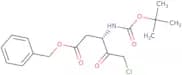
CAS:<p>Please enquire for more information about Fluorescein-6-carbonyl-Val-Glu(OMe)-Ile-DL-Asp(OMe)-fluoromethylketone including the price, delivery time and more detailed product information at the technical inquiry form on this page</p>Fórmula:C44H49FN4O14Pureza:Min. 95%Peso molecular:876.88 g/molBoc-Asp(OBzl)-chloromethylketone
CAS:<p>Boc-Asp(OBzl)-chloromethylketone is a synthetic molecule that is immunoreactive with gp120, the virus protein. It has been shown to inhibit the proliferation of human neuroblastoma cells and induce cell death. This compound also has an effect on cytokine production in vitro. This drug is currently being studied as a potential treatment for HIV infection. Boc-Asp(OBzl)-chloromethylketone binds to the receptor type and viral type, which are essential for the virus life cycle and induces antibody production in vivo.</p>Fórmula:C17H22ClNO5Pureza:Min. 95%Peso molecular:355.81 g/molZ-Leu-Glu(OMe)-Thr-DL-Asp(OMe)-fluoromethylketone
CAS:<p>Please enquire for more information about Z-Leu-Glu(OMe)-Thr-DL-Asp(OMe)-fluoromethylketone including the price, delivery time and more detailed product information at the technical inquiry form on this page</p>Fórmula:C30H43FN4O11Pureza:Min. 95%Peso molecular:654.68 g/mol

![3,6-Di(2-thienyl)-2,5-dihydropyrrolo[3,4-c]pyrrole-1,4-dione](/_next/image/?url=https%3A%2Fstatic.cymitquimica.com%2Fproducts%2F3D%2Fthumb-webp%2FFD62791.webp&w=3840&q=75)
![(2S)-2-Amino-4-methyl-1-[(2R)-2-methyloxiranyl]-1-pentanone trifluoroacetate](/_next/image/?url=https%3A%2Fstatic.cymitquimica.com%2Fproducts%2F3D%2Fthumb-webp%2FFA100028.webp&w=3840&q=75)