Aldeídos
Os aldeídos são compostos orgânicos que contêm um grupo carbonila (C=O) ligado a pelo menos um átomo de hidrogênio. Esses compostos versáteis são fundamentais em várias reações químicas, incluindo oxidação, redução e adição nucleofílica. Os aldeídos são building blocks essenciais na síntese de produtos farmacêuticos, fragrâncias e polímeros. Na CymitQuimica, oferecemos uma ampla seleção de aldeídos de alta qualidade para apoiar suas aplicações de pesquisa e industriais.
Foram encontrados 8573 produtos de "Aldeídos"
Ordenar por
Pureza (%)
0
100
|
0
|
50
|
90
|
95
|
100
Ref: 10-F857731
1g1.430,00€5g4.405,00€10g6.532,00€2.5g2.977,00€50mg394,00€100mg544,00€250mg775,00€500mg1.185,00€TERT-BUTYL 8-FORMYL-2,3-DIHYDRO-4H-BENZO[B][1,4]OXAZINE-4-CARBOXYLATE
Pureza:95%Peso molecular:263.29299932-Methyl-3-(3,4-methylenedioxyphenyl)propanal
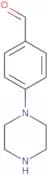
CAS:Fórmula:C11H12O3Pureza:99%+(GC-MS);RGCor e Forma:LiquidPeso molecular:192.2144-Piperazin-1-yl-benzaldehyde
CAS:<p>4-Piperazin-1-yl-benzaldehyde (PPBA) is a natural product that has been shown to have effects on animals and cells. PPBA can be used as an antidote for sulfite poisoning, which is caused by the ingestion of sulfites in food or drink. The mechanism of PPBA's effects is not fully known, but it may involve the inhibition of sulfite reductase, which converts sulfites into sulfates. It also reversibly forms a complex with the transition state of the reaction, enhancing the rate of this reaction. This enhancement is due to a low detection limit and shift in solution temperature. PPBA has been shown to have fluorescence and fluorescent properties when exposed to light, making it useful for endogenous labeling.</p>Fórmula:C11H14N2OPureza:Min. 95%Peso molecular:190.24 g/mol4-((4-methylphenyl)carbonyl)piperazinecarbaldehyde
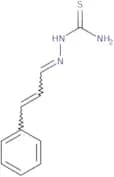
CAS:Please enquire for more information about 4-((4-methylphenyl)carbonyl)piperazinecarbaldehyde including the price, delivery time and more detailed product information at the technical inquiry form on this pagePureza:Min. 95%Cinnamaldehyde thiosemicarbazone
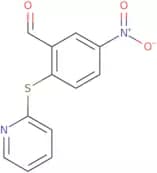
CAS:Cinnamaldehyde thiosemicarbazone is a nitrogen-containing molecule that has been shown to have neuroprotective properties. It is also an antioxidant and potent inhibitor of tyrosinase, which is an enzyme involved in the production of melanin. Cinnamaldehyde thiosemicarbazone has been shown to be effective at nanomolar concentrations in the inhibition of tyrosinase. This compound has been shown to be effective in both basic structure and magnetic resonance spectroscopy studies.Fórmula:C10H11N3SPureza:Min. 95%Cor e Forma:PowderPeso molecular:205.28 g/mol5-Nitro-2-(2'-pyridinethio)benzaldehyde
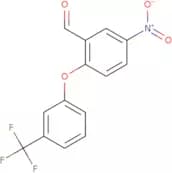
CAS:<p>Please enquire for more information about 5-Nitro-2-(2'-pyridinethio)benzaldehyde including the price, delivery time and more detailed product information at the technical inquiry form on this page</p>Pureza:Min. 95%2-(3-Trifluoromethylphenoxy)-5-nitrobenzaldehyde
CAS:<p>Please enquire for more information about 2-(3-Trifluoromethylphenoxy)-5-nitrobenzaldehyde including the price, delivery time and more detailed product information at the technical inquiry form on this page</p>Fórmula:C14H8F3NO4Pureza:Min. 95%Cor e Forma:PowderPeso molecular:311.21 g/molZolpidem carbaldehyde
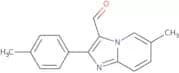
CAS:Zolpidem is a sedative-hypnotic drug, which belongs to the class of imidazopyridines. It has a strong affinity for GABA receptors, and can be used as a treatment for insomnia. Zolpidem's chemical structure is similar to that of benzodiazepines. Zolpidem is an acidic compound with a pKa of 3.6. It has been shown to elute from HPLC columns at a hydrodynamic flow rate of 0.5 mL/min on the column of LiChrosorb RP-18e (250 × 4 mm). The optimum pH for chromatographic separation was found to be 4-5. Multiresponse analysis showed statistically significant differences between different batches of zolpidem in terms of particle size, shape and size distribution, surface area and surface charge. Zolpidem carbaldehyde is an organic compound that is used as an intermediate in the production of drugs such as zolFórmula:C16H14N2OPureza:Min. 95%Peso molecular:250.3 g/mol

![[1,2,4]TRIAZOLO[1,5-A]PYRIDINE-7-CARBALDEHYDE](/_next/image/?url=https%3A%2Fstatic.cymitquimica.com%2Fproducts%2F10%2Fthumb-webp%2FF829859.webp&w=3840&q=75)



![TERT-BUTYL 8-FORMYL-2,3-DIHYDRO-4H-BENZO[B][1,4]OXAZINE-4-CARBOXYLATE](/_next/image/?url=https%3A%2Fstatic.cymitquimica.com%2Fproducts%2F10%2Fthumb-webp%2FF850892.webp&w=3840&q=75)
![4H,5H,6H-CYCLOPENTA[D][1,3]THIAZOLE-2-CARBALDEHYDE](/_next/image/?url=https%3A%2Fstatic.cymitquimica.com%2Fproducts%2F10%2Fthumb-webp%2FF852241.webp&w=3840&q=75)