Glicociência
Subcategorias de "Glicociência"
- Amino açúcares(108 produtos)
- Anticorpos Glico-Relacionados(283 produtos)
- Glicolípidos(46 produtos)
- Glicosaminoglicanos (GAGs)(55 produtos)
- Glicosídeos(419 produtos)
- Monossacáridos(6.617 produtos)
- Oligossacarídeos(3.718 produtos)
- Polissacáridos(505 produtos)
Foram encontrados 11021 produtos de "Glicociência"
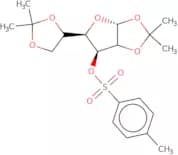
1,2:5,6-Di-O-isopropylidene-3-O-p-toluenesulfonyl-α-D-allofuranose
CAS:1,2:5,6-Di-O-isopropylidene-3-O-p-toluenesulfonyl-a-D-allofuranose is a synthetic carbohydrate with a 5 carbon backbone. The methylation of the C1 and C2 carbon atoms is required to obtain this compound. It is used in the synthesis of complex carbohydrates. This product can be custom synthesized on request and has a purity of 99%.
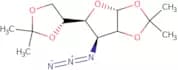
Fórmula:C19H26O8SPureza:Min. 95%Cor e Forma:White To Off-White SolidPeso molecular:414.47 g/mol3-Azido-3-deoxy-1,2:5,6-di-O-isopropylidene-α-D-allofuranose
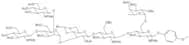
CAS:3-Azido-3-deoxy-1,2:5,6-di-O-isopropylidene-a-D-allofuranose is a custom synthesis. It is a polysaccharide that consists of repeating units of an alpha-(1->4) linked D-glucopyranose residue with a terminal alpha-(1->6) linked allose residue. 3-Azido-3-deoxy-1,2:5,6-di-O-isopropylidene--a--D--allofuranose has been modified by fluorination and methylation. It can be used in the synthesis of oligosaccharides or saccharides with different chemical structures and biological activities.Fórmula:C12H19N3O5Pureza:Min. 95%Peso molecular:285.3 g/mol4-Methoxyphenyl 4-O-{4-O-[[3-O-[2,4-di-O-(3,4,6-tri-O-acetyl-2-deoxy-2-phthalimido-β-D-glucopyranosyl)-3,6-di-O-benzyl-α-D-mannopyra nosyl]-4,6-O-benzylidene-2-O-levulinoyl-β-D-glucopyranosyl]]-3,6-di-O-benzyl-2-deoxy-2-phthalimido-β-D-glucopyranosyl}
4-Methoxyphenyl 4-O-{4-O-[3,6-di-O-(3,4,6-tri-O-acetyl-2-deoxy-2-phthalimido-bDglucopyranosyl)-2,4,6-trihydroxybenzylidene]-aDmannopyra nosyl} -3,6diO(benzyl) -2deoxy2phthalimido -bDglucopyranoside is a high purity synthetic oligosaccharide. It is a complex carbohydrate with a high degree of polymerization. This product has been synthesized by Click modification and fluorination. The product contains an acetate group at the reducing end of the sugar chain and may be glycosylated. The CAS number for this product isFórmula:C161H160N4O48Pureza:Min. 95%Peso molecular:2,918.99 g/molExopolysaccharide - from Bacillus polymixa
Bacterial exopolysaccharide from gram negative Bacillus polymixa
Fórmula:C23H36O18Pureza:Min. 95%Cor e Forma:PowderPeso molecular:600.52 g/molGD3-Ganglioside sodium
CAS:GD3 (shown as sodium salt) has a core disaccharide structure (Galβ1,4Glc) with two sialic acids linked α2,3/α2,8 to the non-reducing galactose residue and ceramide linked β to position 1 on the reducing terminal glucose residue (Ledeen, 2009). GD3 is a minor ganglioside in most normal tissues but plays a crucial role in the development of the brain; it is significantly reduced in adults. However, expression of GD3 is increased in pathological conditions, such as, cancers and neurodegenerative disorders (Malisan, 2002). GD3 was the first cancer-associated ganglioside discovered that promotes adhesion and invasion of cancers. GD3 and GD2 are highly expressed in a various malignant tumours and have become potential targets for next-generation cancer therapy (Liu, 2018).Fórmula:C70H125N3O29·xNaPureza:One SpotCor e Forma:White/Off-White SolidPeso molecular:1,472.74 g/molAdenosine-5'-b-D-galactopyranoside
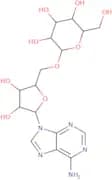
CAS:Adenosine-5'-b-D-galactopyranoside is a complex carbohydrate, which is a glycoconjugate consisting of an adenosine molecule linked to the sugar galactose by an alpha (1→4) glycosidic linkage. It is a methylated, fluorinated, and saccharide-modified analogue of adenosine monophosphate. Adenosine-5'-b-D-galactopyranoside is also known as 5'-Deoxyadenosine 5'-b-D-galactopyranoside or 3',5'-Diadenylic acid 5'-b-D-galactopyranoside. The compound can be custom synthesized in high purity with the desired modifications.Pureza:Min. 95%5-O-tert-Butyldimethylsilyl-1-chloro-2,3-O-isopropylidene-b-D-ribofuranose
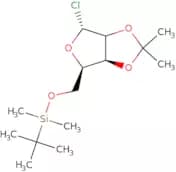
CAS:5-O-tert-Butyldimethylsilyl-1-chloro-2,3-O-isopropylidene-b-D-ribofuranose is a synthetic saccharide that can be used as a custom synthesis. It is an intermediate for the synthesis of glycosides and has been shown to be useful for the methylation of saccharides. This product is also known as 5,5'-dithiobis(2,4,6 trimethylphenyl) disulfide.Fórmula:C14H27ClO4SiPureza:Min. 95%Peso molecular:322.9 g/mol1,2,3,4-Tetra-O-pivaloyl-6-O-(tert-butyldiphenylsilyl)-a-D-mannopyranose
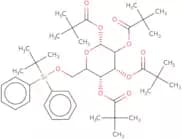
1,2,3,4-Tetra-O-pivaloyl-6-O-(tert-butyldiphenylsilyl)-a-D-mannopyranose is a glycosylated sugar that can be methylated and fluorinated. It has high purity and is custom synthesized for the synthesis of oligosaccharides. This sugar has CAS number 29091-01-9 and is used in the synthesis of polysaccharides.Fórmula:C42H62O10SiPureza:Min. 95%Peso molecular:755.02 g/mol3,6-Di-O-acetyl-γ-cyclodextrin
This gamma-cyclodextrin (γ-CD) derivative is a modified cyclic oligosaccharide composed of eight glucose units, featuring a larger cavity size than α- and β-cyclodextrins. This structural characteristic allows γ-CDs to form inclusion complexes with a wider range of guest molecules, making it particularly versatile in various industries. In the food sector, it is used as a carrier and stabilizer for flavors, fat-soluble vitamins, and polyunsaturated fatty acids, protecting volatile compounds from evaporation. In pharmaceuticals, it enhances the solubility and bioavailability of poorly water-soluble drugs and, thanks to its larger ring size, allows for the encapsulation of larger molecules or even entire drug molecules. γ-CDs and derivatives are also used for environmental remediation and, in analytical chemistry, for the extraction and concentration of target substances.Fórmula:C80H112O56Pureza:Min. 95%Peso molecular:1,969.71 g/molAllyl 3-O-benzyl-2-O-chloroacetyl-a-L-rhamnopyranoside
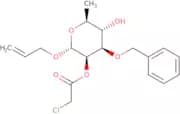
CAS:Allyl 3-O-benzyl-2-O-chloroacetyl-a-L-rhamnopyranoside is a carbohydrate that belongs to the group of modified saccharides. It is a synthetic monosaccharide that can be used in the synthesis of complex carbohydrates and oligosaccharides. The fluorination at C1 position gives this compound high water solubility and improved stability. CAS No. 943307-50-4, Custom synthesis, High purity, Methylation, Glycosylation, Click modification.Fórmula:C18H23ClO6Pureza:Min. 95%Peso molecular:370.83 g/mol2-O-(2-Acetamido-2-deoxy-β-D-glucopyranosyl)-D-mannopyranose
CAS:2-O-(2-Acetamido-2-deoxy-b-D-glucopyranosyl)-D-mannopyranose is a disaccharide that contains two acetamides. It has a glycosidic bond and is classified as a glycoside. This compound has the same sequence of residues as D-mannose, but one less carbon atom. The acetamides form an ester linkage to the 2’ and 3’ hydroxyl groups on the sugar moiety.
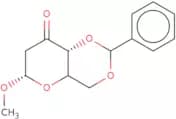
Fórmula:C14H25NO11Pureza:Min. 95%Cor e Forma:PowderPeso molecular:383.35 g/molMethyl 4,6-O-benzylidene-2-deoxy-a-D-glucpyranosid-3-ulose
CAS:Methyl 4,6-O-benzylidene-2-deoxy-a-D-glucpyranosid-3-ulose is a custom synthesis of a complex carbohydrate. It is an Oligosaccharide with a Polysaccharide backbone. The modification of the saccharide is Methylation and Glycosylation. Click chemistry was used to introduce fluorine atoms into the sugar ring. The Carbohydrate is a sugar, which is a chemical compound that consists of carbon, hydrogen and oxygen atoms. It has high purity and fluoroination at the C1 position. This synthetic product can be used in various applications such as food additives, pharmaceuticals, or agrochemicals.Fórmula:C14H16O5Pureza:Min. 95%Peso molecular:264.27 g/molKojipentaose
CAS:Kojipentaose is a glycosidic oligosaccharide that is synthesized by the enzyme phosphorylase. It is an important nutrient for many organisms, including bacteria and fungi. Kojipentaose has been found to be synthesized from the terminal sugars of teichoic acids in both Gram-positive and Gram-negative bacteria. The stereoselectivity of the synthesis may be due to enzymatic activity or the availability of chiral substrates.
Fórmula:C30H52O26Pureza:Min. 95%Peso molecular:828.72 g/mol6'-Sialylgalactose sodium salt
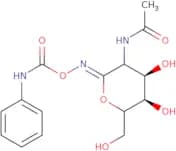
CAS:Sialylated oligosaccharide with the ability to inhibit angiogenesis and tumour development by binding to the vascular endothelial growth factor receptor VEGFR-2. Moreover, sialylated N-glycans in intestinal epithelium of chickens were found to carry terminal sialylgalactose, which interacts with influenza viruses during early stages of infection.Fórmula:C17H28NO14·NaPureza:Min. 95%Cor e Forma:PowderPeso molecular:493.39 g/molGalacto-PUGNAc
CAS:Galacto-PUGNAc is an oligosaccharide with a complex carbohydrate structure. It is synthesized from galactose and pyranose, which are sugars that belong to the group of carbohydrates. Galacto-PUGNAc is modified by methylation, glycosylation, and fluorination. The chemical modification of this compound provides it with high purity and fluorescence properties. Click chemistry is also used in its synthesis, which involves the use of reactive species that contain azides or alkyne groups. This modification increases the stability of the compound, making it a useful tool for molecular biology and biochemistry research.Fórmula:C15H19N3O7Pureza:Min. 75 Area-%Cor e Forma:PowderPeso molecular:353.33 g/mol2-C-Azidomethyl-2,3-O-isopropylidene-L-erythrono-1,4-lactone
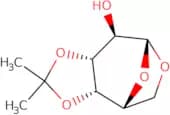
2-C-Azidomethyl-2,3-O-isopropylidene-L-erythrono-1,4-lactone is a glycosylation agent that can be used in the synthesis of saccharide and oligosaccharide. It has been shown to react with various carbohydrates by methylation, click modification, and fluorination. 2CAS is also able to modify polysaccharides. This compound is synthesized from erythronolide B and azidomethane, which are both commercially available compounds. The high purity of this product makes it ideal for use in industries such as pharmaceuticals and biotechnology.Pureza:Min. 95%1,6-Anhydro-3,4-O-isopropylidene-b-D-galactopyranose
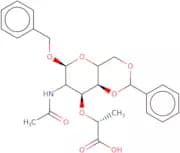
CAS:1,6-Anhydro-3,4-O-isopropylidene-b-D-galactopyranose is a custom synthesis of a complex carbohydrate that has been modified with methylation and glycosylation. It is a saccharide with the CAS number 52579-97-2. This product is highly pure and can be fluorinated for synthesizing other sugars or carbohydrates. The purity of this product is greater than 98%.Fórmula:C9H14O5Pureza:Min. 95%Cor e Forma:White PowderPeso molecular:202.2 g/molBenzyl 2-acetamido-4,6-O-benzylidene-2-deoxy-α-D-muramic acid
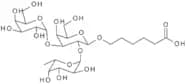
CAS:Benzyl 2-acetamido-4,6-O-benzylidene-2-deoxy-a-D-muramic acid is an analog of benzyl 2-acetamido-4,6-O-benzylidene-2,3,5,6 tetra deoxy a -D muramic acid. It is activated by ethyl bromoacetate and can be conjugated with various biological molecules such as proteins or peptides. The biological properties of this compound have been studied in bioassays. This analog has shown to have anticancer effects and also has anorectic effects in rats. It also inhibits the growth of cancer cells that are resistant to other anticancer drugs. Benzyl 2 acetamido 4,6 O benzylidene 2 deoxy a D muramic acid has also been shown to inhibit pancreatic tumor growth in mice without causing any toxicity to the pancreas.br> BenzFórmula:C25H29NO8Pureza:Min. 95%Cor e Forma:PowderPeso molecular:471.5 g/molBlood Group B trisaccharide-(CH2)5COOH derivative
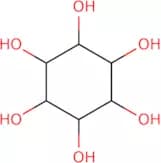
Blood group antigen with spacer armFórmula:C24H42O17Pureza:Min. 95%Cor e Forma:Brown LiquidPeso molecular:602.58 g/molcis-Inositol
CAS:Inositol is a member of the B-vitamin family and is classified as a sugar alcohol. It has a structural similarity to glucose and can be synthesized by plants, bacteria, and mammals. Inositol is found in high concentrations in the brain and liver. Inositol has been shown to inhibit guanine nucleotide-binding proteins (G proteins) and ryanodine receptor channels in HL-60 cells. It also inhibits cancer cell proliferation and suppresses ovarian activity. Inositol appears to work by binding to the inositol-1,4,5-trisphosphate receptor on the surface of cells, thereby inhibiting intracellular calcium release from its storage site within the endoplasmic reticulum. The effects of inositol are mediated by dinucleotide phosphate or p-nitrophenyl phosphate.
Fórmula:C6H12O6Pureza:Min. 90 Area-%Cor e Forma:PowderPeso molecular:180.16 g/mol