Glicociência
A glicociência é o estudo dos carboidratos e seus derivados, bem como das interações e funções biológicas em que participam. Este campo de pesquisa é crucial para compreender uma ampla variedade de processos biológicos, incluindo o reconhecimento celular, a sinalização, a resposta imune e o desenvolvimento de doenças. A glicociência tem aplicações importantes na biotecnologia, na medicina e no desenvolvimento de novos medicamentos e terapias. Na CymitQuimica, oferecemos uma ampla seleção de produtos de alta qualidade e pureza para pesquisa em glicociência. Nosso catálogo inclui monossacarídeos, oligossacarídeos, polissacarídeos, glicoconjugados e reagentes específicos, projetados para apoiar os pesquisadores em seus estudos sobre a estrutura, função e aplicações dos carboidratos em sistemas biológicos. Esses recursos são destinados a facilitar descobertas científicas e aplicações práticas em diversas áreas das biociências e da medicina.
Subcategorias de "Glicociência"
- Amino açúcares(108 produtos)
- Anticorpos Glico-Relacionados(282 produtos)
- Glicolípidos(46 produtos)
- Glicosaminoglicanos (GAGs)(55 produtos)
- Glicosídeos(419 produtos)
- Monossacáridos(6.624 produtos)
- Oligossacarídeos(3.682 produtos)
- Polissacáridos(503 produtos)
Foram encontrados 11046 produtos de "Glicociência"
Ordenar por
Pureza (%)
0
100
|
0
|
50
|
90
|
95
|
100
7-Deoxy-1,2:3,4:5,6-tri-O-isopropylidene-D-glycero-L-ido-heptitol
The 7-Deoxy-1,2:3,4:5,6-tri-O-isopropylidene-D-glycero-L-ido-heptitol is a synthetic oligosaccharide that can be custom synthesized for research purposes. It is composed of the sugar monomers 6,7-dideoxyglucose and 1,2:3,4:5,6-tetraisopropyldecaonol. The 7DG and 1,2:3,4:5,6TIDCA are linked together via an alpha(1→4) glycosidic linkage. This product has been fluorinated to increase its stability in aqueous solutions. br>br> The 7DG and 1,2:3,4:5,6TIDCA monomers are connected by an alpha(1→4) glycosidic linkage. The structuralPureza:Min. 95%N-(Benzyl malonoate-1-yl)-2-amino-2-deoxy-3,5:6,7-di-O-isopropylidene-D-glycero-D-ido-heptono-1.4-lactone
N-(Benzyl malonoate-1-yl)-2-amino-2-deoxy-3,5:6,7-di-O-isopropylidene-D-glycero-D-idoheptono -1.4 -lactone is a synthetic compound that has been modified with fluorination and methylation. It is a monosaccharide that has been synthesized through a click modification and glycosylation. The CAS number for this compound is not available but it is classified as an oligosaccharide and saccharide. This carbohydrate has an average molecular weight of 647.1 g/mol and the structure contains 16 carbons, 36 hydrogens, 1 oxygen, and 2 nitrogens.Pureza:Min. 95%2-Azidomethyl-2-deoxy-3,4-O-isopropylidene-4-C-methyl-L-ribono-1.5-lactone
<p>2-Azidomethyl-2-deoxy-3,4-O-isopropylidene-4-C-methyl-L-ribono-1.5-lactone is a modification of the sugar molecule ribose. It is synthesized by the methylation of 2,6 anhydroglucose with formaldehyde and sodium azide in methanol. This modification prevents the formation of cyclic hemiacetals and epimerization reactions that may occur during glycosylation or polysaccharide formation. 2A diol has been used as a model for oligosaccharides, carbohydrates, and complex carbohydrates. It is highly purified, has a CAS number, and can be used in custom synthesis projects.</p>Pureza:Min. 95%Methyl β-L-arabinopyranoside
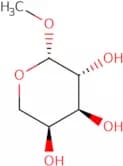
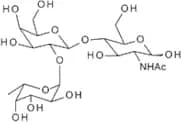
CAS:<p>Methyl β-L-arabinopyranoside is a stereochemically pure monosaccharide that has been used to calibrate and quantify the conformational, stereochemical, and spectrometric methods. Methyl β-L-arabinopyranoside has a conformation that is restricted by the presence of an α-hydroxyl group at C2. The chloride ion can be used to monitor this conformation. The diameter of methyl β-L-arabinopyranoside can be measured with a micropipette and monitored using an aerosol detector. Methyl β-L-arabinopyranoside can also be quantified by mass spectrometry or spectrophotometry. The conformational, stereochemical, and spectrometric methods have been calibrated using methyl β-L-arabinopyranoside as a standard to determine their accuracy in measuring the size of other molecules.</p>Fórmula:C6H12O5Pureza:Min. 95%Cor e Forma:White Off-White PowderPeso molecular:164.16 g/molBlood group H type II trisaccharide
CAS:Core antigen fragment in ABO blood group systemFórmula:C20H35NO15Pureza:Min. 95%Cor e Forma:White PowderPeso molecular:529.5 g/mol(2S, 3S, 4S) -1-Butyl-4- (hydroxymethyl) - 3- (phenylmethoxy) - 2- azetidinecarboxylic acid, methyl ester
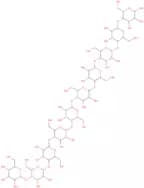
(2S, 3S, 4S) -1-Butyl-4- (hydroxymethyl) - 3- (phenylmethoxy) - 2- azetidinecarboxylic acid, methyl ester is a product that can be custom synthesized. It can be used for the modification of complex carbohydrates, for example oligosaccharides and polysaccharides. This product has been fluorinated to improve its stability and modify saccharide linkages. The hydroxy methyl group at C2 position in this product is capable of being modified with Click chemistry.Pureza:Min. 95%Maltodecaose, min 98%
CAS:α 1,4-glucodecasaccharide derived from starch by hydrolysis and chromatographyFórmula:C60H102O51Pureza:Min. 98 Area-%Cor e Forma:White PowderPeso molecular:1,639.42 g/molOctyl β-D-thioglucopyranoside
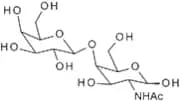
CAS:Non-denaturing, non-ionic detergent for membrane protein solubilisation. Previously under code O-2710 and DO06354.Fórmula:C14H28O5SPureza:Min. 98 Area-%Peso molecular:308.44 g/mol2-Acetamido-2-deoxy-4-O-(b-D-galactopyranosyl)-D-galactopyranose
CAS:2-Acetamido-2-deoxy-4-O-(b-D-galactopyranosyl)-D-galactopyranose is a glycan that binds to human lymphocytes and induces their death. It is a glycan that has been shown to be sialylated, which may be due to its high degree of homology with other glycan structures. The 2-acetamido group confers the ability to bind to sialyltransferases, which are enzymes that catalyze the transfer of sialic acid from glucose onto complex carbohydrates. This binding inhibits the enzymatic activity of these enzymes and prevents the addition of sialic acid onto oligosaccharides, preventing antigen presentation. 2-Acetamido-2-deoxy-4-O-(b-D-galactopyranosyl)-D-galactopyranose is also known as "sialic acid" or "Fórmula:C14H25NO11Pureza:Min. 90 Area-%Cor e Forma:PowderPeso molecular:383.35 g/molTragacanth gum
CAS:Gum tragacanth is an exudate gum from species of Astragalus trees mainly grown in Iran and Turkey. Tragacanth finds applications as an effective emulsifying and thickening agent in the food and pharmaceutical industries. The gum is a slightly acidic salt consisting of two fractions namely the water soluble tragacanthin and the fraction bassorin which swells in water to form a gel. Water soluble tragacanthin is reported as a branched arabiogalactan which is soluble in 70% ethanol. The acidic bassorin has a chain of (1,4)-linked a-D-galacturonic acid units some of which are substituted at O-3 with β-D-xylopyranosyl units and some of these being terminated with galactose or fucose.Cor e Forma:White Powder2,3,4,6-Tetra-O-acetyl-1-deoxy-D-arabino-hex-1-enopyranose
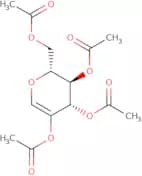
CAS:Tetra-O-acetyl-1-deoxy-D-arabinohexopyranose is a boron trifluoride etherate method for the synthesis of tetraacetylated 1-deoxyhexopyranoses. The yield of this reaction is dependent on the formamide concentration and the hydrogenation time. When formamide is used, the yields are greater than when it is not. This product can be used in a variety of reactions such as the synthesis of 2,3,4,6-tetraiodo-, 2,3,4,6-tetrahalogeno-, or 2,3,4,-trihalogeno hexoses by substitution with iodine or chlorine. Tetraacetylated 1-deoxyhexopyranoses can also be used to synthesize ethanethiols and other alcohols by elimination reactions.Fórmula:C14H18O9Cor e Forma:White PowderPeso molecular:330.29 g/molMethyl 2,3:4,6-di-O-isopropylidene-D-mannopyranoside
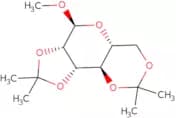
CAS:Methyl 2,3:4,6-di-O-isopropylidene-D-mannopyranoside is a synthetic glycosylate sugar that has been modified with fluorination. It is a monosaccharide that is used in the synthesis of complex carbohydrates. Click modification of this molecule has been performed to yield high purity and desired modifications. CAS number 50705-56-1.Fórmula:C13H22O6Pureza:Min. 95%Cor e Forma:PowderPeso molecular:274.31 g/mol3,5-Dideoxy-N-(1-hexyl)-3,5-imino-D-xylopentitol
<p>3,5-Dideoxy-N-(1-hexyl)-3,5-imino-D-xylopentitol is a synthetic monosaccharide that is used in the production of complex carbohydrates. It can be modified with fluorination and methylation to produce 3,5-dideoxy-N-(1-hexyl)-3,5-[(2-[(2,6-difluoro phenoxy)methyl]phenyl]imino)D-xylopentitol. The compound has been shown to have antiviral properties and has been used in the synthesis of glycosaminoglycans.</p>Pureza:Min. 95%4-Methoxyphenyl 3-O-benzyl-a-D-mannopyranoside
CAS:4-Methoxyphenyl 3-O-benzyl-a-D-mannopyranoside is a synthetic carbohydrate that has been modified with a click reaction. It is an Oligosaccharide, which is a type of Carbohydrate, and has a saccharide sequence. This product is used in the synthesis of complex carbohydrates. The product has high purity and custom synthesis capabilities.Fórmula:C20H24O7Pureza:Min. 95%Peso molecular:376.4 g/mol2-O-Methyl-D-glucose
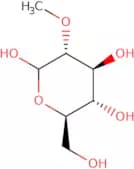
CAS:2-O-Methyl-D-glucose is an aldohexose that is used in the synthesis of a number of biological compounds. It has been shown to inhibit the growth of cancer cells by interfering with the synthesis of fatty acids and proteins.Fórmula:C7H14O6Pureza:Min. 95%Cor e Forma:PowderPeso molecular:194.18 g/molMethyl 4,6-O-benzylidene-2-benzyloxycarbonylamino-2-deoxy-a-D-glucopyranose
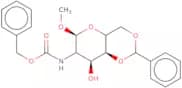
CAS:Methyl 4,6-O-benzylidene-2-benzyloxycarbonylamino-2-deoxy-a-D-glucopyranose is a custom synthesized compound. It is a polysaccharide that is modified with fluorine and methyl groups. The chemical structure of this compound includes a glucose molecule with an amino group at the C1 position and an acetyl group at the C4 position. This modification increases the solubility and stability of this compound. Methyl 4,6-O-benzylidene-2-benzyloxycarbonylamino-2-deoxy--A D glucopyranose has been used in research as a model for glycosylation.Fórmula:C22H25NO7Pureza:Min. 95%Peso molecular:415.44 g/molD-Ribose, 99.0%+
CAS:D-Ribose is a pentose sugar that is the ribose sugar of D-arabinose. It is an inhibitor of bacterial growth and has been shown to inhibit binding of adenine nucleotides to their receptors in the human erythrocyte membrane. Ribose plays a vital role in energy metabolism, as it is a component of ATP and NADH. It also participates in the synthesis of DNA and RNA. Ribose can be found in many foods, such as pears, apples, potatoes, and rice. D-ribose has been shown to have significant cytotoxicity against cancer cells that are dependent on glycolysis for their energy needs. D-Ribose may also be used as a polymerase chain reaction (PCR) substrate to determine the presence of infectious diseases such as HIV or hepatitis C virus in human serum samples.Fórmula:C5H10O5Pureza:Min. 99.0 Area-%Peso molecular:150.13 g/molRef: 3D-R-5495
1kgA consultar100gA consultar250gA consultar500gA consultar2500gA consultar-Unit-kgkgA consultarBlood group B hexasaccharide type II
Core antigen fragment in ABO blood group systemFórmula:C38H65NO30Pureza:Min. 90%Cor e Forma:PowderPeso molecular:1,015.93 g/molUDP-3-O-(R-3-hydroxydecanoyl)-GlcNAc sodium salt
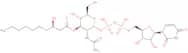
CAS:<p>Substrate for UDP-3-O-acyl-GlcNAc deacetylase</p>Fórmula:C27H43N3O19P2·xNaPureza:Min. 90 Area-%Cor e Forma:White Off-White Solidified MassPeso molecular:777.6 g/mol2,3:5,6-Di-O-isopropylidene-α-D-mannofuranose
CAS:2,3:5,6-Di-O-isopropylidene-a-D-mannofuranose is a nutrient solution that can be used in tissue culture. It is a complex sugar with an active hydroxyl group and a hydrogen bond. This compound has been shown to have antiviral activity against HIV in the laboratory. 2,3:5,6-Di-O-isopropylidene-a-D-mannofuranose is also able to inhibit the growth of liver cells and can be used for diagnostic purposes.Fórmula:C12H20O6Pureza:Min. 95%Cor e Forma:PowderPeso molecular:260.28 g/mol