Glicociência
A glicociência é o estudo dos carboidratos e seus derivados, bem como das interações e funções biológicas em que participam. Este campo de pesquisa é crucial para compreender uma ampla variedade de processos biológicos, incluindo o reconhecimento celular, a sinalização, a resposta imune e o desenvolvimento de doenças. A glicociência tem aplicações importantes na biotecnologia, na medicina e no desenvolvimento de novos medicamentos e terapias. Na CymitQuimica, oferecemos uma ampla seleção de produtos de alta qualidade e pureza para pesquisa em glicociência. Nosso catálogo inclui monossacarídeos, oligossacarídeos, polissacarídeos, glicoconjugados e reagentes específicos, projetados para apoiar os pesquisadores em seus estudos sobre a estrutura, função e aplicações dos carboidratos em sistemas biológicos. Esses recursos são destinados a facilitar descobertas científicas e aplicações práticas em diversas áreas das biociências e da medicina.
Subcategorias de "Glicociência"
- Amino açúcares(108 produtos)
- Anticorpos Glico-Relacionados(284 produtos)
- Glicolípidos(46 produtos)
- Glicosaminoglicanos (GAGs)(55 produtos)
- Glicosídeos(419 produtos)
- Monossacáridos(6.622 produtos)
- Oligossacarídeos(3.699 produtos)
- Polissacáridos(506 produtos)
Foram encontrados 11035 produtos de "Glicociência"
Ordenar por
Pureza (%)
0
100
|
0
|
50
|
90
|
95
|
100
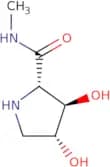
(2S, 3R, 4R) -3, 4- Dihydroxy- N- methyl- 2- pyrrolidinecarboxami de
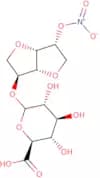
CAS:(2S, 3R, 4R) -3, 4-Dihydroxy-N-methyl-2-pyrrolidinecarboxamide is a synthetic sugar that has been synthesized for the modification of complex carbohydrates. The compound has a CAS number of 1394841-58-7 and can be used to decrease the rate of glycosylation reactions by removing hydroxyl groups from saccharides or oligosaccharides. This compound is typically synthesized by methylation and glycosylation. It is also possible to click modify this product with an azide group. Click modifications are reversible and produce no side products.Pureza:Min. 95%Isosorbide 5-mononitrate 2-b-D-glucuronide
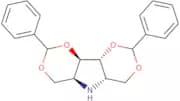
CAS:Isosorbide 5-mononitrate 2-b-D-glucuronide is a reconstituted form of Isosorbide 5-mononitrate. It is used in the treatment of congestive heart failure and angina pectoris. The drug is a nitrovasodilator that relaxes smooth muscle cells, increasing blood flow to the heart. It has been shown to be effective in reducing the frequency of angina attacks and improving exercise tolerance. Isosorbide 5-mononitrate 2-b-D-glucuronide may also have beneficial effects on other cardiovascular diseases such as coronary heart disease, heart attack, or high blood pressure.Fórmula:C12H17NO12Pureza:Min. 95%Peso molecular:367.26 g/mol1,3:4,6-Di-O-benzylidene-2,5-dideoxy-2,5-imino-L-iditol
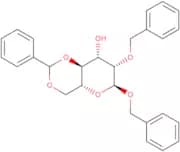
CAS:1,3:4,6-Di-O-benzylidene-2,5-dideoxy-2,5-imino-L-iditol is a synthetic oligosaccharide that can be used as a glycosylation probe. It has been shown to have high purity and good stability in the presence of strong acids and bases. The methyl group on the benzene ring can be replaced with other functional groups such as fluoro or chloro. This product is also available in custom synthesis for those who need it.Fórmula:C20H21NO4Pureza:Min. 95%Cor e Forma:White PowderPeso molecular:339.39 g/mol1,2-Di-O-benzyl-4,6-O-benzylidene-a-D-mannopyranoside
CAS:1,2-Di-O-benzyl-4,6-O-benzylidene-a-D-mannopyranoside is a custom synthesis that belongs to the class of polysaccharides. It is a synthetic modification of D-mannose. The 1,2 position on the glucose moiety has been fluorinated and the 6 position on the mannose moiety has been methylated. This sugar is a monosaccharide with a molecular weight of 587. The glycosylation pattern includes saccharide units linked by glycosidic bonds between the 1 and 2 positions on adjacent sugars in linear or branched chains. This product can be used as an intermediate for other syntheses or as a pharmaceutical drug.Fórmula:C27H28O6Pureza:Min. 95%Peso molecular:448.51 g/mol3-Deoxy-D-arabino-hexonic acid calcium salt
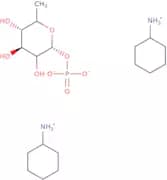
CAS:3-Deoxy-D-arabino-hexonic acid calcium salt is a synthetic, modified monosaccharide that is used as a glycosylation or polysaccharide modification. It has been shown to have high purity and can be custom synthesized to meet the needs of your application. 3-Deoxy-D-arabino-hexonic acid calcium salt has been shown to have strong anti-tumor activity and is an important part of cancer treatment. This compound can be methylated for use in click chemistry reactions.Fórmula:C12H24CaO12Pureza:Min. 95%Peso molecular:400.39 g/molb-L-Fucose-1-phosphate bis(cyclohexylammonium) salt
CAS:b-L-Fucose-1-phosphate bis(cyclohexylammonium) salt is a synthetic, fluorinated monosaccharide that is used in the synthesis of oligosaccharides, polysaccharides and glycoproteins. The compound can be modified using click chemistry. It has been synthesized by reacting b-D-fucose with 2 equivalents of cyclohexylamine in the presence of BF3.Fórmula:C6H11O8P·2C6H14NPureza:Min. 95%Cor e Forma:White PowderPeso molecular:442.48 g/molMethyl 2,3,4,6-tetra-O-acetyl-α-D-glucopyranoside
CAS:Methyl 2,3,4,6-tetra-O-acetyl-a-D-glucopyranoside is a custom synthesis. It is a fluorinated sugar that can be modified with methyl groups and acetyl groups. Methyl 2,3,4,6-tetra-O-acetyl-a-D-glucopyranoside has been used in the synthesis of oligosaccharides and saccharides. This compound can also be glycosylated with other sugars to form complex carbohydrates.Fórmula:C15H22O10Pureza:Min. 95%Cor e Forma:PowderPeso molecular:362.33 g/mol4-Methylphenyl β-D-thiogalactopyranoside
CAS:4-Methylphenyl β-D-thiogalactopyranoside is a custom synthesis. The chemical is an Oligosaccharide, Polysaccharide, Modification, saccharide, Methylation, Glycosylation, Carbohydrate that has been Fluorinated and Synthetically Modified. It is a High purity product with the CAS No. 28244-98-6.Fórmula:C13H18O5SPureza:Min. 95%Cor e Forma:White Off-White PowderPeso molecular:286.35 g/mol3,4:5,6-Di-O-Isopropylidene-L-idonic acid methyl ester
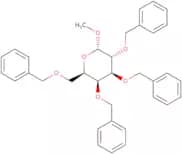
3,4:5,6-Di-O-Isopropylidene-L-idonic acid methyl ester (DIPIM) is a synthetic carbohydrate that is used in the modification of saccharides and oligosaccharides. DIPIM is a fluorinated monosaccharide that can be synthesized by the click chemistry reaction. It is highly pure, with a purity level of 99.9%. DIPIM has been shown to react with glycosyl acceptors to form glycosyl derivatives. This compound also has potential in the design of new therapeutic agents for cancer treatment.Pureza:Min. 95%Methyl 2,3,4,6-tetra-O-benzyl-α-D-galactopyranoside
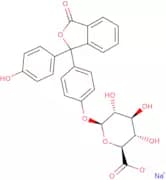
CAS:Methyl 2,3,4,6-tetra-O-benzyl-α-D-galactopyranoside (MBGT) is a pharmaceutical that belongs to the class of aziridines. It has shown high light emission properties at temperatures between 25 and 50 °C. MBGT has been used as a shift reagent for the analysis of carbohydrates and glycols. The spectral shift exhibited by MBGT is due to the resonance stabilization of the molecule's excited state. This effect is increased by hydrogen peroxide, which acts as an oxidant and stabilizes the excited state via electron transfer. A bathochromic shift was observed in aqueous solutions at pH 4.5 when methyl 2,3,4,6-tetra-O-benzyl-α-D-galactopyranoside was combined with potassium hydroxide or sodium hydroxide as a base.Fórmula:C35H38O6Pureza:Min. 98 Area-%Cor e Forma:PowderPeso molecular:554.67 g/molPhenolphthalein b-D-glucuronic acid sodium salt
CAS:beta-glucuronidase substrateFórmula:C26H22O10NaPureza:Min. 95 Area-%Cor e Forma:Yellow PowderPeso molecular:517.44 g/mol2-Azidoethyl 2-O-(2-acetamido-2-deoxy-b-D-glucopyranosyl)-a-D-mannopyranoside
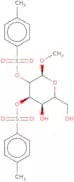
2-Azidoethyl 2-O-(2-acetamido-2-deoxy-b-D-glucopyranosyl)-a-D-mannopyranoside is a carbohydrate that is a modification of the saccharide oligosaccharide. It has been synthesized by custom synthesis and has high purity, methylation, glycosylation and click modification.Fórmula:C16H28N4O11Pureza:Min. 95%Peso molecular:452.41 g/molMethyl 2,3-di-O-p-toluenesulfonyl-a-D-glucopyranoside
Methyl 2,3-di-O-p-toluenesulfonyl-a-D-glucopyranoside is a high purity, custom synthesis sugar that is used in glycosylation and modification. It has a CAS number of 83792-07-4 and can be synthesized from methyl p-toluenesulfonate, D-glucose, and sodium hydroxide. Methyl 2,3-di-O-p-toluenesulfonyl-a-Dglucopyranoside has been shown to react with fluorine to form fluoro derivatives. This compound reacts with glycosylations and modifications such as methylation or acetylation. It is also an oligosaccharide that is composed of monosaccharides and saccharides.
Fórmula:C21H26O10S2Pureza:Min. 95%Peso molecular:502.56 g/mol(2S,3R,4R,5S)-3-O-Benzyl-3,4,5-trihydroxypiperidine-2-carboxylic acid
(2S,3R,4R,5S)-3-O-Benzyl-3,4,5-trihydroxypiperidine-2-carboxylic acid is a synthetic compound. It is a fluorinated glycosylated oligosaccharide with the molecular formula C14H21FNO6. This compound has been modified with methylation, monosaccharide and polysaccharide modifications. It is also a complex carbohydrate that can be custom synthesized and purified to high purity. CAS No.: 366864-11-1Pureza:Min. 95%2,4,7,8,9-Penta-O-acetyl N-acetylneuraminic acid
CAS:2,4,7,8,9-Penta-O-acetyl N-acetylneuraminic acid is a modification of the carbohydrate 2,4,7,8,9-penta-O-acetyl N-acetylneuraminic acid. It is a complex carbohydrate that is custom synthesized to meet the needs of specific customers. This product can be used for the synthesis of oligosaccharides and polysaccharides in glycosylation reactions. It can also be modified with methylation and fluorination. 2,4,7,8,9-Penta-O-acetyl N-acetylneuraminic acid has high purity and is monosaccharide. It also has an acetate group on its sugar chain at position 9. This product can be used as a sugar or in click chemistry reactions because it contains an amine group at position 8.Fórmula:C21H29NO14Pureza:Min. 95%Cor e Forma:PowderPeso molecular:519.45 g/molN- (2, 5-Anhydro- 3- azido- 3- deoxy-4,6-di-O-acetyl- D- altronoyl) - 2, 5- anhydro- 3- amino- 3- deoxy-4,6-di-O-acetyl- D- altronic acid methyl ester
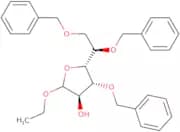
N- (2, 5-Anhydro- 3- azido- 3- deoxy-4,6-di-O-acetyl- D- altronoyl) - 2, 5- anhydro- 3- amino -3,6 di O acetyl -D altronic acid methyl ester is a glycosylation compound that is synthesized by modifying the corresponding nitrophenol with methylamine. It has a CAS number of 1205843.Pureza:Min. 95%Ethyl 3,5,6-tri-O-benzyl-D-glucofuranoside
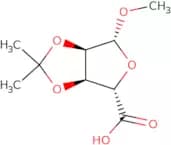
CAS:Ethyl 3,5,6-tri-O-benzyl-D-glucofuranoside is a modification of the natural carbohydrate D-glucose and has been synthesized by methylation. This product has a purity of 99% and is made up of three monosaccharides: D-glucose, D-mannose, and D-galactose. It also contains an oligosaccharide chain that consists of 6 sugar units. Ethyl 3,5,6-tri-O-benzyl-D-glucofuranoside is insoluble in water but soluble in acetone. The molecular weight of this product is 522.2 g/mol.Fórmula:C29H34O6Pureza:Min. 95%Cor e Forma:Yellow Clear LiquidPeso molecular:478.58 g/mol2,3-O-Isopropylidene-1-O-methyl-D-ribosic acid
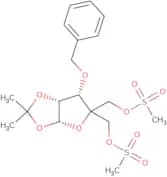
CAS:2,3-O-Isopropylidene-1-O-methyl-D-ribosic acid is a synthetic glycosylate that can be used to modify saccharides and oligosaccharides. It is a methylated form of ribose and has been shown to inhibit the glycosylation reactions of glycogen. 2,3-O-Isopropylidene-1-O-methyl-D-ribosic acid is also known to react with fluorine in order to produce a variety of fluorinated carbohydrates. This product has high purity and can be used for custom synthesis of carbohydrates. The CAS number for this product is 54622-95-6.Fórmula:C9H14O6Pureza:Min. 95%Cor e Forma:PowderPeso molecular:218.2 g/mol3-O-Benzyl 4-C-(methanesulfonyloxymethyl)-5-O-methanesulfonyl-1,2-O-isopropylidene-a-D-ribofuranose
CAS:3-O-Benzyl 4-C-(methanesulfonyloxymethyl)-5-O-methanesulfonyl-1,2-O-isopropylidene-a-D-ribofuranose is an Oligosaccharide with a CAS number of 293751-01-6. It has been synthesized by Click modification and has a purity of greater than 98%. The glycosylation is custom synthesis. Glycosylations are modifications to saccharides that are added to the sugar chain in order to increase the biological activity or improve the pharmacokinetics of the drug.Fórmula:C18H26O10S2Pureza:Min. 98 Area-%Cor e Forma:White PowderPeso molecular:466.53 g/mol5-Azido- 5, 6- dideoxy- 2, 3- O-isopropylidene- D- gulonic acid-1,4-lactone
CAS:5-Azido-5,6-dideoxy-2,3-O-isopropylidene-D-gulonic acid-1,4-lactone is a carbohydrate that belongs to the group of saccharides. It is a synthetic sugar that has been modified with fluorine atoms on the 2 and 3 position of the sugar. 5-Azido-5,6-dideoxygulonic acid 1,4lactone has been shown to be resistant to enzymatic degradation by α amylase and β amylase. The compound also has a high level of purity (>98%) and custom synthesis capabilities.Pureza:Min. 95%