Glicociência
Subcategorias de "Glicociência"
- Amino açúcares(108 produtos)
- Anticorpos Glico-Relacionados(284 produtos)
- Glicolípidos(46 produtos)
- Glicosaminoglicanos (GAGs)(55 produtos)
- Glicosídeos(419 produtos)
- Monossacáridos(6.622 produtos)
- Oligossacarídeos(3.699 produtos)
- Polissacáridos(506 produtos)
Foram encontrados 11035 produtos de "Glicociência"
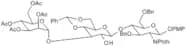
4-Methoxyphenyl 4-O-[4,6-O-benzylidene-3-O-(2,3,4,6-tetra-O-acetyl-α-D-mannopyranosyl)-β-D-glucopyranosyl]-3,6-di-O-benzyl-2-deoxy-2 -phthalimido-β-D-glucopyranoside
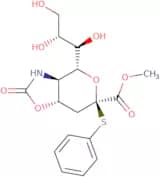
4-Methoxyphenyl 4-O-[4,6-O-benzylidene-3-O-(2,3,4,6-tetra-O-acetyl-a-D-mannopyranosyl)-b-D-glucopyranosyl]-3,6 -di-O-benzyl 2 deoxy 2 phthalimido b D glucopyranoside is a synthetic compound with the molecular formula C76H107N19O38. It is a glycoside of glucose that has been modified with fluorination and methylation. The product is soluble in ethanol and methanol. It has been shown to inhibit the growth of bacteria.Fórmula:C62H65NO22Pureza:Min. 95%Peso molecular:1,176.17 g/molMethyl 5-N,4-O-Carbonyl-3,5-dideoxy-2-S-phenyl-2-thio-D-glycero-b-D-galacto-2-nonulopyranosylonate
CAS:Methyl 5-N,4-O-Carbonyl-3,5-dideoxy-2-S-phenyl-2-thio-D-glycero-b-D-galacto-2-nonulopyranosylonate is a glycosylation agent. It can be used to synthesize complex carbohydrates with a variety of saccharides including glucose, mannose, and galactose. This product is also known as Methyl 3,5 Dideoxy -5-(N-(4'-O-(carbonyl)benzoyl)-3',4'-dimethoxybenzoyl)-2,3'-diene glycero - 2', 3' - dideoxyribofuranosyl(1 '→ 4')pentaacetate or CAS No. 934591–79–4.Fórmula:C17H21NO8SPureza:Min. 95%Cor e Forma:White PowderPeso molecular:399.42 g/molN-(2,4-Dinitrophenyl-deoxygalactonojirimycin
N-(2,4-Dinitrophenyl-deoxygalactonojirimycin is a complex carbohydrate that has been modified with methylation, glycosylation, and click modification. It has an Oligosaccharide chain and a CAS number of 888315-21-2. N-(2,4-Dinitrophenyl-deoxygalactonojirimycin is a high purity product that is available in the form of a white solid.Pureza:Min. 95%N-Fmoc-O-a-(2-acetamido-2-deoxy-3,4,6-tri-O-acetyl-b-D-glucopyranosyl-b-1-4-2,3,6-tri-O-acetyl-a-D-mannopyranosyl)-L-threonine
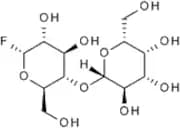
N-Fmoc-O-a-(2-acetamido-2-deoxy-3,4,6-tri-O-acetyl-b-D-glucopyranosyl)-L-threonine is a synthetic sugar. It is an oligosaccharide that is used in the preparation of glycoproteins. It can be modified with fluorine and methyl groups for use in click chemistry reactions. NFAODTGLT has CAS number 539073–78–8 and molecular weight of 676.35. This product is available for custom synthesis with various modifications.Pureza:Min. 95%Lactosyl fluoride
CAS:Lactosyl fluoride is a kinetic inhibitor of glycosidase enzymes. It has been shown to be an effective inhibitor of the enzyme β-galactosidase in both the presence and absence of calcium. Lactosyl fluoride has also been shown to inhibit other glycosidases, including α-galactosidase and α-mannosidase. The lactose derivative is activated by hydrogen fluoride, which allows it to react with the enzyme and block its activity. This product can be used as a chemical biology tool for studying glycoconjugates or as a medicine for treating diseases caused by the accumulation of oligosaccharides, such as Gaucher's disease or Tay-Sachs disease.Fórmula:C12H21FO10Pureza:Min. 95%Cor e Forma:White PowderPeso molecular:344.29 g/mol5-Azido-5-deoxy-1-C-butyl-2,3-O-isopropylidene-D-ribofuranose
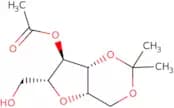
5-Azido-5-deoxy-1-C-butyl-2,3-O-isopropylidene-D-ribofuranose is a custom synthesis of an oligosaccharide that is modified by methylation and glycosylation. It has a CAS number of 533881-00-6.Pureza:Min. 95%4-O-Acetyl-2,5-anhydro-1,3-isopropylidene-D-glucitol
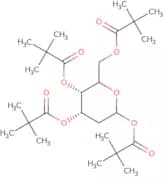
CAS:4-O-Acetyl-2,5-anhydro-1,3-isopropylidene-D-glucitol (4AIG) is a modification of glucose. 4AIG is a white to light yellow crystalline solid that melts with decomposition at 150°C. It is soluble in water and acetone but insoluble in ether. 4AIG can be used as a raw material for the synthesis of oligosaccharides and polysaccharides.Fórmula:C11H18O6Pureza:Min. 95%Peso molecular:246.26 g/mol2-Deoxy-1,3,4,6-tetra-O-pivaloyl-D-glucopyranose
2-Deoxy-1,3,4,6-tetra-O-pivaloyl-D-glucopyranose is a glycosylation sugar that belongs to the category of complex carbohydrates. It is a methylated sugar that can be fluorinated or modified with other saccharides. This product can be custom synthesized and has high purity.
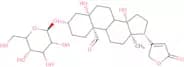
Fórmula:C26H44O9Pureza:Min. 95%Peso molecular:500.64 g/molGlucostrophanthidin
CAS:Glucostrophanthidin is a cardiac glycoside, which is derived from natural plant sources, specifically from species in the Apocynaceae family. This compound exerts its effects primarily through inhibition of the sodium-potassium ATPase enzyme, leading to an increase in intracellular sodium concentration. The downstream effect of this process involves an increase in intracellular calcium via the sodium-calcium exchange mechanism, ultimately enhancing the contractility of cardiac muscle fibers.
Fórmula:C29H42O11Pureza:Min. 95%Peso molecular:566.64 g/mol2-Amino-2,4-dideoxy-4-C-methyl- D-arabinaric acid 1-methyl ester
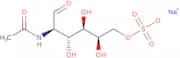
2-Amino-2,4-dideoxy-4-C-methyl-D-arabinaric acid 1-methyl ester is a fluorinated carbohydrate that belongs to the group of modified saccharides. It is a synthetic compound that is custom synthesized and can be used as a chemical intermediate. 2-Amino-2,4-dideoxy-4-C-methyl--D--arabinaric acid 1 methyl ester has been shown to have high purity and can be used in glycosylation reactions. This product also has strong methylation properties and can be used for click chemistry modifications.Pureza:Min. 95%N-Acetyl-D-galactosamine-6-O-sulphate sodium salt - 95%
CAS:N-Acetyl-D-galactosamine-6-O-sulphate sodium salt is a glycosylation product that can be used in the synthesis of oligosaccharides and saccharides. It is also used for the modification of proteins, polysaccharides, fluorination reactions, and click reactions. This compound has been synthesized from D-galactose and acetylated with sulfuric acid to form an ester. N-Acetyl-D-galactosamine-6-O-sulphate sodium salt has a molecular weight of 584.12 g/mol and a melting point of 236°C.Fórmula:C8H14NO9SNaPureza:Min. 95 Area-%Cor e Forma:PowderPeso molecular:323.25 g/mol3,5-Di-C-methyl-L-mannose
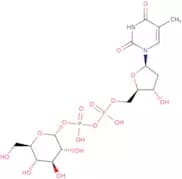
3,5-Di-C-methyl-L-mannose is a custom synthesis that is an Oligosaccharide with a CAS number of 83683-03-1. It is a polysaccharide that is modified by methylation and glycosylation. 3,5-Di-C-methyl-L-mannose has been shown to be effective in inhibiting the growth of cancer cells through modification of glycosylations on proteins and other molecules. 3,5-Di-C-methyl-L-mannose also has high purity and can be synthesized using fluorination reactions.Pureza:Min. 95%Thymidine-5'-diphosphate-D-glucose disodium salt
CAS:Starting point for the biosynthesis of more rare sugars such as deoxysugarsFórmula:C16H24N2O16P2Na2Pureza:Min. 95%Cor e Forma:White Off-White PowderPeso molecular:608.29 g/mol2,2',2''-Triaminotriethylamine-bis(thiogalactopyranosyl acetamide)
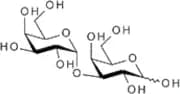
2,2',2''-Triaminotriethylamine-bis(thiogalactopyranosyl acetamide) is a fluorinated sugar that can be used as a building block in glycosylation and oligosaccharide synthesis. It has been shown to be useful for the preparation of complex carbohydrates with desired properties such as high purity.Fórmula:C22H42N4O12S2Pureza:Min. 95%Peso molecular:618.72 g/mol3-O-(α-D-Galactopyranosyl)-D-galactopyranose
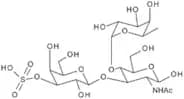
CAS:A carbohydrate, commonly known as alpha gal, found in most mammalian cell membranes. It is not found in primates, including humans, whose immune systems recognize it as a foreign body and produce xenoreactive immunoglobulin M antibodies, leading to organ rejection after transplantation. Anti-α gal immunoglobulin G antibodies are some of the most common in humans. Regular stimulation from gut flora, typically initiated within the first six months of life, leads to an exceptionally high titre of around 1% of all circulating IgG. Recent studies are showing increasing evidence that this allergy may be induced by the bite of the lone star tick (Amblyomma americanum) in North America and the castor bean tick (Ixodes ricincus) in Sweden.Fórmula:C12H22O11Pureza:Min. 95 Area-%Cor e Forma:PowderPeso molecular:342.3 g/mol3'-Sulfated Lewis A sodium salt
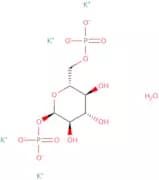
CAS:3'-Sulfated Lewis A sodium salt is a synthetic oligosaccharide that is used as an antigen for the diagnosis of pancreatic cancer. It is conjugated to a monoclonal antibody and binds to the Lewis A epitope on the surface of cells. 3'-Sulfated Lewis A sodium salt has been shown to be useful in bladder cancer, where it can be used as a marker for tumorigenicity. It has also been shown to stimulate selectins and increase sugar residues on cell surfaces, which may lead to increased tumor growth.Fórmula:C20H34NO18SNaPureza:Min. 95%Cor e Forma:White PowderPeso molecular:631.55 g/molα-D-Glucose-1,6-diphosphate tetrapotassium hydrate
CAS:Inhibitor of hexokinase; activator of phosphofructokinase-1Fórmula:C6H14O12P2•4K•(H2O)nPureza:Min. 95%Cor e Forma:PowderPeso molecular:496.51 g/mol1-O-Benzyl-2N, 3-O-carbonyl-β-D-fructofuranosylamine
CAS:The molecule is a complex carbohydrate with a glycosylation site and the following modifications: methylation, click modification, fluorination, saccharide and modification. The molecule was synthesized using custom synthesis methods. The 1-O-benzyl-2N, 3-O-carbonyl-b-D-fructofuranosylamine is available in high purity and CAS No. of 98996-97-3.Fórmula:C14H17NO6Pureza:Min. 95%Cor e Forma:White To Off-White Viscous LiquidPeso molecular:295.29 g/molChitobiose dihydrochloride
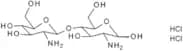
CAS:Chitobiose is a dimer formed by beta-1,4-linked glucosamine units. It is also the repeated dimer of chitin, a polysaccharide.Fórmula:C12H24N2O9·2HClPureza:Min. 98 Area-%Cor e Forma:White PowderPeso molecular:413.25 g/molN-(4-Methoxybenzylidene)-b-D-glucosamine
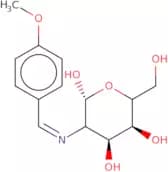
CAS:N-(4-Methoxybenzylidene)-b-D-glucosamine is a fluorinated synthetic monosaccharide. It is used in the synthesis of oligosaccharides and polysaccharides. N-(4-Methoxybenzylidene)-b-D-glucosamine can be modified with methyl groups, which are important for glycosylation, or click modification (a reaction in which a carbon atom and an oxygen atom are covalently bonded through a single bond). The sugar also has high purity and can be used as an analytical reference standard.Fórmula:C14H19NO6Pureza:Min. 95%Peso molecular:297.3 g/mol