Glicociência
A glicociência é o estudo dos carboidratos e seus derivados, bem como das interações e funções biológicas em que participam. Este campo de pesquisa é crucial para compreender uma ampla variedade de processos biológicos, incluindo o reconhecimento celular, a sinalização, a resposta imune e o desenvolvimento de doenças. A glicociência tem aplicações importantes na biotecnologia, na medicina e no desenvolvimento de novos medicamentos e terapias. Na CymitQuimica, oferecemos uma ampla seleção de produtos de alta qualidade e pureza para pesquisa em glicociência. Nosso catálogo inclui monossacarídeos, oligossacarídeos, polissacarídeos, glicoconjugados e reagentes específicos, projetados para apoiar os pesquisadores em seus estudos sobre a estrutura, função e aplicações dos carboidratos em sistemas biológicos. Esses recursos são destinados a facilitar descobertas científicas e aplicações práticas em diversas áreas das biociências e da medicina.
Subcategorias de "Glicociência"
- Amino açúcares(108 produtos)
- Anticorpos Glico-Relacionados(282 produtos)
- Glicolípidos(46 produtos)
- Glicosaminoglicanos (GAGs)(55 produtos)
- Glicosídeos(419 produtos)
- Monossacáridos(6.624 produtos)
- Oligossacarídeos(3.682 produtos)
- Polissacáridos(503 produtos)
Foram encontrados 11046 produtos de "Glicociência"
Ordenar por
Pureza (%)
0
100
|
0
|
50
|
90
|
95
|
100
D-Gulonic acid-1,4-lactone
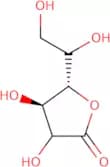
CAS:D-Gulonic acid-1,4-lactone is a naturally occurring compound that is formed from L-gulonic acid and a 1,4-lactone ring. It has been shown to have inhibitory properties against the matrix metalloproteinases MMP-2 and MMP-9. It also has an effect on dehydroascorbic acid, which plays an important role in the regulation of bioavailability of vitamin C. D-Gulonic acid-1,4-lactone has been found to stimulate collagen synthesis in human skin cells, which may be due to its ability to increase the activity of enzymes such as pyruvate kinase and lactate dehydrogenase. The structural analysis of this compound reveals a pyrazole ring with two hydroxyl groups (OH).Fórmula:C6H10O6Pureza:Min. 98 Area-%Cor e Forma:White PowderPeso molecular:178.14 g/molThreo-2-Pentulose(9CI)
CAS:Threo-2-Pentulose is a monosaccharide that is found in plants. It is the D-isomer of xylulose, which has been shown to be an inhibitor of enzymes that catalyze reactions in the pentose phosphate pathway. Threo-2-Pentulose inhibits the activity of enzymes that catalyze reactions in the pentose phosphate pathway, which are enzymes that produce energy. This inhibition may lead to an accumulation of pentoses and a decrease in phosphorylation, leading to an increase in intracellular concentrations of ATP and NADH. Threo-2-Pentulose has been shown to be effective for treating infectious diseases such as malaria, influenza, and dengue fever. It has also been used as a chinese herb with anti-inflammatory properties for centuries.Pureza:Min. 95%Lactose octaacetate
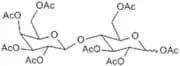
CAS:The acetates of lactose are useful starting points and intermediates in the synthesis of oligosaccharides based on lactose, particularly in the synthesis of the important oligosaccharides that occur in human milk.Fórmula:C28H38O19Pureza:Min. 98 Area-%Cor e Forma:White PowderPeso molecular:678.59 g/mol2,3,5-Tri-O-benzyl-D-lyxofuranose
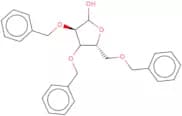
CAS:2,3,5-Tri-O-benzyl-D-lyxofuranose is a custom organic synthesis. The product is an Oligosaccharide and Polysaccharide that belongs to the carbohydrate family. It can be used for methylation reactions and click chemistry modifications with other molecules. This product has been found to have high purity, and it can be used in various applications such as Fluorination, complex carbohydrate, and Modification. 2,3,5-Tri-O-benzyl-D-lyxofuranose is a monosaccharide sugar that has a molecular weight of 327.24 g/mol and a melting point of 155°C.Fórmula:C26H28O5Pureza:Min. 95%Cor e Forma:Yellow PowderPeso molecular:420.5 g/mol2-Amino-β-D-arabinofurano[1,2;4,5]oxazoline
CAS:<p>2-Amino-b-D-arabinofurano[1,2;4,5]oxazoline is an organic compound that can be used in the synthesis of saccharides. It is also a fluorescent probe for amino acids and sugars. 2-Amino-b-D-arabinofurano[1,2;4,5]oxazoline has been shown to be a high purity product and can be custom synthesized. This compound is often used in glycosylation reactions with sugar or saccharide donors. The synthesis of 2-amino b D arabinofurano [1,2;4,5] oxazoline is not complicated and can be achieved by modifying the methyl group on the ring at C2 position. The CAS number for this compound is 27963-98-0.</p>Fórmula:C6H10N2O4Pureza:Min. 95%Cor e Forma:PowderPeso molecular:174.15 g/mol(Hydroxypropyl)methyl cellulose phthalate
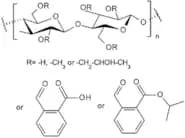
CAS:Hypromellose phthalate (hydroxypropyl methylcellulose phthalate, or HPMCP) is a phthalic acid ester of hydroxypropyl methylcellulose. Hypromellose phthalate was introduced in 1971 as a cellulose derivative for enteric coatings, used to protect drugs from degradation by gastric acid or to prevent them from causing side effects in the stomach. HPMCP is also used in sustained-release preparations, in binders and as microcapsule bases.Cor e Forma:White Off-White PowderPhenyl 2,3,4-tri-O-acetyl-b-D-thioglucuronide methyl ester
CAS:<p>Phenyl 2,3,4-tri-O-acetyl-b-D-thioglucuronide methyl ester is a custom synthesis. It is a complex carbohydrate with an Oligosaccharide and Polysaccharide structure. The modification of saccharides with Methylation, Glycosylation, or Carbohydrate changes the chemical properties of this compound. Phenyl 2,3,4-tri-O-acetyl-b-D-thioglucuronide methyl ester has a CAS No. 62812-42-2 and is also known as sugar. This compound is fluorinated at the phenolic hydroxyl group to produce a stable molecule with high purity.</p>Pureza:Min. 95%Ethyl 6-azido-2,4-di-O-benzoyl-3-O-benzyl-6-deoxy-a-D-thiomannopyranoside
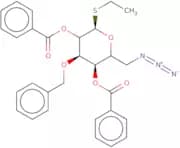
Ethyl 6-azido-2,4-di-O-benzoyl-3-O-benzyl-6-deoxy-a-D-thiomannopyranoside is a custom synthesis of a highly purified compound that has been modified to include fluorination. It is an oligosaccharide with a complex carbohydrate structure and high purity. The modification includes Click chemistry and the monosaccharides are sugar, which may be useful for pharmaceutical or biomedical applications.Fórmula:C29H29N3O6SPureza:Min. 95%Peso molecular:547.62 g/molD-Mannonic acid-1,4-lactone
CAS:<p>D-Mannonic acid-1,4-lactone is a recombinant carbohydrate that is synthesized from l-ribose and l-arabinose. It has lysozyme inhibitory activity. D-Mannonic acid-1,4-lactone can be used to study the synthesis of lactones by escherichia coli and their inhibitory effects on lysozyme. The compound consists of two stereoisomers: dl-mannonic acid and ldl-mannonic acid. It can be detected by liquid chromatography (LC) and electrophoresis.</p>Fórmula:C6H10O6Pureza:Min. 95%Cor e Forma:White PowderPeso molecular:178.14 g/molMan-5 Glycan, 2-AB labelled
<p>Man-5 Glycan, 2-AB labelled is a synthetic oligosaccharide that contains a mannose and a galactose moiety. It has been synthesized by click chemistry with the use of 2-aminobenzaldehyde and glycosylation with methylated and fluorinated mannose. This compound is used as a standard for the detection of carbohydrate binding proteins.</p>Pureza:Min. 95%Haloperidol-1-hydroxy-2'-b-D-glucuronide
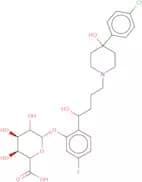
CAS:Haloperidol-1-hydroxy-2'-b-D-glucuronide is a modified carbohydrate that is synthesized from the sugar glucose. This product has been custom synthesized and is fluorinated at the 1 position of the sugar ring. The glycosylation of this product can be customized to your specifications. Haloperidol-1-hydroxy-2'-b-D-glucuronide has a CAS number of 100442-86-2.Fórmula:C27H33ClFNO9Pureza:Min. 95%Peso molecular:570 g/molD-Glucose 3-sulfate sodium salt
CAS:D-Glucose 3-sulfate sodium salt is a fluorinated, monosaccharide that can be used as a synthetic, oligosaccharide or complex carbohydrate. It is custom synthesized with glycosylation and polysaccharides and has been shown to be useful in click modification. D-Glucose 3-sulfate sodium salt is also methylated and sugar modified. The CAS number for this product is 89830-83-1. It has high purity and can be purchased at any lab supply store.Fórmula:C6H11NaO9SPureza:Min. 98 Area-%Cor e Forma:PowderPeso molecular:282.2 g/molscyllo-Inosamine
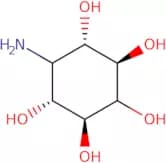
CAS:<p>Scyllo-inosamine is a redox potential that belongs to the class of antimicrobial agents. It is derived from the amino acid inosine, which is found in RNA and DNA. Scyllo-inosamine has been shown to inhibit bacterial growth by inhibiting protein synthesis. It also acts as an aminotransferase inhibitor, which may be used for the treatment of certain human pathogens. Scyllo-inosamine has been shown to have beneficial effects on the regulation of benzyl groups and hydroxyl group reactions. It has also been shown to inhibit polymerase chain reaction activity and titration calorimetry activity.</p>Fórmula:C6H13NO5Pureza:Min. 95%Cor e Forma:PowderPeso molecular:179.17 g/mol3,4:5,6-Di-O-isopropylidene-D-glucitol
CAS:3,4:5,6-Di-O-isopropylidene-D-glucitol is a chemical compound that belongs to the class of aldehydes. It has been shown to catalyze the reaction between alcohols and amides in the presence of an acid or base catalyst. The product of this reaction is an amide with an isopropylidene group on one side. 3,4:5,6-Di-O-isopropylidene-D-glucitol also has two chiral centers and can be used to synthesize stereoselective aldoses, such as D-(+)-gluconic acid and L-(+)-gluconolactone.Fórmula:C12H22O6Pureza:Min. 98 Area-%Cor e Forma:PowderPeso molecular:262.3 g/mol2,3:4,6-Di-O-isopropylidene-2-keto-L-gulonic acid
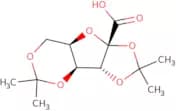
CAS:2,3:4,6-Di-O-isopropylidene-2-keto-L-gulonic acid is a mediator that is used in the synthesis of epoxides. It is obtained by the reaction of hydrogen peroxide with 2,3:4,6-di-o-isopropylidene-2-keto-l-gulonic acid monohydrate. This product can be used as an intermediate in organic synthesis to produce chiral epoxides. The stereochemistry of the epoxides depends on the chirality of the substrate and the stereoselectivity for this process is high. The epoxides are then recycled and reused to make more 2,3:4,6--di--isopropylidene--2--keto--l--gulonic acid monohydrate.Pureza:Min. 95%2,3-O-Isopropylidene-5-O-tosyl-D-ribonic acid-1,4-lactone
CAS:<p>2,3-O-Isopropylidene-5-O-tosyl-D-ribonic acid-1,4-lactone is a synthetic 2,3:5,6-diisopropylidene glycoside of D-ribose. It is a methylated sugar with an alpha-(2,3)-linked D-(+)-glucopyranosyl moiety and an alpha-(2,5)-linked L(+)-fucopyranosyl moiety. This compound can be used as a building block for the synthesis of polysaccharides and glycoconjugates. 2,3:5,6-Diisopropylidene glycoside of D-ribose is also used to synthesize oligosaccharides in carbohydrate chemistry.</p>Fórmula:C12H14O7SPureza:Min. 95%Cor e Forma:White PowderPeso molecular:302.04 g/mol2,5:3,4-Dianhydro-6-O-2-propenyl-dimethyl acetal-L-talose
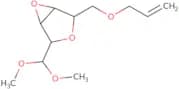
CAS:2,5:3,4-Dianhydro-6-O-2-propenyl-dimethyl acetal-L-talose is a fluorinated sugar that is synthesized by the reaction of an acetal with glycosylation. It has been modified to contain a methyl group and a click modification. 2,5:3,4-Dianhydro-6-O-2-propenyl-dimethyl acetal-L-talose is used as a fluorescent probe for the detection of nucleic acids in living cells. It has high purity and can be custom synthesized to meet customer specifications.Fórmula:C11H18O5Pureza:Min. 95%Peso molecular:230.26 g/molHyaluronic acid sodium - Average MW 1.8 - 2.5 million Da
CAS:Gycosaminoglycan in many organs; joint lubricant and shock absorberFórmula:(C14H20NO11Na)nPureza:Min. 95%Cor e Forma:Powder2,3,4,6-Tetra-O-allyl-D-glucopyranose
CAS:<p>2,3,4,6-Tetra-O-allyl-D-glucopyranose is a synthetic oligosaccharide that is used in the synthesis of glycoproteins and other complex carbohydrates. The sugar has been fluorinated to produce 2,3,4,6-Tetra-O-fluoro-D-glucopyranose. This sugar can be custom synthesized with methylation or click modification. It is a high purity product with no impurities detected.</p>Pureza:Min. 95%Diethylgalactarate
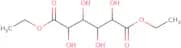
CAS:Diethylgalactarate is a polymer that is solid at room temperature. It has a yield value of 10%. Diethylgalactarate is soluble in organic solvents, but insoluble in water. This polymer has been shown to have good thermal stability and microstructure when used as a monomer with other polymers. Diethylgalactarate has also been shown to have high permeability, which makes it an ideal candidate for use in drug delivery systems.Fórmula:C10H18O8Pureza:Min. 95%Peso molecular:266.25 g/mol


![2-Amino-β-D-arabinofurano[1,2;4,5]oxazoline](/_next/image/?url=https%3A%2Fstatic.cymitquimica.com%2Fproducts%2F3D%2Fthumb-webp%2FMA05416.webp&w=3840&q=75)