Glicociência
Subcategorias de "Glicociência"
- Amino açúcares(108 produtos)
- Anticorpos Glico-Relacionados(282 produtos)
- Glicolípidos(46 produtos)
- Glicosaminoglicanos (GAGs)(55 produtos)
- Glicosídeos(419 produtos)
- Monossacáridos(6.624 produtos)
- Oligossacarídeos(3.682 produtos)
- Polissacáridos(504 produtos)
Foram encontrados 11047 produtos de "Glicociência"
1,3,4,6-Tetra-O-galloyl glucose
CAS:Tetra-O-galloyl glucose is a pentagalloyl glucose that is found in the Chinese herb Paeonia lactiflora. It has been shown to inhibit the replication of hepatitis B virus, and can be used for the treatment of hepatitis B infection. Tetra-O-galloyl glucose also has anti-inflammatory activities, which may be due to its ability to inhibit prostaglandin synthesis.Fórmula:C34H28O22Pureza:Min. 95%Peso molecular:788.57 g/molGlobotriaosylsphingosine
CAS:Globotriaosylsphingosine is dramatically increased in plasma of classically affected male Fabry patients and plasma and tissues of Fabry mice. Globotriaosylsphingosine was shown to be an inhibitor of α-galactosidase A activity. Furthermore, exposure of smooth muscle cells, but not fibroblasts, to globotriaosylsphingosine at concentrations observed in plasma of patients promotes proliferation. It was suggested that measurement of circulating globotriaosylsphingosine would be useful to monitor Fabry disease and may contribute to a better understanding of the disorder.
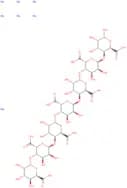
Fórmula:C36H67NO17Pureza:Min. 95%Cor e Forma:PowderPeso molecular:785.91 g/molL-Heptaguluronic acid heptasodium
CAS:Please enquire for more information about L-Heptaguluronic acid heptasodium including the price, delivery time and more detailed product information at the technical inquiry form on this pageFórmula:C42H58O43•Na7Pureza:Min. 95%Peso molecular:1,411.81 g/mol6-Cyano-6-deoxy-a-cyclodextrin
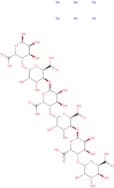
CAS:Alpha-cyclodextrin (α-CD) derivative with a hydrophilic exterior and lipophilic cavity (smaller than β-CDs and γ-CDs) to allocate certain guest molecules. This structural characteristic enables applications in molecular encapsulation, solubility enhancement, and stabilization across multiple industries. In pharmaceuticals, it serves as a drug delivery vehicle, enhancing the bioavailability and stability of active ingredients. The food industry utilizes it as a stabilizer for flavors, colors, and nutrients, as well as a functional ingredient for its effects on lipid metabolism. In cosmetics, it acts as a complex agent for fragrances and active components. Its applications extend to analytical chemistry for chiral separation and to materials science for developing smart materials and nanosystems.Fórmula:C42H54N6O24Pureza:Min. 95%Peso molecular:1,026.9 g/molL-Hexaguluronic acid hexasodium
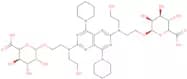
CAS:Please enquire for more information about L-Hexaguluronic acid hexasodium including the price, delivery time and more detailed product information at the technical inquiry form on this pageFórmula:C36H50O37•Na6Pureza:Min. 95%Peso molecular:1,212.7 g/molDipyridamole di-O-b-D-glucuronide
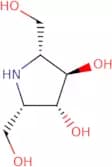
CAS:Dipyridamole di-O-b-D-glucuronide is a fluorinated oligosaccharide that has been synthesized using the click chemistry reaction. It is a monosaccharide that has been glycosylated and modified with methyl groups to produce a high purity product. The carbohydrate consists of one or more sugar units linked by glycosidic bonds. Carbohydrates are classified by their number of sugar units and by the presence of other chemical groups such as phosphate, sulfate, or hydroxyl. This product is also used in the synthesis of complex carbohydrates and polysaccharides.Fórmula:C36H56N8O16Pureza:Min. 95%Peso molecular:856.87 g/mol2,5-Dideoxy-2,5-imino-D-glucitol
CAS:2,5-Dideoxy-2,5-imino-D-glucitol is a potent inhibitor of glycosidases. It has been shown to have significant antifungal activity against Candida albicans in the caco-2 cell model system. 2,5-Dideoxy-2,5-imino-D-glucitol inhibits β-(1→3)-glycosidase activity by binding to the active site of the enzyme and preventing substrate hydrolysis. The compound is also an enantiopure and asymmetric synthesis. This drug has been shown to be a model system for studying glycosidase inhibition.Fórmula:C6H13NO4Pureza:Min. 95%Peso molecular:163.17 g/mol3'-b-Sialyl-N-acetyllactosamine
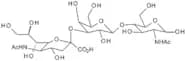
CAS:3'-b-Sialyl-N-acetyllactosamine is an oligosaccharide that is synthesized from L-arabinose and 3'-phosphoadenosine 5'-phosphosulfate. It has a high degree of purity and is custom synthesized to order. The CAS number for this product is 210418-18-1.Fórmula:C25H42N2O19Pureza:Min. 95%Cor e Forma:White PowderPeso molecular:674.6 g/molGlyco-diosgenin
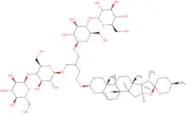
CAS:Glyco-diosgenin is an amphipathic molecule that has been found to stabilize proteins. It has the potential to be developed as a drug target for stabilizing proteins in cells. Glyco-diosgenin was synthesized by chemical modification of diosgenin, which is a steroidal saponin found in plants. The chemical modification that occurred at the 3-hydroxyl position of glyco-diosgenin produced a more effective molecule due to increased solubility and decreased toxicity. The protein stabilization properties of glyco-diosgenin have been shown by cryo-electron microscopy on plant cells, titration calorimetry, and functional studies on various proteins.Fórmula:C56H92O25Pureza:Min. 97 Area-%Cor e Forma:PowderPeso molecular:1,165.31 g/molβ-Estradiol 3-(β-D-glucuronide) 17-sulfate dipotassium
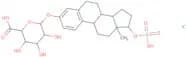
CAS:β-Estradiol 3-(β-D-glucuronide) 17-sulfate dipotassium is a synthetic, nonsteroidal estrogen with a high affinity for the human estrogen receptor. It is used in the treatment of various types of breast cancer and as hormone replacement therapy. β-Estradiol 3-(β-D-glucuronide) 17-sulfate dipotassium is a part of the drug class selective estrogen receptor modulators (SERMs). The compound has been shown to have antiestrogenic activity through its ability to compete with estradiol for binding to the estrogen receptor. This compound also has some antiandrogenic effects and can inhibit sex hormone binding globulin (SHBG), leading to increased levels of free testosterone in blood plasma.Fórmula:C24H32O11S•K2Pureza:Min. 95%Peso molecular:606.77 g/molMethyl 2-azido-3,4,6-tri-O-acetyl-2-deoxy-b-D-mannopyranoside
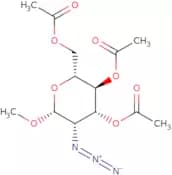
CAS:Methyl 2-azido-3,4,6-tri-O-acetyl-2-deoxy-bD mannoside is a custom synthesis that can be modified to suit the needs of the customer. It is an oligosaccharide and polysaccharide that has been modified with methylation and glycosylation. This product has CAS No. 97604-59-6 and is available for purchase in high purity with a purity level of at least 95%. Methyl 2-azido-3,4,6-triO acetyl -2 deoxy b D mannoside has been fluorinated to create a synthetic sugar.
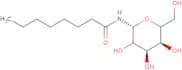
Fórmula:C13H19N3O8Pureza:Min. 95%Cor e Forma:White PowderPeso molecular:345.31 g/molOctanoyl b-D-glucosylamine
CAS:Octanoyl b-D-glucosylamine is a synthetic compound that has been designed for use in the synthesis of complex carbohydrates. It is an octanoyl derivative of D-glucosamine, which is a sugar. This compound can be used for the modification of saccharides and polysaccharides, as well as sugars. It has been shown to be resistant to glycosylation and fluorination reactions.
Fórmula:C14H27NO6Pureza:Min. 95%Peso molecular:305.37 g/molMono-(6-(diethylenetriamine)-6-deoxy)-β-Cyclodextrin
CAS:Please enquire for more information about Mono-(6-(diethylenetriamine)-6-deoxy)-β-Cyclodextrin including the price, delivery time and more detailed product information at the technical inquiry form on this page
Fórmula:C46H81N3O34Pureza:Min. 95%Peso molecular:1,220.1 g/molkappa-Carrageenan
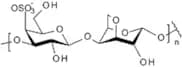
CAS:Kappa-Carrageenan is a gelling sulphated galactan extracted from red seaweed (typically Mastocarpus stellata and Chondrus crispus). The structure of all carrageenans consists of a strictly alternating masked repeating unit of 1,3-linked α-D-galactose and 1,4-linked β-D-galactose. The α-linked galactose occurs as α-3-6-anhydro unit and the β-linked sugar occurs as the 4-sulphate.
The image was kindly provided by Prof Mike Guiry from Cork who runs ‘The Seaweed Site’.Cor e Forma:White PowderGlucosamine L-5-methyltetrahydrofolate
CAS:Please enquire for more information about Glucosamine L-5-methyltetrahydrofolate including the price, delivery time and more detailed product information at the technical inquiry form on this page
Fórmula:C20H25N7O6•(C6H13NO5)2Pureza:Min. 95%Peso molecular:817.8 g/molD-Gluconic acid potassium salt
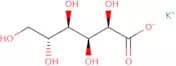
CAS:D-Gluconic acid potassium salt is a glycol ether with biochemical properties that can be used to synthesize covalent linkages. It has been shown to have antimicrobial properties in wild-type strains of Escherichia coli and Salmonella typhimurium. D-Gluconic acid potassium salt has been shown to exhibit inhibitory effects on the synthesis of DNA, RNA, and protein, as well as enzyme activities. The matrix effect is an analytical method that measures the inhibition of bacterial growth in agar plates. Electrochemical impedance spectroscopy (EIS) is a technique that measures changes in electrical resistance when bacteria are placed on an electrode surface. This technique has been used to show that D-gluconic acid potassium salt exhibits inhibitory effects against group P2 enzymes, such as polymerase chain reaction (PCR), which is used for DNA replication and amplification.
Fórmula:C6H11KO7Pureza:Min. 95%Peso molecular:234.25 g/molCellulose - Microcystalline USP
CAS:Cellulose is a linear polysaccharide of β 1-4 linked glucose residues. The polysaccharide chains are bundled as microfibrils in cell walls and provide the essential structural components within growing plants. Each microfibril exhibits a high degree of three-dimensional internal bonding resulting in a crystalline structure that is insoluble in water, resistant to reagents and very strong. The crystalline region of cellulose is isolated to produce microcrystalline cellulose. Microcrystalline cellulose is a term for refined wood pulp and is used as a texturizer, an anti-caking agent, a fat substitute, an emulsifier, an extender, and a bulking agent in food production.
Pureza:Min. 95%Danaparoid sodium - mixture of dermatan sulfate, heparan sulfate and chondroitin sulfate
CAS:Danaparoid sodium (the active pharmaceutical ingredient in Orgaran; Merck Sharp and Dohme) is a biopolymeric non-heparin drug that is used as anticoagulant and antithrombotic agent, approved for the prophylaxis of postoperative deep-vein thrombosis. It consists of a mixture of three glycosaminoglycans: heparan sulphate, dermatan sulphate, and chondroitin sulphate. Danaparoid, has well established antithrombotic activity. The drug has a high antifactor Xa to antifactor IIa (thrombin) activity ratio, a low tendency to cause bleeding and minimal effects on the fibrinolytic system.
Pureza:Min. 95%Cor e Forma:White Powder3-Acetamido-3,6-dideoxy-D-galactose
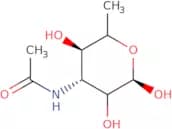
CAS:3-Acetamido-3,6-dideoxy-D-galactose is a monosaccharide with two functional groups. It has been shown to be bifunctional and can act as a glycosyl donor or acceptor. 3-Acetamido-3,6-dideoxy-D-galactose was isolated from the type strain of Streptomyces venezuelae. It is also found in fatty acids and some strains of bacteria, such as Bacillus megaterium. The biological properties of 3-acetamido--3,6-dideoxy--D--galactose have been studied using monoclonal antibodies, magnetic resonance spectroscopy (MRS), and 13C nuclear magnetic resonance spectroscopy (NMR).
Fórmula:C8H15NO5Pureza:Min. 95%Cor e Forma:PowderPeso molecular:205.21 g/mol1,4:3,6-Dianhydro-L-iditol
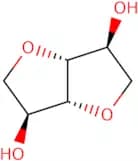
CAS:1,4:3,6-Dianhydro-L-iditol is a synthetic compound that is used in pharmaceutical preparations and tissue culture. It has been shown to inhibit the growth of bacteria such as Staphylococcus aureus and Mycobacterium tuberculosis in vitro assays. The synthesis of 1,4:3,6-dianhydro-L-iditol involves intramolecular hydrogenation of fatty acids with alkanoic acids and the use of solid catalysts.
Fórmula:C6H10O4Pureza:Min. 95%Peso molecular:146.14 g/mol