Glicociência
A glicociência é o estudo dos carboidratos e seus derivados, bem como das interações e funções biológicas em que participam. Este campo de pesquisa é crucial para compreender uma ampla variedade de processos biológicos, incluindo o reconhecimento celular, a sinalização, a resposta imune e o desenvolvimento de doenças. A glicociência tem aplicações importantes na biotecnologia, na medicina e no desenvolvimento de novos medicamentos e terapias. Na CymitQuimica, oferecemos uma ampla seleção de produtos de alta qualidade e pureza para pesquisa em glicociência. Nosso catálogo inclui monossacarídeos, oligossacarídeos, polissacarídeos, glicoconjugados e reagentes específicos, projetados para apoiar os pesquisadores em seus estudos sobre a estrutura, função e aplicações dos carboidratos em sistemas biológicos. Esses recursos são destinados a facilitar descobertas científicas e aplicações práticas em diversas áreas das biociências e da medicina.
Subcategorias de "Glicociência"
- Amino açúcares(108 produtos)
- Anticorpos Glico-Relacionados(282 produtos)
- Glicolípidos(46 produtos)
- Glicosaminoglicanos (GAGs)(55 produtos)
- Glicosídeos(419 produtos)
- Monossacáridos(6.624 produtos)
- Oligossacarídeos(3.682 produtos)
- Polissacáridos(503 produtos)
Foram encontrados 11046 produtos de "Glicociência"
Ordenar por
Pureza (%)
0
100
|
0
|
50
|
90
|
95
|
100
1,2,3,4-Tetra-O-acetyl-β-D-glucuronide methyl ester
CAS:<p>Building block for chemical modification of GlcU, including glucuronylation</p>Fórmula:C15H20O11Pureza:Min. 97 Area-%Cor e Forma:PowderPeso molecular:376.31 g/mol3'-b-Sialyl-N-acetyllactosamine
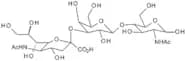
CAS:3'-b-Sialyl-N-acetyllactosamine is an oligosaccharide that is synthesized from L-arabinose and 3'-phosphoadenosine 5'-phosphosulfate. It has a high degree of purity and is custom synthesized to order. The CAS number for this product is 210418-18-1.Fórmula:C25H42N2O19Pureza:Min. 95%Cor e Forma:White PowderPeso molecular:674.6 g/molMethyl 2-deoxy-L-ribofuranoside
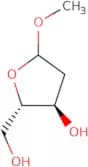
CAS:Methyl 2-deoxy-L-ribofuranoside is an intermediate in the synthesis of l-arabinose. It can be obtained by the reaction of methyl 2,3-dideoxy-D-ribofuranoside with pivaloyl chloride. The antiviral activity of this compound has been shown by its ability to inhibit the replication of influenza A virus. Methyl 2-deoxy-L-ribofuranoside is a fluorinating agent that can be used for the synthesis of oligosaccharides and nucleosides. This intermediate also serves as a substrate for a number of organic reactions, including regioselective and stereoselective chlorination.Fórmula:C6H12O4Pureza:Min. 95%Cor e Forma:PowderPeso molecular:148.16 g/molTetradecyl b-D-maltopyranoside
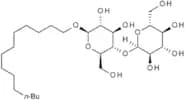
CAS:Tetradecyl b-D-maltopyranoside is a crystalline polymer of high molecular weight that is made up of repeating units of tetradecyl b-D-maltose. It has a lamellar morphology and can be sectioned with techniques such as electron microscopy, X-ray diffraction, and differential scanning calorimetry. Tetradecyl b-D-maltopyranoside is a metastable form of the compound. It has been found in nature in the form of the monomer unit, tetradecyl maltosyl (tetramethyleneglycol) b-d-maltoside. In order to produce this compound as a polymer, it must first be heated to about 160°C for several hours, which causes the monomers to assemble into chains of tetrahedrons. The properties of tetradecyl b-D-maltopyranoside depend on its environmentFórmula:C26H50O11Pureza:Min. 95 Area-%Cor e Forma:PowderPeso molecular:538.67 g/molCellulose acetate - MW 30,000
CAS:<p>Cellulose acetate fiber is one of the earliest synthetic fibers and is based on cotton or tree pulp cellulose. Cellulose acetate is used as a film base in photography, as a component in some coatings, and as a frame material for eyeglasses. It is also used as a synthetic fiber in the manufacture of cigarette filters and playing cards. In photographic film, cellulose acetate replaced nitrate film in the 1950s, being far less flammable and cheaper to produce but in recent years has been rendered obsolete by the advent of digital cameras.</p>Cor e Forma:PowderSodium alginate, viscosity 300 - 600 mPa.s
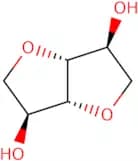
CAS:<p>Sodium alginate is the sodium salt of a polysaccharide obtained from brown seaweeds. The main use for alginate is in textile printing as a thickener in the printing of cottons with reactive dyes. In the food industry it is used as a thickener and gelling agent. The chemical structure consists of blocks of (1,4) linked-β-D-polymannuronic acid (poly M), (1,4) linked-α-L-polyguluronic acid (poly G) and alternating blocks of the two uronic acids (poly MG).</p>Cor e Forma:Powder1,4:3,6-Dianhydro-L-iditol
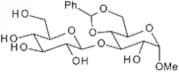
CAS:<p>1,4:3,6-Dianhydro-L-iditol is a synthetic compound that is used in pharmaceutical preparations and tissue culture. It has been shown to inhibit the growth of bacteria such as Staphylococcus aureus and Mycobacterium tuberculosis in vitro assays. The synthesis of 1,4:3,6-dianhydro-L-iditol involves intramolecular hydrogenation of fatty acids with alkanoic acids and the use of solid catalysts.</p>Fórmula:C6H10O4Pureza:Min. 95%Peso molecular:146.14 g/molMethyl 4,6-O-benzylidene-3-O-(b-D-glucopyranoside)-a-D-glucopyranoside
CAS:Methyl 4,6-O-benzylidene-3-O-(b-D-glucopyranoside)-a-D-glucopyranoside is a synthetic oligosaccharide. It is an important building block of polysaccharides and glycoconjugates. This compound is used in the synthesis of complex carbohydrates, such as glycosylation, polysaccharides, and click modification. It can be custom synthesized for research purposes and has been shown to be high purity.Fórmula:C20H28O11Pureza:Min. 95%Peso molecular:444.43 g/molN-Benzoyl-D-glucosamine
CAS:<p>Lectins are carbohydrate-binding proteins that can be classified into different types based on their specificities for glycan structures. One of the most common types is the N-acetyl-D-glucosamine (NAG) lectin, which binds to oligomers of NAG and related sugars. Lectins are used to activate cells and induce cell death. The dodecyl NAG lectin has been shown to bind to glucocerebrosides in a reductively irreversible manner and has been used as a model for such interactions. This lectin is also inexpensively produced from a synthetic benzylidene acetal, which can be made from commercially available materials. It has been shown that this lectin binds to polyacrylamide gels in an SDS-polyacrylamide gel electrophoresis, with a pH optimum at 7.0 and an amino acid composition that includes glutamic acid, glutamine, asparagine, ser</p>Fórmula:C13H17NO6Pureza:Min. 95%Cor e Forma:White PowderPeso molecular:283.28 g/mol2,3-Di-O-benzyl-6-O-tert-butyldimethylsilyl-gamma-cyclodextrin
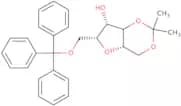
<p>This gamma-cyclodextrin (γ-CD) derivative is a modified cyclic oligosaccharide composed of eight glucose units, featuring a larger cavity size than α- and β-cyclodextrins. This structural characteristic allows γ-CDs to form inclusion complexes with a wider range of guest molecules, making it particularly versatile in various industries. In the food sector, it is used as a carrier and stabilizer for flavors, fat-soluble vitamins, and polyunsaturated fatty acids, protecting volatile compounds from evaporation. In pharmaceuticals, it enhances the solubility and bioavailability of poorly water-soluble drugs and, thanks to its larger ring size, allows for the encapsulation of larger molecules or even entire drug molecules. γ-CDs and derivatives are also used for environmental remediation and, in analytical chemistry, for the extraction and concentration of target substances.</p>Fórmula:C208H288O40SI8Pureza:Min. 95%Peso molecular:4,475.79 g/mol2,5-Anhydro-1,3-O-isopropylidene-6-O-trityl-D-glucitol
CAS:2,5-Anhydro-1,3-O-isopropylidene-6-O-trityl-D-glucitol is a complex carbohydrate that is synthesized by the modification of glucose. This product has been modified with methylation and glycosylation. 2,5-Anhydro-1,3-O-isopropylidene-6-O-trityl--D--glucitol is a white powder that is soluble in water and ethanol. It can be used for fluoroquinolone resistance studies, which are important for developing new antibiotics to combat bacterial infections.Fórmula:C28H30O5Pureza:Min. 95%Peso molecular:446.53 g/molSucrose cocoate
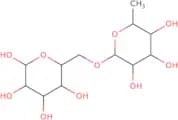
CAS:Blend of sucrose esters with fatty acid esters from coconut oil used in Cosmetic industry applications.Pureza:Min. 95%β-Rutinose
CAS:Beta-rutinose is a potent kinase inhibitor that has shown anti-tumor activity in Chinese hamster ovary (CHO) cells. It inhibits the activity of cyclin-dependent kinases, which are essential for cell division and proliferation. Beta-rutinose has been shown to induce apoptosis in human cancer cells, making it a promising candidate for anticancer therapy. This compound is an analog of rutin, a flavonoid found in many plants, and has been shown to have potent anticancer effects in vitro and in vivo. Beta-rutinose inhibits the growth of cancer cells by blocking the activity of specific kinases involved in tumor progression, making it an attractive target for developing new cancer therapies. Additionally, this compound has been found to be effective at reducing protein levels associated with cancer cell growth and proliferation.Fórmula:C12H22O10Pureza:Min. 95%Peso molecular:326.3 g/molD-Glucose-6-phosphate dipotassium salt hydrate
CAS:<p>Glucose 6-phosphatase substrate</p>Fórmula:C6H11O9PK2·H2OPureza:Min. 95%Peso molecular:354.33 g/mol2-Acetamido-3,4,6-tri-O-acetyl-1-O-[(N-Cbz-aminoethoxy)ethoxy]-2-deoxy-β-D-galactopyranose
CAS:2-Acetamido-3,4,6-tri-O-acetyl-1-O-[(N-Cbz-aminoethoxy)ethoxy]-2-deoxy-b-D-galactopyranose is a custom synthesis of a complex carbohydrate. It is a polysaccharide that contains fluorine and has been modified with methylation, glycosylation, click modification, and polysaccharide modifications. 2-Acetamido-3,4,6-tri-O -acetyl -1 -O-[(N -Cbz -aminoethoxy)ethoxy] -2 deoxy b D galactopyranose is also known as CAS No. 1261568 35 7 and it's molecular weight is 546.81 g/mol.Fórmula:C26H36N2O12Pureza:Min. 95%Peso molecular:568.57 g/mol6-Chloro-6-deoxy-D-mannose
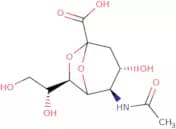
CAS:6-Chloro-6-deoxy-D-mannose is a naturally occurring sugar that is found in the spermatozoa of many animals. It is a mannose derivative that has been shown to be an inhibitor of the enzyme glyceraldehyde 3-phosphate dehydrogenase, which plays an important role in energy metabolism and isomerization of 6-phosphate to glucose-1 phosphate. This property may be responsible for its contraceptive effects. The drug also inhibits phosphoglucomutase and enhances the transfer of glucose from the liver to other tissues, increasing blood glucose concentrations. 6-Chloro-6 deoxy mannose also has antifertility effects in rats by inhibiting transfer of spermatozoa through the female reproductive tract.Fórmula:C6H11ClO5Pureza:Min. 95%Cor e Forma:White Off-White PowderPeso molecular:198.6 g/molN-Acetyl-2,7-anhydro-α-neuraminic acid
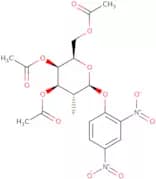
CAS:N-Acetyl-2,7-anhydro-a-neuraminic acid is a synthetic derivative of a naturally occurring sugar that is found in the human brain and other tissues. It has been proposed as a potential drug for the treatment of inflammatory bowel disease due to its ability to inhibit the growth of cells in the colon and prevent inflammation. N-Acetyl-2,7-anhydro-a-neuraminic acid has been shown to have antiinflammatory properties by inhibiting the synthesis of proinflammatory cytokines. This compound binds to an enzyme called galactosamine kinase, which is involved in making certain proteins that are necessary for inflammation. The chemical structure of N-Acetyl-2,7-anhydro-a-neuraminic acid was determined through structural analysis and carbon source titration calorimetry. Magnetic resonance spectroscopy showed that this compound reacts with water molecules and chemical ionization revealed that itFórmula:C11H17NO8Pureza:Min. 95%Peso molecular:291.25 g/mol2,4-Dinitrophenyl 3,4,6-tri-O-acetyl-2-deoxy-2-fluoro-b-D-galactoside
CAS:<p>2,4-Dinitrophenyl 3,4,6-tri-O-acetyl-2-deoxy-2-fluoro-b-D-galactoside is a glycosidase inhibitor that is used in the validation of β-glucosidases. It has been shown to inhibit the activity of a number of glycosidases, including α-, β-, and γ-. 2,4-Dinitrophenyl 3,4,6-tri-O-acetyl -2 -deoxy -2 -fluoro -b D galactoside inhibits the hydrolysis of oligosaccharides containing a terminal α-- or β--glucose moiety to produce smaller sugars. This compound can be used as an acceptor for spectrophotometric assays and as an analytical standard for measuring the degree of polymerization (DP) of oligosaccharides. The rate of its reaction with gly</p>Fórmula:C18H19FN2O12Pureza:Min. 95%Cor e Forma:PowderPeso molecular:474.35 g/molD-Maltose monohydrate
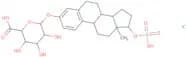
CAS:Please enquire for more information about D-Maltose monohydrate including the price, delivery time and more detailed product information at the technical inquiry form on this pageFórmula:C12H24O12Pureza:Min. 98 Area-%Cor e Forma:White PowderPeso molecular:360.31 g/molβ-Estradiol 3-(β-D-glucuronide) 17-sulfate dipotassium
CAS:<p>β-Estradiol 3-(β-D-glucuronide) 17-sulfate dipotassium is a synthetic, nonsteroidal estrogen with a high affinity for the human estrogen receptor. It is used in the treatment of various types of breast cancer and as hormone replacement therapy. β-Estradiol 3-(β-D-glucuronide) 17-sulfate dipotassium is a part of the drug class selective estrogen receptor modulators (SERMs). The compound has been shown to have antiestrogenic activity through its ability to compete with estradiol for binding to the estrogen receptor. This compound also has some antiandrogenic effects and can inhibit sex hormone binding globulin (SHBG), leading to increased levels of free testosterone in blood plasma.</p>Fórmula:C24H32O11S•K2Pureza:Min. 95%Peso molecular:606.77 g/mol






![2-Acetamido-3,4,6-tri-O-acetyl-1-O-[(N-Cbz-aminoethoxy)ethoxy]-2-deoxy-β-D-galactopyranose](/_next/image/?url=https%3A%2Fstatic.cymitquimica.com%2Fproducts%2F3D%2Fthumb-webp%2FMA137616.webp&w=3840&q=75)