Antimicrobianos
Os antimicrobianos são agentes que destroem ou inibem o crescimento de microrganismos, incluindo bactérias, vírus, fungos e parasitas. Esses compostos são essenciais na prevenção e tratamento de infecções, desempenhando um papel crucial na medicina, agricultura e indústria alimentícia. Na CymitQuimica, oferecemos uma ampla gama de antimicrobianos de alta qualidade e pureza, adequados para diversas aplicações científicas e industriais. Nosso catálogo inclui antibióticos, antifúngicos, antivirais e desinfetantes, todos projetados para atender às necessidades de pesquisa e desenvolvimento, bem como para aplicações clínicas e de produção. Com nossos produtos, os profissionais podem garantir a eficácia e a segurança no controle de infecções e na proteção da saúde pública.
Subcategorias de "Antimicrobianos"
- Antibióticos(4.131 produtos)
- Antifúngicos(909 produtos)
- Antiparasitários(703 produtos)
- Antivíricos(766 produtos)
Foram encontrados 2425 produtos de "Antimicrobianos"
Ordenar por
Pureza (%)
0
100
|
0
|
50
|
90
|
95
|
100
Beauveriolide III
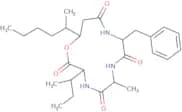
CAS:Beauveriolide III is a cyclic depsipeptide, which is a specialized class of natural products. It is derived from the fungal species Beauveria, known for producing various biologically active compounds. The mode of action of Beauveriolide III involves the inhibition of acyl-CoA:cholesterol acyltransferase (ACAT), an enzyme crucial for cholesterol esterification in cells. This inhibition can lead to reduced cholesterol accumulation, making it a molecule of interest in the study of cholesterol metabolism.Fórmula:C27H41N3O5Pureza:Min. 95%Peso molecular:487.6 g/molCephradine monohydrate
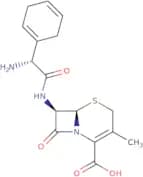
CAS:<p>Cephradine monohydrate is a first-generation cephalosporin antibiotic, which is derived from the fungus Acremonium. It operates by inhibiting bacterial cell wall synthesis, a critical process necessary for bacterial growth and replication. This inhibition occurs through the binding of the antibiotic to penicillin-binding proteins, leading to cell lysis and subsequent bacterial death.</p>Fórmula:C16H19N3O4S·H2OPureza:Min. 95%Peso molecular:367.42 g/mol1,3''-Di-HABA kanamycin A
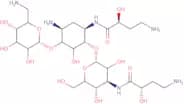
CAS:1,3''-Di-HABA kanamycin A is a chemically modified antibiotic derivative. It is derived from kanamycin A, a well-known aminoglycoside antibiotic that is originally sourced from the bacterium *Streptomyces kanamyceticus*. The modification with 1,3''-Di-HABA alters its pharmacodynamic properties, potentially influencing its specificity and interaction with biological targets.Fórmula:C26H50N6O15Pureza:Min. 95%Peso molecular:686.71 g/molN-[[(5S)-3-(4-Methylsulfinylphenyl)-2-oxo-1,3-oxazolidin-5-yl]methyl]acetamide
CAS:N-[[(5S)-3-(4-Methylsulfinylphenyl)-2-oxo-1,3-oxazolidin-5-yl]methyl]acetamide is a synthetic compound, which is derived from the oxazolidinone class of molecules known for their antimicrobial properties. Its mechanism of action involves the inhibition of bacterial protein synthesis by binding to the 50S subunit of the bacterial ribosome, thereby preventing the formation of a functional 70S initiation complex. This effectively disrupts the growth and replication of susceptible bacterial strains.Fórmula:C13H16N2O4SPureza:Min. 95%Peso molecular:296.34 g/molDanofloxacin d3 (methyl d3)
CAS:<p>Danofloxacin d3 (methyl d3) is a synthetic fluoroquinolone antibiotic, which is derived from the parent compound, danofloxacin, incorporating stable isotope labeling with deuterium. The presence of three deuterium atoms in the methyl group offers an isotopic variation that is utilized in precise quantitative studies. The mechanism of action of danofloxacin d3 involves the inhibition of bacterial DNA gyrase and topoisomerase IV, which are crucial enzymes for bacterial DNA replication, transcription, and repair.</p>Fórmula:C19H20FN3O3Pureza:Min. 95%Peso molecular:360.4 g/molCarbovir triphosphate triethylamine
CAS:<p>Carbovir triphosphate triethylamine is a nucleotide analog, which is a derivative of nucleoside analogs designed for antiviral applications. It is synthesized through chemical modification of guanosine analogs, resulting in its active triphosphate form. This compound functions as a potent antiretroviral agent by mimicking natural nucleotides and interfering with viral DNA synthesis. The active triphosphate impedes the action of viral reverse transcriptase by incorporating itself into the viral DNA chain, causing premature termination and effectively halting viral replication.</p>Pureza:Min. 95%Macranthoside B
CAS:<p>Macranthoside B is a natural iridoid glycoside, which is derived primarily from the roots of certain plants, such as Rehmannia species. This compound is known for its biological activity, which includes potential anti-inflammatory and antioxidant effects. The mode of action of macranthoside B involves modulation of various cellular pathways, possibly through the inhibition of inflammatory mediators and free radical scavenging.</p>Fórmula:C53H86O22Pureza:Min. 95%Peso molecular:1,075.24 g/molPeplomycin sulfate
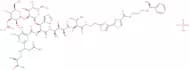
CAS:<p>Peplomycin sulfate is an anticancer antibiotic, which is a derivative of the bleomycin family of glycopeptide antibiotics produced by the bacterium *Streptomyces verticillus*. This antibiotic operates through a mode of action that involves the induction of DNA strand breaks by forming a complex with iron and oxygen, leading to the generation of free radicals. These radicals cleave DNA strands, thereby inhibiting DNA synthesis and inducing apoptosis in cancerous cells.</p>Fórmula:C61H90N18O25S3Pureza:Min. 95%Peso molecular:1,571.67 g/molVanoxonin
CAS:<p>Please enquire for more information about Vanoxonin including the price, delivery time and more detailed product information at the technical inquiry form on this page</p>Fórmula:C18H25N3O9Pureza:Min. 95%Peso molecular:427.40 g/molCyclopentylalbendazole
CAS:<p>Cyclopentylalbendazole is an anthelmintic compound, which is a synthetic derivative of benzimidazole, originally sourced from chemical synthesis processes. Its mode of action involves the selective binding to beta-tubulin, disrupting the polymerization of microtubules within the parasites. This inhibition of microtubule formation is crucial for cellular processes such as nutrient uptake and intracellular transport, eventually leading to immobilization and subsequent death of the parasites.</p>Fórmula:C14H17N3O2SPureza:Min. 95%Peso molecular:291.37 g/molGanciclovir hydrate
CAS:<p>Ganciclovir hydrate is an antiviral compound, which is a synthetic analogue of 2'-deoxy-guanosine derived from chemical synthesis. It functions through selective inhibition of viral DNA polymerase, specifically by incorporating into the viral DNA during replication. This incorporation leads to chain termination, effectively impeding the synthesis of viral DNA and curbing viral proliferation.</p>Fórmula:C9H15N5O5Pureza:Min. 95%Peso molecular:273.25 g/molPlazomicin sulfate
CAS:<p>An aminoglycoside antibiotic. Found applications in treatment of UTi's as it decreases the ability of bacteria to make protein.</p>Fórmula:C25H48N6O10·XH2SO4Pureza:Min. 85%Cor e Forma:PowderPeso molecular:592.69 g/molSilthiofam-des(trimethylsilyl)
CAS:<p>Silthiofam-des(trimethylsilyl) is a synthetic fungicidal compound, serving as a crucial component in the agricultural sector. It originates as a derivative from organic chemistry processes, designed to enhance the fungicide silthiofam by modifying its chemical structure to improve its stability and activity.</p>Fórmula:C10H13NOSPureza:Min. 95%Peso molecular:195.28 g/molAAI101
CAS:Please enquire for more information about AAI101 including the price, delivery time and more detailed product information at the technical inquiry form on this pageFórmula:C11H14N4O5SPureza:Min. 95%Peso molecular:314.32 g/molent NAP 226-90
CAS:ent NAP 226-90 is an organic compound functioning as an antibacterial agent, which is derived from a biologically active natural product. Its mode of action involves the inhibition of essential bacterial enzymes, leading to the disruption of cellular processes within susceptible microorganisms. This compound is particularly effective against a broad spectrum of gram-positive bacteria, making it valuable in medical microbiology research for understanding bacterial resistance mechanisms.Fórmula:C10H15NOPureza:Min. 95%Peso molecular:165.23 g/molOligomycin B
CAS:<p>Oligomycin B is an antibiotic compound, which is derived from Streptomyces species. It is an inhibitor of the mitochondrial ATP synthase complex, specifically targeting the F₀ subunit of ATP synthase. This action obstructs the proton channel, preventing the flow of protons across the mitochondrial membrane. As a result, Oligomycin B effectively halts ATP synthesis by oxidative phosphorylation, which is crucial for the survival of aerobic organisms.</p>Fórmula:C45H72O12Pureza:Min. 95%Cor e Forma:PowderPeso molecular:805.05 g/mol(S)-4-(((R)-6-(2-Chloro-4-fluorophenyl)-5-(methoxycarbonyl)-2-(thiazol-2-yl)-3,6-dihydropyrimidin-4-yl)methyl)morpholine-3-carboxyli c acid
CAS:<p>(S)-4-(((R)-6-(2-Chloro-4-fluorophenyl)-5-(methoxycarbonyl)-2-(thiazol-2-yl)-3,6-dihydropyrimidin-4-yl)methyl)morpholine-3-carboxylic acid is a selective chemical inhibitor, derived from synthetic organic chemistry methodologies. This compound is engineered for precise interaction with a target protein, modulating cellular pathways involved in disease progression. Its unique structure, including the chlorofluorophenyl and thiazolyl moieties, confers high binding affinity and specificity, making it a valuable tool in biochemical research.</p>Fórmula:C21H20ClFN4O5SPureza:Min. 95%Peso molecular:494.9 g/molOxysanguinarine
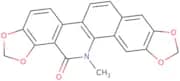
CAS:<p>Oxysanguinarine is an alkaloid compound, which is derived from the plant species of the Papaveraceae family. As a benzophenanthridine alkaloid, it is predominantly extracted from plants such as Sanguinaria canadensis. Its mode of action involves disrupting microbial cell membranes and interfering with enzyme systems, leading to antimicrobial and antifungal effects. This compound exhibits potential in inhibiting the growth of various pathogens, making it a subject of interest in pharmaceutical and microbiological research. Applications of oxysanguinarine extend to studying its efficacy in antimicrobial treatments, exploring its potential as a natural pesticide, and investigating its role in traditional medicine. Due to its complex biochemical interactions, ongoing research aims to better understand its mechanisms and potential therapeutic uses.</p>Fórmula:C20H13NO5Pureza:Min. 95%Peso molecular:347.3 g/molQuilseconazole
CAS:<p>Please enquire for more information about Quilseconazole including the price, delivery time and more detailed product information at the technical inquiry form on this page</p>Fórmula:C22H14F7N5O2Pureza:Min. 95%Peso molecular:513.4 g/molBRD-K98645985
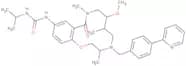
CAS:<p>BRD-K98645985 is a synthetic biochemical reagent, likely developed through chemical synthesis or natural product isolation. It functions as a modulator of specific biochemical pathways, potentially acting as an enzyme inhibitor, receptor agonist, or antagonist. This compound interacts with targeted proteins or cellular mechanisms, altering physiological responses or signaling cascades. The precise mode of action often involves binding to active sites, thereby influencing molecular conformation and activity.</p>Fórmula:C33H43N5O4Pureza:Min. 95%Peso molecular:573.7 g/mol

![N-[[(5S)-3-(4-Methylsulfinylphenyl)-2-oxo-1,3-oxazolidin-5-yl]methyl]acetamide](/_next/image/?url=https%3A%2Fstatic.cymitquimica.com%2Fproducts%2F3D%2Fthumb-webp%2FWDA80041.webp&w=3840&q=75)