Antimicrobianos
Os antimicrobianos são agentes que destroem ou inibem o crescimento de microrganismos, incluindo bactérias, vírus, fungos e parasitas. Esses compostos são essenciais na prevenção e tratamento de infecções, desempenhando um papel crucial na medicina, agricultura e indústria alimentícia. Na CymitQuimica, oferecemos uma ampla gama de antimicrobianos de alta qualidade e pureza, adequados para diversas aplicações científicas e industriais. Nosso catálogo inclui antibióticos, antifúngicos, antivirais e desinfetantes, todos projetados para atender às necessidades de pesquisa e desenvolvimento, bem como para aplicações clínicas e de produção. Com nossos produtos, os profissionais podem garantir a eficácia e a segurança no controle de infecções e na proteção da saúde pública.
Subcategorias de "Antimicrobianos"
- Antibióticos(4.130 produtos)
- Antifúngicos(909 produtos)
- Antiparasitários(703 produtos)
- Antivíricos(766 produtos)
Foram encontrados 2424 produtos de "Antimicrobianos"
Ordenar por
Pureza (%)
0
100
|
0
|
50
|
90
|
95
|
100
4-Demethyl daunomycinone
CAS:<p>4-Demethyl daunomycinone is an anthracycline derivative, which is a natural or semi-synthetic compound derived from the bacterium *Streptomyces*. It is primarily studied for its potential use in anticancer therapies, given its structural similarity to other well-known anthracyclines like daunorubicin and doxorubicin. These compounds are known to intercalate into DNA, thereby disrupting the function of DNA and RNA synthesis, leading to the inhibition of cell proliferation.</p>Fórmula:C20H16O8Pureza:Min. 95%Peso molecular:384.34 g/molSapecin
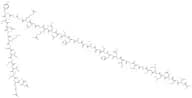
CAS:Sapecin is an antimicrobial peptide, which is derived from the hemolymph of the silk moth (Bombyx mori) with potent bactericidal action. The source of Sapecin is the immune system of the silk moth, where it acts as a natural defense mechanism against microbial infections. Its mode of action involves disrupting bacterial cell membranes, leading to cell lysis and death. The peptide achieves this by inserting itself into the lipid bilayer, creating pores that compromise the structural integrity of the membrane.Fórmula:C164H266N58O52S6Pureza:Min. 95%Peso molecular:4,074.62 g/molCefepime Related Compound E
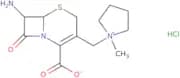
CAS:<p>Cefepime Related Compound E is a chemical impurity, which is typically encountered as a byproduct in the synthesis or degradation of the antibiotic cefepime. This impurity is derived from synthetic processes used in the pharmaceutical industry and can originate from a variety of pathways during the manufacturing or storage of cefepime.</p>Fórmula:C13H20ClN3O3SPureza:Min. 95%Peso molecular:333.83 g/molBleomycin A5 hydrochloride
CAS:Bleomycin A5 hydrochloride is an antineoplastic antibiotic, which is derived from the bacterium Streptomyces verticillus. Its mode of action involves binding to DNA and inducing strand breaks through the generation of free radicals, specifically targeting deoxyribose units. This leads to the inhibition of DNA synthesis and cell division, ultimately resulting in cell death.Fórmula:C57H89N19O21S2•HClPureza:Min. 95%Cor e Forma:PowderPeso molecular:1,177.03 g/molClindamycin 3-phosphate
CAS:<p>Clindamycin 3-phosphate is an antibiotic prodrug, which is a derivative of clindamycin. It is semisynthetic with a synthetic origin, derived by chemically modifying the natural compound lincomycin obtained from the bacterium *Streptomyces lincolnensis*. The mode of action of Clindamycin 3-phosphate involves the inhibition of bacterial protein synthesis. It binds to the 50S subunit of the bacterial ribosome, thereby interfering with the translocation step in protein elongation, ultimately leading to the suppression of bacterial growth.</p>Fórmula:C18H34ClN2O8PSPureza:Min. 95%Cor e Forma:White To Off-White SolidPeso molecular:504.96 g/molDoripenem
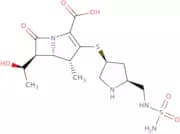
CAS:<p>Doripenem is a carbapenem antibiotic with action on bacterial cell wall synthesis and is used for treating complicated bacterial infections like intra-abdominal infections and urinary tract infections.</p>Fórmula:C15H24N4O6S2Pureza:Min. 95%Cor e Forma:White PowderPeso molecular:420.51 g/molQuinupristin
CAS:Quinupristin is a semi-synthetic antibiotic, which is derived from the natural compound pristinamycin IIA produced by the bacterium Streptomyces pristinaespiralis. It operates by binding to the 50S ribosomal subunit in bacterial cells, inhibiting protein synthesis and thus exerting a bacteriostatic effect. This mechanism effectively disrupts the growth and proliferation of susceptible bacteria.Fórmula:C53H67N9O10SPureza:Min. 95%Peso molecular:1,022.22 g/molFaropenem sodium hydrate
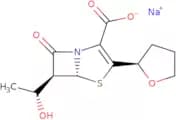
CAS:Faropenem sodium hydrate is a hydrated form of faropenem sodium with similar action and applications as faropenem sodium hemipentahydrate.Fórmula:C12H14NNaO5S·xH2OPureza:Min. 95%Cor e Forma:PowderPeso molecular:307.3 g/molAlamifovir
CAS:Alamifovir is an antiviral agent, which is synthetically derived. The mode of action of Alamifovir involves the inhibition of viral replication within host cells by targeting specific viral enzymes crucial for the replication process. This interference with the viral life cycle diminishes the ability of the virus to propagate and spread within the host organism.Fórmula:C19H20F6N5O5PSPureza:Min. 95%Peso molecular:575.42 g/molOfloxacin Q acid
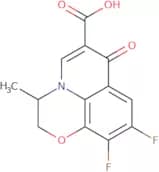
CAS:Ofloxacin Q acid is a quinolone analog, which is a synthetic derivative known for its significant antibacterial properties. This compound is sourced from the chemical synthesis of fluoroquinolone derivatives, designed to enhance reactivity and efficacy in pharmaceutical applications. Ofloxacin Q acid acts by inhibiting bacterial DNA gyrase and topoisomerase IV, enzymes critical for DNA replication, transcription, and repair, thereby leading to the cessation of bacterial growth and replication.Fórmula:C13H9F2NO4Pureza:Min. 95%Peso molecular:281.21 g/molCefmenoxime hydrochloride
CAS:Cefmenoxime hydrochloride is a third-generation cephalosporin antibiotic with action on bacterial cell wall synthesis and is used for treating gynecological and obstetric infections.Fórmula:C16H17N9O5S3HClPureza:Min. 95%Cor e Forma:White PowderPeso molecular:529.79 g/molSancycline hydrochloride
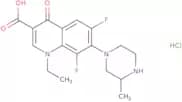
CAS:<p>Sancycline hydrochloride is a tetracycline antibiotic, which is derived from the natural fermentation process of Streptomyces bacteria. The mechanism of action involves the inhibition of protein synthesis by bindin directly to the 30S ribosomal subunit, thereby preventing the attachment of aminoacyl-tRNA to the A site of the ribosome. This action effectively halts the growth of bacteria by impeding protein production, making it bacteriostatic rather than bactericidal.</p>Fórmula:C21H23ClN2O7Pureza:Min. 95%Peso molecular:450.87 g/molLomefloxacin hydrochloride
CAS:<p>Lumefantrine is an antimalarial compound with a mode of action that inhibits heme detoxification in Plasmodium parasites. It is used in combination with artemether for treating malaria.</p>Fórmula:C17H19F2N3O3•HClPureza:Min. 95%Cor e Forma:PowderPeso molecular:387.81 g/molSpiramycin I
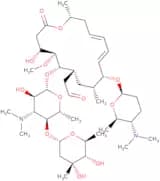
CAS:<p>Spiramycin I is a macrolide antibiotic with action on bacterial protein synthesis inhibition and is used for treating toxoplasmosis and bacterial infections.</p>Fórmula:C43H74N2O14Pureza:Min. 95 Area-%Cor e Forma:White PowderPeso molecular:843.05 g/molTaniborbactam hydrochloride
CAS:<p>Taniborbactam hydrochloride is a β-lactamase inhibitor that is synthetically derived for use in combination with β-lactam antibiotics. Its mode of action involves the inhibition of β-lactamase enzymes, which are produced by certain bacteria to confer resistance to β-lactam antibiotics, including cephalosporins and carbapenems.</p>Fórmula:C19H30BCl2N3O5Pureza:Min. 95%Peso molecular:462.2 g/molSulbactam pivoxyl
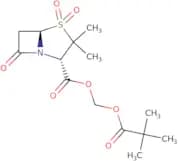
CAS:**Sulbactam pivoxyl** is a prodrug, which is a chemically modified form of sulbactam intended to improve its pharmacokinetic properties. Sulbactam itself is a beta-lactamase inhibitor of synthetic origin, specifically designed to combat antibiotic resistance by inhibiting the beta-lactamase enzymes produced by certain bacteria. These enzymes typically break down beta-lactam antibiotics, rendering them ineffective.Fórmula:C14H21NO7SPureza:Min. 95%Peso molecular:347.38 g/molCurvularin
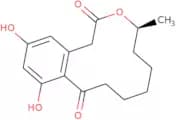
CAS:<p>Curvularin is a secondary metabolite, which is derived from the fungal genus *Curvularia*. This compound is produced through the natural biosynthetic pathways of filamentous fungi, specifically isolated from strains such as *Curvularia lunata*. Curvularin exerts its biological activity primarily through modulation of microtubule dynamics, making it a significant subject of study in cell biology. It disrupts the polymerization processes, impacting the assembly and stability of microtubules, which are critical components of the cytoskeleton involved in cell division, intracellular transport, and structural integrity.</p>Pureza:Min. 95%Ceftizoxime
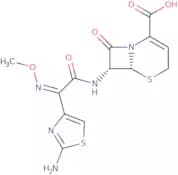
CAS:<p>Ceftizoxime is a third-generation cephalosporin antibiotic with action on bacterial cell wall synthesis and is used for treating respiratory tract infections, urinary tract infections, and gonorrhea.</p>Fórmula:C13H13N5O5S2Pureza:Min. 95%Cor e Forma:PowderPeso molecular:383.41 g/molPefloxacin-d3
CAS:Produto ControladoPefloxacin-d3 is a deuterated fluoroquinolone antibiotic, which is a synthetic derivative of pefloxacin utilized primarily for research purposes. This compound is chemically modified to include deuterium atoms, a stable isotope of hydrogen, thus offering unique properties essential for precise quantitative analysis in pharmacokinetic studies.Fórmula:C17H17D3FN3O3Pureza:Min. 95%Peso molecular:336.38 g/molCecropin A
CAS:Cecropin A is an antimicrobial peptide, which is derived from the immune systems of insects, specifically moths. It displays potent antimicrobial properties through its ability to disrupt bacterial cell membranes, leading to cell lysis and death. This peptide primarily targets Gram-negative bacteria but is also effective against some Gram-positive strains. Cecropin A has garnered significant scientific interest due to its potential applications in developing new antimicrobial agents, particularly in the face of increasing antibiotic resistance. By integrating Cecropin A into therapeutic strategies, researchers aim to broaden the spectrum of antimicrobial options available for use in both clinical and agricultural settings, offering a promising avenue for future drug development.Fórmula:C184H313N53O46Pureza:Min. 95%Peso molecular:4,003.78 g/mol