Ácidos Cinâmicos
Foram encontrados 660 produtos de "Ácidos Cinâmicos"
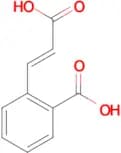
2-Carboxycinnamic acid (predominantly trans)
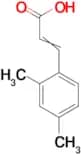
CAS:Fórmula:C10H8O4Pureza:97%Cor e Forma:SolidPeso molecular:192.173-(2,4-Dimethylphenyl)acrylic acid
CAS:Fórmula:C11H12O2Pureza:95%Cor e Forma:SolidPeso molecular:176.2153-(4-Propoxyphenyl)acrylic acid
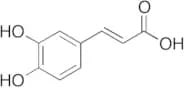
CAS:Fórmula:C12H14O3Pureza:97%Cor e Forma:SolidPeso molecular:206.241trans-Caffeic Acid
CAS:Applications trans-Caffeic Acid is a useful synthetic intermediate. It was used as a reactant to synthesize N-caffeoylphenalkylamide derivatives as bacterial efflux pump inhibitors. It is also used to prepare caffeic acid phenethyl ester analogs with antitumor structures.
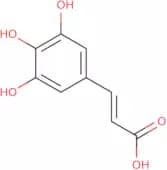
References Michalet, S., et al.: Bioorg. Med. Chem. Lett., 17, 1755 (2007); Nagaoka, T., et al.: Bioorg. Med. Chem., 10, 3351 (2002)Fórmula:C9H8O4Cor e Forma:NeatPeso molecular:180.163,4,5-Trihydroxycinnamic acid
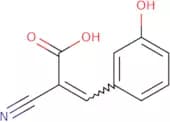
CAS:3,4,5-Trihydroxycinnamic acid is a phenolic compound found in the bark of Betula pubescens that has been shown to have antiinflammatory activity. It also has antioxidant properties and has been shown to inhibit the production of TNF-α (tumor necrosis factor-alpha) and to reduce oxidative stress in cells. 3,4,5-Trihydroxycinnamic acid has also been shown to inhibit prostate cancer cell growth by inducing apoptosis. Cell culture experiments have shown that 3,4,5-trihydroxycinnamic acid reduces lung damage caused by lipopolysaccharide (LPS)-induced inflammatory response.Fórmula:C9H8O5Pureza:Min. 95%Cor e Forma:PowderPeso molecular:196.16 g/molalpha-Cyano-3-hydroxycinnamic acid
CAS:alpha-Cyano-3-hydroxycinnamic acid is a mitochondrial matrix analog that has been shown to inhibit the uptake of carnitine, glutamate, and branched-chain amino acids. This compound also inhibits the activity of glyceraldehyde-3-phosphate dehydrogenase and dodecyl CoA dehydrogenase, which are enzymes involved in the production of cellular energy. alpha-Cyano-3-hydroxycinnamic acid also inhibits the synthesis of mitochondrial DNA and RNA. The compound binds to the enzyme succinate dehydrogenase, inhibiting its function. This inhibition leads to a decrease in cellular energy production and an increase in oxidative stress.
Fórmula:C10H7NO3Pureza:Min. 95%Cor e Forma:PowderPeso molecular:189.17 g/mola-Cyano-4-hydroxycinnamic acid
CAS:a-Cyano-4-hydroxycinnamic acid is a high quality chemical that is useful as a reagent, intermediate and building block. This compound has been used in the synthesis of various complex compounds including the fine chemicals, useful scaffolds and research chemicals. The versatility of this compound makes it an important reaction component for many reactions.
Fórmula:C10H7NO3Pureza:Min. 98 Area-%Peso molecular:189.17 g/molRef: 3D-W-200275
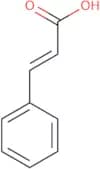
-Unit-kgkgA consultar1kgA consultar50gA consultar100gA consultar250gA consultar500gA consultartrans-Cinnamic acid
CAS:Cinnamic acid is a phenolic acid that is found in plants and has a general structure of CH2-C6H4-CO2H. It can be metabolized by the enzyme cinnamate 4-hydroxylase to caffeic acid. Cinnamic acid has been shown to have genotoxic activity through its ability to form DNA adducts, which can cause mutations in cells. This compound also has antioxidant properties and may be used as an anticancer agent due to its ability to inhibit proliferation of cancer cells and induce apoptosis. Cinnamic acid inhibits the production of prostaglandin E2 (PGE2) in rat primary astrocytes, which may lead to the development of inflammatory eye disorders such as uveitis or retinal detachment. The compound is also able to suppress the expression of toll-like receptor 2 (TLR2), which may make it useful for treatment of infectious diseases. Cinnamic acid also forms hydrogen bondsFórmula:C9H8O2Pureza:Min. 95%Cor e Forma:White PowderPeso molecular:148.16 g/molRef: 10-F749587
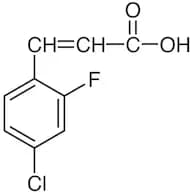
Produto descontinuado4-Chloro-2-fluorocinnamic Acid
CAS:Fórmula:C9H6ClFO2Pureza:>97.0%(GC)(T)Cor e Forma:White to Almost white powder to crystalPeso molecular:200.59