Ácidos Cinâmicos
Foram encontrados 660 produtos de "Ácidos Cinâmicos"
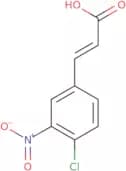
cis-4-Chloro-3-nitrocinnamic acid
Cis-4-Chloro-3-nitrocinnamic acid is an aromatic organic compound with potential utility in biochemical research and synthesis. This compound is typically derived from synthetic chemical processes involving chlorination and nitration reactions on cinnamic acid derivatives. Its molecular structure, characterized by both chloro and nitro functional groups, allows it to interact in unique ways with various biochemical pathways and molecular frameworks.
Fórmula:C9H6ClNO4Pureza:Min. 95%Cor e Forma:White PowderPeso molecular:227.6 g/mol4-Aminocinnamic acid
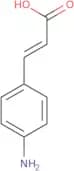
CAS:4-Aminocinnamic acid is a monomer that can be polymerized to form polymers. It is soluble in organic solvents and is resistant to UV light. 4-Aminocinnamic acid has been shown to have photochemical properties and can be used to produce hydrogen bonds with other molecules. This compound has been used as a carbon source for microbial growth and has been shown to be an effective genetic control agent for the bacteria Escherichia coli. 4-Aminocinnamic acid has also been shown to inhibit the growth of butyric acid producing bacteria, such as Clostridium butyricum, while promoting the growth of lactic acid producing bacteria, such as Lactobacillus plantarum.
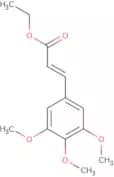
Fórmula:C9H9NO2Pureza:90%Cor e Forma:PowderPeso molecular:163.17 g/molEthyl 3,4,5-trimethoxycinnamate
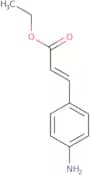
CAS:Ethyl 3,4,5-trimethoxycinnamate is a cinnamic acid derivative that has significant cytotoxicity and anticancer activity. It inhibits the growth of Leishmania parasites by inhibiting the production of gamma-aminobutyric acid, which is essential for cell division and survival. Ethyl 3,4,5-trimethoxycinnamate has been shown to inhibit the growth of cancer cells in vitro by binding to DNA at dipole sites and disrupting the integrity of the molecule. This compound also has optical properties that may be due to its ability to absorb light in the blue region of the spectrum. The anti-cancer effects of ethyl 3,4,5-trimethoxycinnamate may be related to its ability to inhibit cell growth.Fórmula:C14H18O5Pureza:Min. 95%Cor e Forma:SolidPeso molecular:266.29 g/molEthyl 4-aminocinnamate
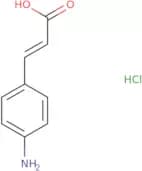
CAS:Ethyl 4-aminocinnamate is a supramolecular, homologous, activated, linear polymer. It is used as an amine and phosphazene ligand in mesomorphic solid-state chemistry. It has a reversible covalent bond that can be thermally broken and re-formed. This property allows for the synthesis of polymers with functional groups on both ends of the molecule. The nitro group on this compound can be reduced to amine to give another functional group. Ethyl 4-aminocinnamate has been shown to have pharmacokinetic properties that are similar to those of ethyl 4-aminobenzoate (EB). EB is an inhibitor of NS5B polymerase that blocks RNA synthesis and leads to inhibition of viral replication. EB also inhibits ring opening reactions in the presence of nitro groups, which may explain its inhibitory effect on HIV RNA synthesis.Fórmula:C11H13NO2Pureza:Min. 95%Cor e Forma:PowderPeso molecular:191.23 g/mol4-Aminocinnamic acid hydrochloride
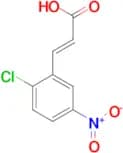
CAS:4-Aminocinnamic acid hydrochloride (4ACA) is a synthetic compound that inhibits the bacterial membrane by binding to the polypeptide chain of the protein. It is a water-soluble polymer that is capable of enhancing the water solubility of other compounds and has been shown to inhibit the growth of typhimurium. 4ACA binds to chalcone, anilines, and styrene, which are all substrates for bacterial enzymes. The interaction between 4ACA and these substrates alters their chemical properties and provides resistance to bacteria.Fórmula:C9H9NO2·HClPureza:Min. 95%Cor e Forma:Off-White PowderPeso molecular:199.63 g/mol4-Chloro-3-nitrocinnamic acid
CAS:4-Chloro-3-nitrocinnamic acid is a thionyl chloride derivative of cinnamic acid. It is used as an intermediate in the preparation of pharmaceuticals and dyestuffs. 4-Chloro-3-nitrocinnamic acid inhibits the activity of amides, dimethylformamide, alkaline hydrolysis, xylene, carboxyphenyl, cinnamic, refluxing, nitrophenyl and carboxylic acids. 4-Chloro-3-nitrocinnamic acid reacts with chloride to form the corresponding chloride salt. This compound can also react with formamide to form an amide salt. The ester group of 4-chloro-3-nitrocinnamic acid can be cleaved by nitro compounds to produce nitro derivatives.Fórmula:C9H6ClNO4Pureza:Min. 95%Cor e Forma:Off-White PowderPeso molecular:227.6 g/mola-Cyano-4-hydroxycinnamic acid
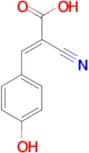
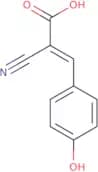
CAS:a-Cyano-4-hydroxycinnamic acid is a cyclic peptide that has been shown to have cytotoxic and antimicrobial properties. It has been shown to be effective in reducing the viability of cells in vitro by interfering with DNA synthesis and cell signaling pathways, as well as causing oxidative stress. This compound also induces apoptosis in squamous carcinoma cells and hypoxic tumor cells; this effect may be due to its ability to induce the release of cytochrome c from mitochondria. a-Cyano-4-hydroxycinnamic acid has been shown to produce antibacterial activity against Gram-positive bacteria, such as Streptococcus pneumoniae and Staphylococcus aureus, but not against Gram-negative bacteria, such as Escherichia coli or Pseudomonas aeruginosa.Fórmula:C10H7NO3Cor e Forma:Slightly Yellow PowderPeso molecular:189.17 g/moltrans-4-Coumaric acid
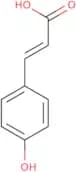
CAS:Trans-4-coumaric acid or p-coumaric acid, is a derivative of the cinnamic acid. It is the initial substrate to produce several intermediates such as ferulic acid, caffeic acid, rosmarinic acid, gallic acid, and carnosic acid. Trans-4-coumaric acid, as well as its derivatives, have antioxidant properties; they are common ingredients in cosmetics and as dietary supplement.Fórmula:C9H8O3Pureza:Min. 98 Area-%Cor e Forma:PowderPeso molecular:164.16 g/molMethyl 4-hydroxy-3-methoxycinnamate
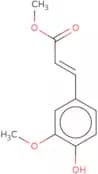
CAS:Methyl 4-hydroxy-3-methoxycinnamate is a natural phenolic compound that is found in small quantities in many plants and foods. It is used to produce other compounds, such as vanillin, which are used as flavoring agents. Methyl 4-hydroxy-3-methoxycinnamate can be quantified using the enzymatic reaction of peroxidase with 3,4,5-trimethoxybenzene. The kinetics of this reaction have been studied by titration calorimetry. Aspergillus niger catalase has been shown to be sensitive to methyl 4-hydroxy-3-methoxycinnamate. Birch and oak wood lignocellulosic biomass can be converted into sugars through a hydrolysis process with methyl 4-hydroxy-3-methoxycinnamate. The carbohydrate content of birch and oak wood was reduced by approximately 60
Fórmula:C11H12O4Pureza:Min. 95%Cor e Forma:PowderPeso molecular:208.21 g/mol3-Hydroxycinnamic acid
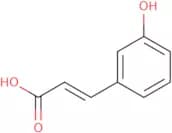
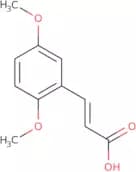
CAS:3-Hydroxycinnamic acid is a natural compound that belongs to the group of caffeic acids. It is found in many plants, including coffee beans and tea leaves. 3-Hydroxycinnamic acid has been shown to inhibit the proliferation of 3T3-L1 preadipocytes and HL-60 cells by inhibiting mitochondrial membrane potential. This compound also inhibits the activity of 4-hydroxyphenylacetic acid (4HPA) hydroxylase, which converts phenylalanine into tyrosine and 4HPA, an intermediate in the synthesis of melanin. 3-Hydroxycinnamic acid can be used as a model system for studying caffeic acids in vitro. Structural analysis has demonstrated that 3-hydroxycinnamic acid contains nitrogen atoms, which may be essential for its anti-inflammatory activities.Fórmula:C9H8O3Pureza:Min. 95%Cor e Forma:PowderPeso molecular:164.16 g/mol2,5-Dimethoxycinnamic acid
CAS:2,5-Dimethoxycinnamic acid is an unsymmetrical phenolic compound that is synthesized from caffeic acid. It has been shown to have a number of biological activities such as anti-inflammatory, coagulation, and inhibitory effects on platelet aggregation. 2,5-Dimethoxycinnamic acid has also been shown to be a potent inhibitor of platelet aggregation and thrombosis formation in vitro. This natural compound is also found in plants such as green tea leaves which contain the polyphenols epigallocatechin gallate and hydroxyanisole. The chromophore group in the molecule is responsible for the yellow color of this substance.Fórmula:C11H12O4Pureza:Min. 95%Cor e Forma:PowderPeso molecular:208.21 g/mol2-Methylcinnamic acid, predominantly trans
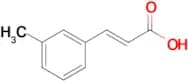
CAS:The 2-methylcinnamic acid is a derivative of cinnamic acid. It is an organic compound that is a colorless liquid at room temperature. The 2-methylcinnamic acid can be synthesized via the Suzuki coupling reaction between 2-chlorocinnamic acid and 4-hydroxycinnamic acid in the presence of a ruthenium complex, a diphosphine ligand, and an acidic co-solvent. This organic compound has been shown to inhibit prostaglandin synthesis by interacting with the prostanoid receptor, a protein located on the surface of cells that binds to inflammatory agents or hormones. These interactions may also lead to the inhibition of cyclooxygenase (COX) enzymes, which are responsible for prostaglandin synthesis. The 2-methylcinnamic acid can also be converted into flavonoids such as quercetin and apigenin through oxidation reactions.
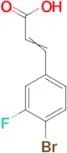
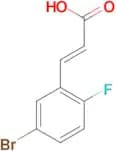
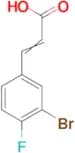
Fórmula:C10H10O2Pureza:Min. 95%Cor e Forma:PowderPeso molecular:162.19 g/mol3-(4-Bromo-3-fluorophenyl)acrylic acid
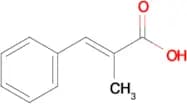
CAS:Fórmula:C9H6BrFO2Pureza:98%Cor e Forma:SolidPeso molecular:245.0472-Methyl-3-phenylacrylic acid
CAS:Fórmula:C10H10O2Pureza:97%Cor e Forma:Light yellow powderPeso molecular:162.1883-(3-Chlorophenyl)acrylic acid
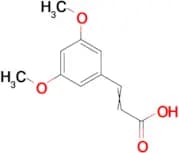
CAS:Fórmula:C9H7ClO2Pureza:95%Cor e Forma:White to very pale yellow powderPeso molecular:182.63-(3,5-Dimethoxyphenyl)acrylic acid
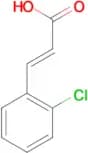
CAS:Fórmula:C11H12O4Pureza:95%Cor e Forma:SolidPeso molecular:208.2132-Chlorocinnamic acid
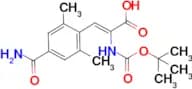
CAS:Fórmula:C9H7ClO2Pureza:98%Cor e Forma:Solid, White to light yellow crystal powderPeso molecular:182.6(Z)-2-((tert-butoxycarbonyl)amino)-3-(4-carbamoyl-2,6-dimethylphenyl)acrylic acid
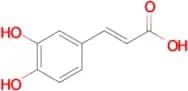
CAS:Pureza:96%Peso molecular:334.37200933-(3,4-Dihydroxyphenyl)acrylic acid
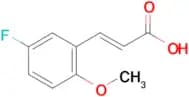
CAS:Fórmula:C9H8O4Pureza:95%Cor e Forma:Solid, Yellow powderPeso molecular:180.1595-Fluoro-2-methoxycinnamic acid
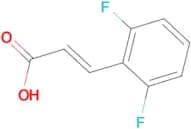
CAS:Fórmula:C10H9FO3Pureza:95%Cor e Forma:SolidPeso molecular:196.177trans-2,6-Difluorocinnamic acid
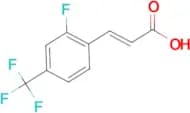
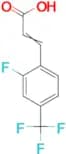
CAS:Fórmula:C9H6F2O2Pureza:98%Cor e Forma:SolidPeso molecular:184.1422-Fluoro-4-(trifluoromethyl)cinnamic acid
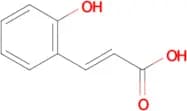
CAS:Fórmula:C10H6F4O2Pureza:98%Cor e Forma:SolidPeso molecular:234.15(2E)-3-(2-hydroxyphenyl)acrylic acid
CAS:Fórmula:C9H8O3Pureza:98%Cor e Forma:SolidPeso molecular:164.16a-Cyano-4-hydroxycinnamic acid
CAS:Fórmula:C10H7NO3Pureza:97%Cor e Forma:Pale yellow to yellow green powderPeso molecular:189.17






![(E)-3-([1,1′-Biphenyl]-4-yl)acrylic acid](/_next/image/?url=https%3A%2Fstatic.cymitquimica.com%2Fproducts%2F10%2Fthumb-webp%2FF552529.webp&w=3840&q=75)