Nucleotídeos
Os nucleotídeos são compostos orgânicos que servem como building blocks dos ácidos nucleicos, essenciais para a formação de DNA e RNA. Cada nucleotídeo é composto por uma base nitrogenada, uma molécula de açúcar e um ou mais grupos fosfato. Esses nucleotídeos se unem para formar longas cadeias, criando o material genético que carrega e transmite informações genéticas em todos os organismos vivos. Nesta seção, você encontrará uma ampla variedade de nucleotídeos cruciais para pesquisas em genética, biologia molecular e bioquímica. Eles são fundamentais para estudar processos genéticos, sintetizar ácidos nucleicos e desenvolver ferramentas diagnósticas e terapêuticas. Na CymitQuimica, oferecemos nucleotídeos de alta qualidade para apoiar suas pesquisas científicas e aplicações, garantindo precisão e confiabilidade em seus experimentos.
Subcategorias de "Nucleotídeos"
Foram encontrados 2634 produtos de "Nucleotídeos"
Ordenar por
Pureza (%)
0
100
|
0
|
50
|
90
|
95
|
100
Adenosine 3',5'-diphosphate disodium salt
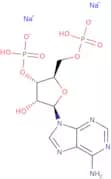
CAS:<p>Adenosine 3',5'-diphosphate disodium salt is a nucleotide that is found in all cells and is involved in the regulation of many physiological processes, including energy metabolism and blood flow. It has inhibitory effects on platelets and calcium ion channels. Adenosine 3',5'-diphosphate disodium salt also inhibits the synthesis of prostaglandins by blocking the conversion of arachidonic acid to prostaglandin H2, which leads to an anti-inflammatory effect. Adenosine 3',5'-diphosphate disodium salt has been shown to be effective in treating primary pulmonary hypertension and bowel disease. The reaction solution can be used for polymerase chain reactions, multivariate logistic regression, or other applications.</p>Fórmula:C10H15N5O10P2·2NaPureza:Min. 96 Area-%Cor e Forma:White Beige PowderPeso molecular:473.18 g/mol2'-Deoxy-2'-fluorocytidine
CAS:<p>2'-Deoxy-2'-fluorocytidine is a nucleoside analog with the potential as an Crimean-Congo hemorrhagic fever virus antiviral</p>Fórmula:C9H12FN3O4Pureza:Min. 98 Area-%Cor e Forma:White Off-White PowderPeso molecular:245.21 g/mol5-Methoxyuridine
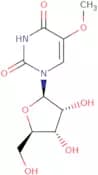
CAS:<p>5-Methoxyuridine is a nucleoside that is structurally related to uridine. It is an intermediate in the biosynthesis of pyrimidines and is also used as a precursor for other compounds. 5-Methoxyuridine has been shown to inhibit protein synthesis by binding to purine receptors and inhibiting the function of protein kinases. The x-ray crystal structures of 5-methoxyuridine bound to two different p2y receptors have been determined. The analytical chemistry of 5-methoxyuridine is based on UV absorption measurements, which are able to identify hydrogen bonds between the base and the sugar moiety. This drug has been investigated for its potential use in cancer therapy due to its ability to inhibit RNA synthesis, which can lead to cell death by incomplete replication or transcription. 5-Methoxyuridine inhibits messenger RNA (mRNA) production in bacteria by interfering with sequence recognition and binding sites within the ribosome and preventing</p>Fórmula:C10H14N2O7Pureza:Min. 98 Area-%Cor e Forma:PowderPeso molecular:274.23 g/mol2'-Chloro-2'-deoxyuridine
CAS:<p>2'-Chloro-2'-deoxyuridine is a thymidine analog for research applications</p>Fórmula:C9H11ClN2O5Pureza:Min. 95%Cor e Forma:PowderPeso molecular:262.65 g/mol2-Amino-2'-deoxy-2'-fluoroadenosine
CAS:<p>2-Amino-2'-deoxy-2'-fluoroadenosine is a modified nucleoside. Fluorination modifications can make molecules have increased resistance to enzymatic degradation, which has useful applications in drug development. The extra amino group could also enhance binding properties or alter biological activity.</p>Fórmula:C10H13FN6O3Pureza:Min. 95%Cor e Forma:PowderPeso molecular:284.25 g/mol1-(β-D-Arabinofuranosyl)thymine
CAS:<p>1-(β-D-Arabinofuranosyl)thymine is a nucleoside analog. It has a similar structure to thymidine. It has possible applications in research into the specificity and kinetics of thymidine kinases and has demonstrated antiviral activity against some viruses.</p>Fórmula:C10H14N2O6Pureza:Min. 95%Cor e Forma:White PowderPeso molecular:258.23 g/mol7-Methyl-6-thioguanosine inner salt
CAS:<p>7-Methyl-6-thioguanosine inner salt is a compound that inhibits the activity of creatine kinase and phosphatase, which are enzymes involved in energy metabolism. It also binds to actin filaments and prevents their depolymerization. The binding mechanism of 7-methyl-6-thioguanosine inner salt is believed to be due to its ability to form disulfide bonds with cysteine residues on the surface of the enzyme. This inhibition has been shown to reduce the ATP production in mammalian cells and has been used as a model system for studying cellular processes.</p>Fórmula:C11H15N5O4SPureza:Min. 95 Area-%Cor e Forma:White PowderPeso molecular:313.33 g/molAdenosine 5'-diphosphate bis(cyclohexylammonium) salt
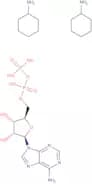
CAS:<p>Adenosine 5'-diphosphate bis(cyclohexylammonium) salt is a novel antiviral agent that has been shown to be an activator of the adenylate cyclase enzyme. It also inhibits DNA and RNA synthesis in viruses, which prevents viral replication. Adenosine 5'-diphosphate bis(cyclohexylammonium) salt is active against cancer cells and has been shown to inhibit tumor growth and prolong survival in animal models. This compound can be synthesized by reacting the monophosphate with phosphoramidites or deoxyribonucleosides.</p>Fórmula:C10H15N5O10P2·2C6H13NPureza:Min. 98 Area-%Cor e Forma:PowderPeso molecular:625.55 g/molUridine 3'-monophosphate disodium salt
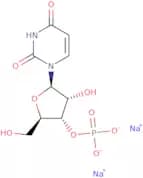
CAS:<p>Uridine 3'-monophosphate disodium salt is a nucleotide that is part of the pyrimidine family. It is synthesized from uridine and phosphoric acid in a reaction that requires hydrogen bonding and the presence of an enzyme. Uridine 3'-monophosphate disodium salt has been shown to inhibit the production of eosinophil cationic protein, which may be due to its ability to denature proteins. This drug also has an effect on the synthesis of proteins by inhibiting enzymes such as acetylcholinesterase and catalase. The synthesis of glycosidic bonds is also inhibited, which may lead to an increase in body mass index (BMI).</p>Fórmula:C9H11N2Na2O9PPureza:Min. 95%Cor e Forma:White PowderPeso molecular:368.15 g/mol2'-Deoxy-N2-phenoxyacetylguanosine
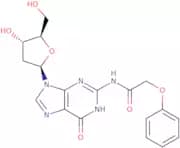
CAS:<p>2'-deoxy-N2-phenoxyacetylguanosine is a synthetic nucleoside that is used as a substrate in experiments to study the properties of guanine. The compound can be synthesized by the reaction of 2'-deoxy-N2-phenoxyacetaldehyde with guanine. The synthesis starts with the condensation of 2'-deoxyribose and N2-phenoxyacetaldehyde, followed by the oxidation of the resulting anhydride to give aldehyde, which reacts with guanine to form a Schiff base. This then undergoes hydrolysis to yield 2'-deoxy-N2-phenoxyacetylguanosine.</p>Fórmula:C18H19N5O6Pureza:Min. 95%Peso molecular:401.38 g/molAzathioprine
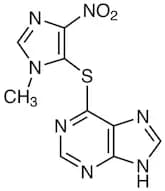
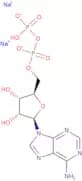
CAS:Fórmula:C9H7N7O2SPureza:>98.0%(T)(HPLC)Cor e Forma:Light yellow to Yellow to Green powder to crystalPeso molecular:277.26Adenosine 5'-diphosphate disodium salt
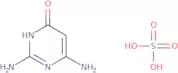
CAS:<p>Adenosine 5'-diphosphate disodium salt is a sodium salt of adenosine 5'-diphosphate. It is found in the extract of plants such as salvianolic acid and rhizoma gastrodiae, as well as in dinucleotide phosphate. This product has been shown to have cardioprotective effects against ischemia reperfusion injury in animal models. It also has congestive heart failure activity, which may be due to its ability to relax vascular smooth muscle and increase the diameter of lymphatic vessels. Adenosine 5'-diphosphate disodium salt has been shown to inhibit the binding of serotonin (5-hydroxytryptamine) to 5-HT2 receptors, which are present in heart tissue.</p>Fórmula:C10H13N5Na2O10P2Pureza:Min. 95 Area-%Cor e Forma:White PowderPeso molecular:471.16 g/mol2,4-Diamino-6-hydroxypyridine sulphate
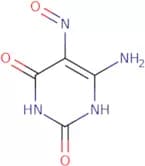
CAS:<p>2,4-Diamino-6-hydroxypyridine sulphate is a nucleoside for use in research applications</p>Fórmula:C4H6N4O•(H2SO4)xPureza:Min. 95%Cor e Forma:PowderPeso molecular:224.2 g/mol4-Amino-2,6-dihydroxy-5-nitrosopyrimidine
CAS:<p>4-Amino-2,6-dihydroxy-5-nitrosopyrimidine is a molecule that has been shown to be an effective inhibitor of the enzyme tyrosinase in the oxidation of tyrosine to DOPA, which is a precursor of melanin. It is believed that vibrational and structural changes during these reactions are responsible for the inhibitory effects. 4-Amino-2,6-dihydroxy-5-nitrosopyrimidine has also been shown to have anti cancer effects on glioma cells. This molecule binds to copper ions, forming a chelate ring that can stabilize reactive intermediates and terminate free radicals. The chlorine atom on this molecule may be responsible for its cytotoxic effects by reacting with nucleophilic sites on proteins. The functional groups on this molecule react with acid catalysts, such as protonation or dehydration reactions.</p>Fórmula:C4H4N4O3Pureza:Min. 98 Area-%Cor e Forma:PowderPeso molecular:156.1 g/mol4-[(1Z)-2-(4-Chlorophenyl)vinyl]pyridine
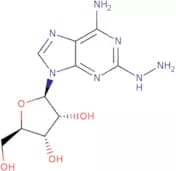
CAS:<p>4-[(1Z)-2-(4-Chlorophenyl)vinyl]pyridine is a modified nucleoside that is used in anticancer drugs. It has shown antiviral and antitumor effects. 4-[(1Z)-2-(4-Chlorophenyl)vinyl]pyridine is synthesized by condensing 4-chlorobenzaldehyde and 2,3-dichloropyridine. The nucleoside has been modified to be phosphorylated at the 5′ position and contains a ribonucleotide moiety and a deoxyribonucleotide moiety. This product is of high purity and quality, with an activator group at the 5′ position.</p>Fórmula:C13H10ClNPureza:Min. 95%Peso molecular:215.68 g/mol2-Hydrazinoadenosine
CAS:<p>2-Hydrazinoadenosine is an active analogue of adenosine. It is a potent agonist for the adenosine receptor subtypes A1 and A2A with high affinity. 2-Hydrazinoadenosine has been shown to inhibit cardiac contractility in animal models, as well as to produce hypotension, bradycardia, and bronchodilation in humans. This drug also has a functional effect on the heart by binding to adenosine receptors, which leads to the inhibition of catecholamine release. This drug is used clinically as an antiarrhythmic agent and a vasodilator in coronary artery disease.</p>Fórmula:C10H15N7O4Pureza:Min. 95%Cor e Forma:PowderPeso molecular:297.27 g/molCytidine 5'-diphosphocholine
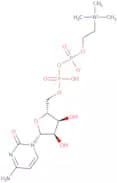
CAS:<p>Cytidine 5'-diphosphocholine is a nucleotide that is a precursor of uridine 5'-triphosphate and cytidine 5'-monophosphate, which are important for DNA synthesis. Cytidine 5'-diphosphocholine is used in the preparation of samples for experiments. This compound has been shown to induce neuronal death in an experimental model. It has also been shown to inhibit polymerase chain reactions and affect the activity of enzymes such as alpha-7 nicotinic acetylcholine receptors and glutamate decarboxylase. Cytidine 5'-diphosphocholine has been found to have no effect on basic fibroblast cells, but it does have physiological effects on human erythrocytes.</p>Fórmula:C14H26N4O11P2Pureza:Min. 98 Area-%Cor e Forma:White PowderPeso molecular:488.32 g/mol4-(b-D-Ribofuranosyl)-vic-triazolo[4,5-b]pyridin-5-one
CAS:<p>Ribonucleosides, Deoxyribonucleosides and Activator are a group of synthetic compounds that are used in the synthesis of DNA. Ribonucleosides and Deoxyribonucleosides are nucleotides that contain ribose or deoxyribose as the sugar moiety. Activator is an activator for DNA polymerase, which catalyses the formation of a phosphodiester bond between two adjacent 3'-5' phosphate groups on a single strand of DNA. Ribonuclesides, Deoxyribonucleosides and Activator are used in recombinant DNA technology to synthesize DNA molecules containing modified bases. The CAS number for Ribonuclesides, Deoxyribonucleosides and Activator is 59892-40-9.</p>Fórmula:C10H12N4O5Pureza:Min. 95%Peso molecular:268.23 g/mol8-Chloro-2'-deoxyadenosine
CAS:<p>8-Chloro-2'-deoxyadenosine is a nucleoside analogue and a disinfectant that inhibits the synthesis of DNA. It has been used to control active viruses and to induce apoptotic cell death in cancer cells. 8-Chloro-2'-deoxyadenosine binds to viral RNA and DNA, preventing viral replication by inhibiting the activity of reverse transcriptase, which is an enzyme that copies the virus's genetic information from RNA into DNA. This drug has also been shown to be effective for the treatment of HIV infection. 8-Chloro-2'-deoxyadenosine disrupts DNA synthesis and cellular metabolism by blocking transcription and protein synthesis.</p>Fórmula:C10H12ClN5O3Pureza:Min. 95%Cor e Forma:PowderPeso molecular:285.69 g/mol5-Methyl-2-thiouracil
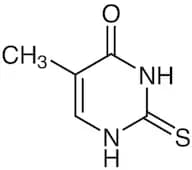
CAS:Fórmula:C5H6N2OSPureza:>98.0%(T)(HPLC)Cor e Forma:White to Almost white powder to crystalPeso molecular:142.18






![4-[(1Z)-2-(4-Chlorophenyl)vinyl]pyridine](/_next/image/?url=https%3A%2Fstatic.cymitquimica.com%2Fproducts%2F3D%2Fthumb-webp%2FNC65881.webp&w=3840&q=75)
![4-(b-D-Ribofuranosyl)-vic-triazolo[4,5-b]pyridin-5-one](/_next/image/?url=https%3A%2Fstatic.cymitquimica.com%2Fproducts%2F3D%2Fthumb-webp%2FNR04971.webp&w=3840&q=75)