Nucleotídeos
Subcategorias de "Nucleotídeos"
Foram encontrados 2638 produtos de "Nucleotídeos"
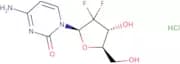
Gemcitabine HCl
CAS:Anticancer nucleoside; DNA synthesis interference
Fórmula:C9H11F2N3O4·HClPureza:Min. 98 Area-%Cor e Forma:White PowderPeso molecular:299.66 g/molClevudine
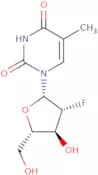
CAS:Clevudine is a synthetic pyrimidine analogue effective against the hepatitis B virus (HBV). Once inside the cell, it is converted into its active forms, clevudine monophosphate and clevudine triphosphate. The triphosphate form competes with thymidine to be incorporated into viral DNA, leading to DNA chain termination and inhibition of the HBV DNA polymerase (reverse transcriptase). Due to its long half-life, clevudine significantly reduces covalently closed circular DNA (cccDNA), making relapse less likely after treatment ends.
Fórmula:C10H13FN2O5Pureza:Min. 95%Cor e Forma:White PowderPeso molecular:260.22 g/molRef: 3D-NC09470
Produto descontinuado6-Azauridine
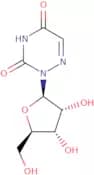
CAS:Inhibitor of uridine monophosphate synthase
Fórmula:C8H11N3O6Pureza:Min. 95%Cor e Forma:White PowderPeso molecular:245.19 g/mol5-Aminouridine
CAS:5-Aminouridine is an analog of uridine that is used in the synthesis of RNA. It inhibits the synthesis of RNA by viruses, and it may also inhibit the synthesis of RNA by cells, including muscle cells. 5-Aminouridine has been shown to inhibit protein synthesis in muscle cells incubated with orotic acid. The drug may also interact with other drugs metabolized by UDP-glucose pyrophosphorylase, such as carbamazepine and phenytoin. This interaction may lead to decreased serum levels of these drugs following treatment with 5-aminouridine.
Fórmula:C9H13N3O6Pureza:Min. 90 Area-%Cor e Forma:PowderPeso molecular:259.22 g/molRef: 3D-NA163143
Produto descontinuado3'-O-Acetyl-5'-tert-butyldiphenylsilyl-2'-deoxy-2'-fluoro-5-methyluridine
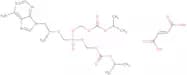
3'-O-Acetyl-5'-tert-butyldiphenylsilyl-2'-deoxy-2'-fluoro-5-methyluridine is a synthetic nucleoside that has antiviral activity. It is a modified nucleoside that contains a monophosphate group, which makes it an activator of DNA polymerase. 3'-O-Acetyl-5'-tert-butyldiphenylsilyl-2'-deoxy-2'-fluoro-5-methyluridine is novel because it contains an acetyl group at the 3' position and a silyl ether on the 2' oxygen atom. 3'-O-Acetyl-5'-tert-butyldiphenylsilyl-2'-deoxy-2'-fluoro -5 -methyluridine has CAS No. 62768‑36‑3 and is available in high purity.Pureza:Min. 95%Tenofovir disoproxil fumarate
CAS:Anti-viral; reverse transcriptase inhibitor
Fórmula:C23H34N5O14PPureza:Min. 97.5 Area-%Cor e Forma:White Off-White PowderPeso molecular:635.52 g/mol5-Bromo-2'-deoxyuridine
CAS:5-Bromo-2'-deoxyuridine (5-BrDU) is a nitrate reductase inhibitor that prevents the reduction of nitrate to nitrite by inhibiting the enzyme nitrate reductase. It is a genotoxic agent that has been shown to cause DNA damage and cell death in vitro. 5-BrDU has been shown to induce preconditioning in vivo, reducing neuronal injury after ischemia. This drug also binds to NMDA receptors and may be useful as a model system for studying neurodegenerative diseases such as Alzheimer's disease. 5-BrDU has been shown to inhibit the polymerase chain reaction in wild-type strains of bacteria, but not in strains with a mutation in their DNA gyrase genes.
Fórmula:C9H11BrN2O5Pureza:Min. 99 Area-%Cor e Forma:White Off-White PowderPeso molecular:307.1 g/molRef: 3D-NB06315
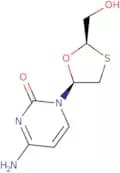
Produto descontinuadoLamivudine
CAS:Anti-viral; reverse transcriptase inhibitor
Fórmula:C8H11N3O3SPureza:Min. 95%Cor e Forma:White PowderPeso molecular:229.26 g/molN4-Methylcytidine
CAS:N4-Methylcytidine is a member of the group P2. Its chemical structure consists of two nitrogen atoms, one carbon atom, and four hydrogen atoms. It is a nucleoside analogue that inhibits synthesis of human mitochondrial DNA by inhibiting bacterial enzyme uridine-cytidine kinase, which converts uridine to cytidine in the mitochondria. N4-Methylcytidine has been shown to be potent against viruses such as HIV and herpes simplex virus type 1 (HSV-1) in cell culture studies. This antiviral effect is due to the interference with viral dna replication and protein synthesis by preventing incorporation of uracil into dna and ribosomal RNA.
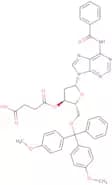
Fórmula:C10H15N3O5Pureza:Min. 95%Cor e Forma:PowderPeso molecular:257.24 g/molN6-Benzoyl-2'-deoxy-5'-O-DMT-adenosine 3'-O-succinate triethylammonium salt
CAS:N6-Benzoyl-2'-deoxy-5'-O-DMT-adenosine 3'-O-succinate triethylammonium salt is a novel nucleoside analog that has antiviral and anticancer properties. It is a ribonucleotide with an N6-(benzoyl)-2'-deoxyadenosine base linked to the 3' position of the sugar through an acetyl group, with a succinic acid moiety at the 5' position. This drug inhibits DNA synthesis and has been shown to block HIV replication in vitro. It also has activity against human papillomavirus type 16 (HPV16) infections in vivo.
Fórmula:C42H39N5O9·C6H15NPureza:Min. 95%Cor e Forma:PowderPeso molecular:858.98 g/molRef: 3D-NB10413
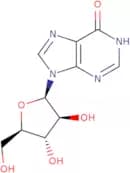
Produto descontinuado9-(b-D-Arabinofuranosyl)hypoxanthine
CAS:9-(b-D-Arabinofuranosyl)hypoxanthine is a glycosylated analogue of the incretin hormone glucagon-like peptide-1 (GLP-1). It has been shown to inhibit Streptococcus pyogenes and other bacteria. 9-(b-D-Arabinofuranosyl)hypoxanthine has also been shown to have inhibitory properties against zirconium oxide, pulmonary vasodilation, squamous cell carcinoma, and rate constant. This drug has not been studied in clinical trials for antiviral prophylaxis or arabinoside. The only known side effects are drug interactions with cyclin D2 and nitrate reductase.
Fórmula:C10H12N4O5Pureza:Min. 98 Area-%Cor e Forma:White PowderPeso molecular:268.23 g/molRef: 3D-NA03401
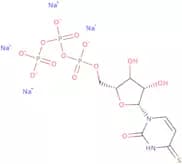
Produto descontinuado4-Thiouridine-5'-triphosphate sodium salt - aqueous solution
CAS:4-Thiouridine-5'-triphosphate sodium salt - aqueous solution (4TUTP) is an analog of uridine and can be used as a template for the synthesis of single-stranded DNA. 4TUTP has been shown to have a high affinity for dsDNA, allowing it to form a ternary complex with DNA polymerase and single-stranded DNA template. 4TUTP can also be used to prepare samples for profiling experiments or other molecular studies. It is reactive, so should be handled with caution in order to avoid unwanted crosslinking. 4TUTP may also be used in chloroplast research.Fórmula:C9H15N2O14P3S·xNaPureza:Min. 95 Area-%Cor e Forma:Clear LiquidPeso molecular:500.20 g/molRef: 3D-NT34810
Produto descontinuado2',5'-Dideoxyadenosine
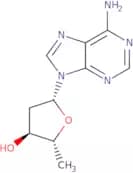
CAS:2',5'-Dideoxyadenosine is a nucleotide analog that inhibits the enzyme adenylate cyclase, by binding non-competitively via the P-site
Fórmula:C10H13N5O2Pureza:Min. 95%Cor e Forma:White Off-White PowderPeso molecular:235.25 g/molRef: 3D-ND07997
Produto descontinuadoThymidine-5'-triphosphate trisodium
CAS:Thymidine-5'-triphosphate or dTTP, is a nucleotide used by the cell to synthesize DNA molecules. Thymidine-5'-triphosphate is used in molecular biology techniques and assays as a substrate of the enzyme DNA polymerase, e.g. polymerase chain reaction (PCR), DNA sequencing, pyrosequencing reactions. Salt form of thymidine-5'-triphosphate has been used in a newly developed detection system for SARS-CoV-2 that combines bioluminescence in real-time (BART) with reverse-transcriptase loop-mediated amplification (RT-LAMP).Fórmula:C10H17N2O14P3•Na3Pureza:(%) Min. 90%Cor e Forma:White PowderPeso molecular:551.14 g/mol8-Azido-ATP-γ-biotin sodium
8-Azido-ATP is a novel nucleoside that has been shown to be an activator of DNA and RNA synthesis in human cells. It is synthesized by the enzymatic transfer of a gamma-biotin moiety from ATP to dATP, resulting in 8-azido-ATP. This drug has antiviral and anticancer activity and has been shown to inhibit the replication of HIV. The 8-azido-ATP can be used as an activator for purine nucleotide incorporation into DNA or RNA, which may help with cancer treatment or prevention. 8-Azido-ATP also inhibits the growth of certain viruses, such as herpes simplex virus type 1 (HSV1) and cytomegalovirus (CMV).Fórmula:C25H41N12O14P3S•NaxPureza:Min. 95%Cor e Forma:White/Off-White SolidPeso molecular:858.65 g/molN6-Benzoyl-3'-O-tert-butyldimethylsilyl-2'-O-(2-methoxyethyl)adenosine
N6-Benzoyl-3'-O-tert-butyldimethylsilyl-2'-O-(2-methoxyethyl)adenosine is a modified nucleoside with antiviral activity. This compound is synthesized by a modified method that avoids the use of phosphoramidites, which are usually used to synthesize nucleosides. N6-Benzoyl-3'-O-tert-butyldimethylsilyl-2'-O-(2-methoxyethyl)adenosine is an activator of viral RNA polymerase and has been shown to be active against HIV and herpes simplex virus type 1.
Pureza:Min. 95%5-Chloro-2'-deoxyuridine
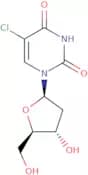
CAS:5-Chloro-2'-deoxyuridine is a nucleoside analog that inhibits DNA synthesis by inhibiting the enzyme thymidylate synthetase. It has been used for the treatment of bladder cancer and may also be beneficial in treating other cancers such as colon cancer. 5-Chloro-2'-deoxyuridine is taken up from the intestine by cells, where it is converted to thymidine monophosphate and then to thymidine diphosphate, which inhibits DNA synthesis by interfering with cell division. The mechanism of action is similar to that of cytosine arabinoside, but it does not require activation by intracellular enzymes. 5-Chloro-2'-deoxyuridine can cause cell lysis and can inhibit protease activity during cell culture, which makes it a useful tool for purifying proteins or peptides. The drug has been shown to be an analog of cytosine arabinos
Fórmula:C9H11ClN2O5Pureza:Min. 98 Area-%Cor e Forma:White PowderPeso molecular:262.65 g/molStavudine 5'-triphosphate sodium salt - 100 mM aqueous solution
Stavudine 5'-triphosphate sodium salt is a modified nucleoside analog with antiviral and anticancer properties. It is a phosphoramidate of stavudine, which has been modified by the replacement of the L-cysteine moiety with a 2-thiophenecarboxamide group. The novel chemical structure of stavudine 5'-triphosphate sodium salt leads to higher solubility in water than other analogues and improved pharmacokinetics. Stavudine 5'-triphosphate sodium salt is an activator for the synthesis of DNA, RNA, and protein. It also inhibits viral replication by interfering with viral DNA polymerase and ribonucleotide reductase, which are essential enzymes for viral replication.Fórmula:C10H17N2O13P3·xNaPureza:Min. 95 Area-%Cor e Forma:Clear LiquidPeso molecular:466.17 g/molα-Thymidine
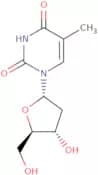
CAS:a-Thymidine is a thymidylate analog that is used as an anti-HIV drug. It is the L-enantiomer of thymidine, which is a nucleoside base in DNA. The biological effects of a-thymidine are due to its ability to be incorporated into DNA and act as a competitive inhibitor of the enzyme protein synthesis. It also has been shown to have antiviral properties against herpes simplex virus type 1 and hepatitis B virus.
Fórmula:C10H14N2O5Pureza:Min. 98 Area-%Cor e Forma:PowderPeso molecular:242.23 g/molN6-Acetyl-2',3',5'-tri-O-acetyl-8-hydroxyadenosine
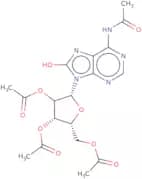
N6-Acetyl-2',3',5'-tri-O-acetyl-8-hydroxyadenosine is a modified nucleoside that is used in the synthesis of oligonucleotides. It is an activator with antiviral and anticancer properties, as well as various other biological activities. The CAS number for this product is 91359-02-2. The purity of this product ranges from 99% to 100%. This chemical has not been previously synthesized and has not been modified by any substituents or moieties.
Fórmula:C18H21N5O9Pureza:Min. 95%Cor e Forma:PowderPeso molecular:451.39 g/molRef: 3D-NA08462
Produto descontinuado