Vitaminas
As vitaminas são compostos orgânicos necessários em pequenas quantidades para funções fisiológicas essenciais e para a saúde geral. Desempenham papéis cruciais no metabolismo, na função imunológica e na manutenção celular. Nesta categoria, encontrará uma ampla gama de vitaminas, incluindo tipos solúveis em água e em gordura, necessários para a pesquisa em nutrição, bioquímica e ciências da saúde. Na CymitQuimica, oferecemos vitaminas de alta qualidade para apoiar seus esforços de pesquisa e desenvolvimento, garantindo a precisão e eficácia de seus estudos sobre as funções e deficiências das vitaminas.
Foram encontrados 1123 produtos de "Vitaminas"
Ordenar por
Pureza (%)
0
100
|
0
|
50
|
90
|
95
|
100
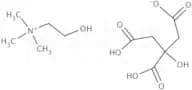
Choline dihydrogen citrate
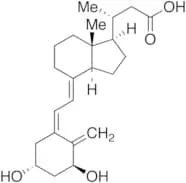
CAS:Fórmula:C11H21NO8Cor e Forma:White to almost white powder or crystalsPeso molecular:295.29Calcitroic Acid
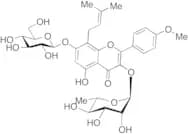
CAS:Produto Controlado<p>Stability Light Sensitive<br>Applications Calcitroic Acid is a major metabolite of Calcitriol (C144500).<br> Not a dangerous good if item is equal to or less than 1g/ml and there is less than 100g/ml in the package<br>References Esvelt, R.P. et al.: Arch. Biochem. Biophys., 206, 403 (1981); Onisko, B.L. et al.: Biochemistry, 19, 4124 (1980); Reddy, G.S. et al.: Biochemistry, 28, 1763 (1989);<br></p>Fórmula:C23H34O4Pureza:>85%Cor e Forma:NeatPeso molecular:374.51Icariin
CAS:Produto Controlado<p>Stability Light Sensitive<br>Applications Icariin inhibits the ROS-dependent JNK and p38 pathways.<br>References Zhou, H., et al.: Exp. Ther. Med., 7, 1116 (2014)<br></p>Fórmula:C33H40O15Cor e Forma:NeatPeso molecular:676.66Perhydrofarnesyl Acetone
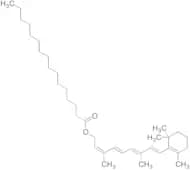
CAS:Produto Controlado<p>Applications Perhydrofarnesyl Acetone is used as a flavor and fragrance agent, it is often used in jasmine compositions.<br>References Toda, H. et al.: Dev. Food Sci., 17, 181 (1988); Maggi, F. et al.: Food Chem., 113, 216 (2009); Maggi, F. et al.: Chem. Biodiv., 8, 2057 (2011);<br></p>Fórmula:C18H36OCor e Forma:ColourlessPeso molecular:268.4813-cis-Vitamin A Palmitate
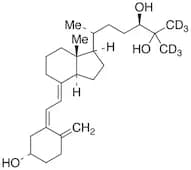
CAS:Fórmula:C36H60O2Cor e Forma:Colourless To YellowPeso molecular:524.8604Secalciferol-d6
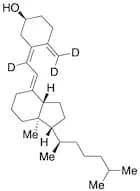
CAS:Produto Controlado<p>Stability Light Sensitive, Temperature Sensitive<br>Applications A labelled metabolite of Vitamin D, a possible anti-inflammatory steroid.<br> Not a dangerous good if item is equal to or less than 1g/ml and there is less than 100g/ml in the package<br>References Boyan, B., et al.: Steroids, 66, 363 (2001), Holick, M., et al.: J. Cell Biochem., 88, 296 (2003), Vogeser, M., et al.: Clin. Chem., 50, 1415 (2004), Singh, R., et al.: J. Clin. Endocrinol. Metab., 91, 3055 (2006),<br></p>Fórmula:C272H6H38O3Cor e Forma:NeatPeso molecular:422.67Tachysterol (>90%)
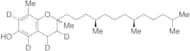
CAS:<p>Stability Light Sensitive, Temperature Sensitive<br>Applications Bioactive, synthetic vitamin D3 analog; exhibits antiproliferative effect on keratinocytes. Antipsoriatic.<br> Not a dangerous good if item is equal to or less than 1g/ml and there is less than 100g/ml in the package<br>References Matsunaga, T., et al.: J. Dermatol., 17, 135 (1990), Gerritsen, M.J.P., et al.: Br. J. Dermatol., 131, 57 (1994),<br></p>Fórmula:C28H44OPureza:>90%Cor e Forma:NeatPeso molecular:396.65(2RS,4R,8R)-δ-Tocopherol-d4 (Mixture of Diastereomers)
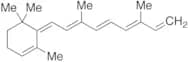
CAS:Produto Controlado<p>Applications Labelled δ-Tocopherol. One of the naturally occurring forms of Vitamin E. Isolated from soybean oil.<br>References Emerson, et al.: Science, 83, 421 (1936), Bieri, J.G., et al.: J. Nutr., 104, 850 (1974), Jiang, Q., et al.: Am. J. Clin. Nutr., 74, 714 (2001),<br></p>Fórmula:C27H42D4O2Cor e Forma:NeatPeso molecular:406.68all-trans-Anhydro Retinol (90%)
CAS:<p>Stability Light Sensitive, Temperature Sensitive<br>Applications A metabolite of vitamin A (Retinol) (R252000).<br>References Allo, S., et al.: J. Biol. Chem., 266, 22003 (1991), Brancolini, C., et al.: J. Cell Biol., 139, 759 (1997), Bubb, M., et al.: J. Biol .Chem., 269, 14869 (1994),<br></p>Fórmula:C20H28Pureza:90%Cor e Forma:Yellow-OrangePeso molecular:268.44α-Tocopherol Acetate
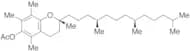
CAS:<p>Applications α-Tocopherol acetate is the most bioactive of the naturally occurring forms of Vitamin E. Richest sources are green vegetables, grains, and oils, particularly palm, safflower and sunflower oils.<br>References Bianchi, G., et al.: Eur. J. Lipid Sci. Technology, 105, 229 (2003), Sakouhi, F., et al.: Food Chem., 108, 833 (2008),<br></p>Fórmula:C31H52O3Cor e Forma:Off-WhitePeso molecular:472.74all-trans-Retinal
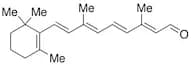
CAS:Produto Controlado<p>Stability Hygroscopic<br>Applications Corotenoid component of the visual pigments. All-trans retinal is converted to retinoic acid in vivo by the action of retinal dehydrogenase.<br>References Ball, et al.: Biochem. J., 42, 516 (1948), O’Brien, D.F., et al.: Science, 218, 961 (1982),<br></p>Fórmula:C20H28OCor e Forma:Yellow To Dark OrangePeso molecular:284.44β-Tocopherol (Racemic Mixture)
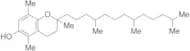
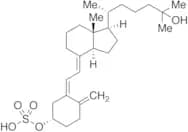
CAS:Produto Controlado<p>Stability Hygroscopic<br>Applications β-Tocopherol (Racemic Mixture) is one of the naturally occurring forms of Vitamin E. Is biologically less active than α-Tocopherol. This is the racemic mixture of all stereoisomers.<br> Not a dangerous good if item is equal to or less than 1g/ml and there is less than 100g/ml in the package<br>References Bianchi, G., et al.: Eur. J. Lipid Sci. Technology, 105, 229 (2003), Sakouhi, F., et al.: Food Chem., 108, 833 (2008),<br></p>Fórmula:C28H48O2Cor e Forma:Colourless To BeigePeso molecular:416.6825-Hydroxy Vitamin D3 3-Sulfate Sodium Salt (90%)
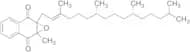
CAS:Produto Controlado<p>Stability Light Sensitive, Temperature Sensitive<br>Applications 25-Hydroxyvitamin D3 3-Sulfate is a metabolite of 24,25-Dihydroxyvitamin D3 and 25-Hydroxyvitamin D3 (C125700).<br>References Higashi, T. et al.: Steroids, 65, 281 (2000); Higashi, T. et al.: Ann. Clin. Biochem., 36, 43 (1999);<br></p>Fórmula:C27H43NaO5SPureza:90%Cor e Forma:NeatPeso molecular:502.68Vitamin K1 2,3-Epoxide
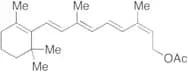
CAS:Produto Controlado<p>Applications Vitamin K1 2,3-Epoxide is a metabolite of Vitamin K1 (V676080), which is occurs widely in green plants, algae, and photosynthetic bacteria.<br>References Smee, D.F., et al.: Antimicrob. Agents Chemother., 23, 676 (1983), Miyamoto, T., et al.: Biochem. Pharmacol., 35, 839 (1986); Hassan, M.M.A., et al.: Anal. Profiles Drug Subs., 17, 449 (1988), Breton, J., et al.: Biochemistry, 33, 12405 (1994), Dowd, P., et al.: Science, 269, 1684 (1995);<br></p>Fórmula:C31H46O3Cor e Forma:Light YellowPeso molecular:466.7013-cis-Retinyl Acetate (85%)
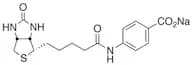
CAS:Produto Controlado<p>Applications 13-cis-Retinyl Acetate is a derivative of 13-Cis-Retinol (R252110), an active metabolite of vitamin A.<br>References Shantz, E., et al.: J. Biol. Chem., 183, A61 (1950), Barua, A., et al.: Biochem. J., 164, 133 (1977), Brouwer, I., et al.: Nutr. Res. Rev., 14, 267 (2001), Grillenberger, M., et al.: Br. J. Nutr., 95, 379 (2006),<br></p>Fórmula:C22H32O2Pureza:85%Cor e Forma:NeatPeso molecular:328.49(+)-Biotin 4-Amidobenzoic Acid, Sodium Salt
CAS:<p>Applications (+)-Biotin 4-Amidobenzoic Acid, Sodium Salt is a fluorigenic substrate for the determination of Biotinidase activity.<br></p>Fórmula:C17H20N3O4S·NaCor e Forma:White To Light YellowPeso molecular:385.41