Vitaminas
As vitaminas são compostos orgânicos necessários em pequenas quantidades para funções fisiológicas essenciais e para a saúde geral. Desempenham papéis cruciais no metabolismo, na função imunológica e na manutenção celular. Nesta categoria, encontrará uma ampla gama de vitaminas, incluindo tipos solúveis em água e em gordura, necessários para a pesquisa em nutrição, bioquímica e ciências da saúde. Na CymitQuimica, oferecemos vitaminas de alta qualidade para apoiar seus esforços de pesquisa e desenvolvimento, garantindo a precisão e eficácia de seus estudos sobre as funções e deficiências das vitaminas.
Foram encontrados 1123 produtos de "Vitaminas"
Ordenar por
Pureza (%)
0
100
|
0
|
50
|
90
|
95
|
100
Isopyridoxal Hydrochloride
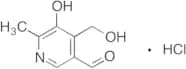
CAS:<p>Applications Isopyridoxal Hydrochloride is an active vitamer of the B6 complex in humans, and a metabolite standard in the determination of all seven vitamin B6-related compounds. It is also a metabolite in a pyridoxine degradation pathway by soil bacteria.<br>References Edwards, P., et. al.: Clinica Chimica Acta: Int. J. Clin. Chem., 190, (1990); Lee, Y. C., et. al.: J. Bio. Chem., 261, (1986); Argoudelis, C. J.: J. Chromatogr. A, 790, (1998)<br></p>Fórmula:C8H9NO3·HClCor e Forma:NeatPeso molecular:203.62Vitamin D2 O-t-Butyldimethylsilyl Ether
CAS:Produto ControladoFórmula:C34H58OSiPureza:>85%Cor e Forma:NeatPeso molecular:510.91Plumbagin
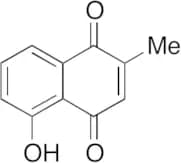
CAS:<p>Applications Plumbagin induces apoptosis in cancer cells. It also inhibits NADPH oxidase 4 in a time- and dose-dependent manner.<br> Not a dangerous good if item is equal to or less than 1g/ml and there is less than 100g/ml in the package<br>References Klotz, L., et al.: Molecules, 19 14902 (2014); Gupta, S., et al.: Cancer Metastasis Rev., 29, 405 (2010); Schramm, A., et al.: Vascul. Pharmacol., 56, 216 (2012)<br></p>Fórmula:C11H8O3Cor e Forma:Dark OrangePeso molecular:188.18Vitamin K4
CAS:Produto Controlado<p>Applications Vitamin K4, is a chemically synthesized Vitamin K which plays an important role in the normal blood coagulation system.<br>References jiang Y. et al.: Pharmazie. 2013 Jun;68(6):442-8.<br></p>Fórmula:C15H14O4Cor e Forma:NeatPeso molecular:258.27Vitamin D4
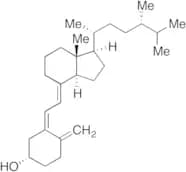
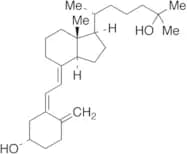
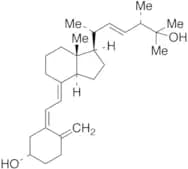
CAS:<p>Stability Hygroscopic, Temperature Sensitive<br>Applications Vitamin D4 is the active analogue of Vitamin D.<br> Not a dangerous good if item is equal to or less than 1g/ml and there is less than 100g/ml in the package<br>References Holick, M., et al.: J. Biochemistry, 10, 2799 (1971), Haddad, J., et al.: J. Bone Miner. Res., 4, 243 (1989), Palmieri, G., et al.: J. Clin. Endocrin. Metab., 82, 3516 (1997),<br></p>Fórmula:C28H46OCor e Forma:NeatPeso molecular:398.66Calcifediol
CAS:Produto Controlado<p>Stability Light Sensitive, Temperature Sensitive<br>Applications Calcifediol is a metabolite of Vitamin D. The principal circulating form of vitamin D3, formed in the liver by hydroxylation at C-25. Calcium regulator.<br> Not a dangerous good if item is equal to or less than 1g/ml and there is less than 100g/ml in the package<br>References Morii, et al.: Arch. Biochem. Biophys., 120, 513 (1967); Blunt, et al.: Biochemistry, 7, 3317 (1968), Liu, et al.: Science, 311, 1770 (2006);<br></p>Fórmula:C27H44O2Cor e Forma:Off-WhitePeso molecular:400.64BGP 15
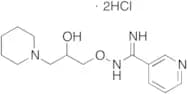
CAS:Produto Controlado<p>Applications BGP 15 is a calcipotriene-based vitamin D3 analog that inhibits poly(ADP-ribose) polymerasesis (PARP), a class of enzymes that regulate DNA repair and apoptosis (1). BGP 15 is also a cardioprotective agent (2). Also, BPG 15 improves mitochondrial function, protects neurons from dying in vitro and in vivo, and promotes cardiac innervation in vivo.<br>References (1) Berkovich, L., et al.: Anticancer Drugs. 21, 609 (2010) (2) Szabados, E., et al. Biochem Pharmacol. 59, 937 (2000)<br></p>Fórmula:C14H22N4O2·2HClCor e Forma:NeatPeso molecular:351.27Levomefolic Acid-13C,d3
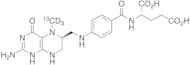
CAS:Produto Controlado<p>Applications A labelled active form of folic acid used at the cellular level for DNA reproduction, the cysteine cycle and the regulation of homocysteine among other functions. It is a coenzymated form of folic acid. It has been proposed for treatment of cardiovascular disease.<br>References Willems, F. et al.: Br. J. Pharmacol., 145, 823 (2004); Prinz-Langhebohi, R.: et al., Br. J. Pharmacol., 158, 2014 (2009); Wright, A. et al.: Brit, J. Nutrit., 103, 724 (2010)<br></p>Fórmula:CC192H3H22N7O6Cor e Forma:BeigePeso molecular:463.472-Chloro-5-nitro-N-4-pyridinylbenzamide
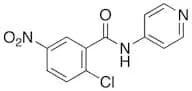
CAS:Produto Controlado<p>Applications A cell-permeable chloro-nitro-benzamido compound that acts as a potent, specific, irreversible, and high-affinity antagonist of PPARγ with a Ki of 1 nM. Displays >800-fold greater selectivity for PPARγ over PPARα and PPARδ (Ki = 0.85 µM and 1.8 µM, respectively). Blocks hormone- and agonist-induced adipogenesis in 3T3-L1 cells. It suppresses interactions between PPARγ and coactivator-derived peptides, while promotes the recruitment of corepressor-derived peptides. Shown to modulate the interaction of PPARγ2 with the cofactor proteins through covalent binding to Cys313 in its ligand-binding domain.<br>References Lee, G., et al: J. Biol. Chem., 277, 19649 (2003), Schaefer, K.L., et al: Cancer Res., 65, 2251 (2005), Masuda, T., et al.: Clin. Cancer Res., 11, 4012 (2005), Raikwar, H.P., et al.: J. Neuroimmunol., 167, 99 (2005)<br></p>Fórmula:C12H8ClN3O3Cor e Forma:NeatPeso molecular:277.66Menaquinone 7, Synthetic (90%)
CAS:<p>Stability Light and Temperature Sensitive<br>Applications Menaquinones are isoprenoid quinones of the naphthalene series and belongs to the K2 Vitamin homologs. Menaquinones were originally discovered as the anti-hemorrhagic factor and now encompasses a variety of physiological processes. Menaquinone 7 belongs to the class of K2-Vitamins homologs. Menaquinone 7 has been identified as the most bioactive cofactor for the carboxylation reaction of Gla-proteins such as osteocalcin and matrix-Gla protein, which plays a crucial role in building and maintaining overall bone health.<br>References Hugenholtz, P., et al.: J. Bacteriol., 180, 4765 (1998), Ginet, N., et al.: Biochemistry, 40, 1812 (2001), Cape, J., et al.: J. Biol. Chem., 280, 34654 (2005),<br></p>Fórmula:C46H64O2Pureza:90%Cor e Forma:Light YellowPeso molecular:649.00Biopterin
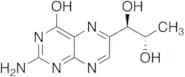
CAS:<p>Stability Hygroscopic<br>Applications A pteridine widely distributed in nature; naturally occurring as the L-erythro-form. Considered as a growth factor for some insects. Fluoresces with a blue color in alkaline solution.<br>References Klatt, P., et al.: J. Biol. Chem., 269, 13861 (1994); Mitnaul, L., et al.: Biochemistry, 92, 885 (1995); Thony, B., et al.: Biochem. J., 347, 1 (2000);<br></p>Fórmula:C9H11N5O3Cor e Forma:Off WhitePeso molecular:237.2225-Hydroxy Vitamin D2
CAS:Produto Controlado<p>Stability Light Sensitive, Temperature Sensitive<br>Applications A metabolite of Vitamin D2 (V676040).<br> Not a dangerous good if item is equal to or less than 1g/ml and there is less than 100g/ml in the package<br>References Barnes, P., et al.: J. Clin. Invest., 83, 1527 (1989), Holick, M., et al.: J. Cell Biochem., 88(2), 296 (2003), Maunsell, Z., et al.: Clin. Chem., 51, 1683 (2005),<br></p>Fórmula:C28H44O2Cor e Forma:White To Light YellowPeso molecular:412.65Folitixorin (~80%)(Mixture of Diastereomers)
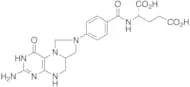
CAS:<p>Stability Hygroscopic, Moisture Sensitive, Temperature Sensitive<br>Applications A stable folate lyophilized compound suitable for use in the treatment of cancer and other therapies.<br>References Park, H., et al.: Science, 268, 1866 (1995), Banerjee, R., et al.: J. Biol. Chem., 282, 14916 (2007), Klar, T., et al.: J. Mol. Biol., 366, 954 (2007),<br></p>Fórmula:C20H23N7O6Cor e Forma:NeatPeso molecular:457.44Acetyl Vitamin B12
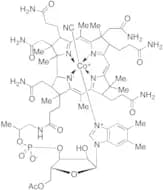
CAS:<p>Applications Acetyl Vitamin B12 is a derivative of Vitamin B12 (V676020). Vitamin B12 gets converted by the body into its bioactive forms, methylcobalamin and cobamamide, which serve as enzyme cofactors. Severe deficiency may result in megaloblastic anemia and/or neurological impairment.<br>References Rickes, et al.: Science, 107, 396 (1948); Kirschbaum, J., et al.: Anal. Profiles Drug Subs., 10, 183 (1981); Grasbeck, R., et al.: Clin. Biochem., 17, 99 (1984)<br></p>Fórmula:C65H90CoN14O15PPureza:>85%Cor e Forma:NeatPeso molecular:1397.40δ-Tocopherol (>90%)
CAS:<p>Applications One of the naturally occurring forms of Vitamin E. Isolated from soybean oil.<br>References Emerson, et al.: Science, 83, 421 (1936), Bieri, J.G., et al.: J. Nutr., 104, 850 (1974), Jiang, Q., et al.: Am. J. Clin. Nutr., 74, 714 (2001),<br></p>Fórmula:C27H46O2Pureza:>90%Cor e Forma:Light Yellow To Dark BrownPeso molecular:402.65trans-Doxercalciferol
CAS:Produto Controlado<p>Applications A Vitamin D derivative.<br> Not a dangerous good if item is equal to or less than 1g/ml and there is less than 100g/ml in the package<br>References Koeffler, M.R., et al.: Blood, 74, 82 (1989),<br></p>Fórmula:C28H44O2Cor e Forma:NeatPeso molecular:412.65Succinimidyl-6-(biotinamido) Hexanoate
CAS:Produto Controlado<p>Stability Moisture Sensitive<br>Applications Succinimidyl-6-(biotinamido) Hexanoate is a biotinylation reagent incorporating an aminocaproyl “spacer”. This can reduce the steric hindrance in binding avidin to some biotinylated compounds when used to biotinylate both the antibody and the carrier in the Protein Avidin-Biotin Capture System. This system avoids the direct interaction of a captured antibody with solid surfaces, such as plastics, which may reduce antigenicity. It has also been used to enhance the detection of DNA on nitrocellulose. Has also been used as a cell surface labelling reagent<br>References Hofmann, K., et al.: Biochemistry, 21, 978 (1982); Leary, J.J., et al.: P. Natl. Acad. Sci. USA, 80, 4045, (1983); Suter, M., et al.: Immunology Letters, 13, 313 (1986); Gretch, D.R., et al.: Anal. Biochem., 163, 270 (1987), Burgess, T.L., et al.: J. Biol. Chem., 269 (32), 19188 (1995), Schumacher, T.N.M., et al.: Science, 271, 1854 (1996)<br></p>Fórmula:C20H30N4O6SCor e Forma:Off White Crystalline PowderPeso molecular:454.54