Nucleosídeos
Foram encontrados 3569 produtos de "Nucleosídeos"
2,2-Crylo-5-methyluridine
2,2-Crylo-5-methyluridine is a synthetic diphosphate nucleotide that has been shown to be an activator of DNA synthesis. It is used in the synthesis of oligonucleotides and as a monophosphate for the synthesis of 2'-O-methyl ribonucleosides. 2,2-Crylo-5-methyluridine has been shown to have anticancer activity, which may be due to its ability to inhibit tumor proliferation or induce apoptosis.Pureza:Min. 95%2-Iodo-2’-deoxyadenosine
CAS:2-Iodo-2’-deoxyadenosine is a novel nucleoside that is a modified adenosine. It has been shown to possess anticancer activity. 2-Iodo-2’-deoxyadenosine has a high degree of cytotoxicity and can induce apoptosis in cancer cells. This drug also inhibits the growth of herpes simplex virus type 1 (HSV) and HIV, which are both types of viruses that infect humans. The antiviral activity may be due to the inhibition of viral DNA synthesis or RNA transcription. 2-Iodo-2’-deoxyadenosine is synthesized from adenine, iodine, and sulfuric acid with high purity and quality. It is not active against bacteria because it does not inhibit bacterial DNA gyrase or topoisomerase IV enzymes.Pureza:Min. 95%2-Thiopseudouridine
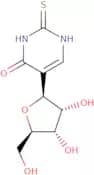
CAS:2-Thiopseudouridine is a heterocyclic nucleoside that is used as a building block for the synthesis of natural products. 2-Thiopseudouridine is prepared by a two-step process involving the desymmetrization of pseudoisocytidine and the formation of an aminopyrimidinone. The desymmetrization reaction proceeds with high stereoselectivity to yield the desired product in high yields. Other carbocyclic nucleosides can be synthesized from 2-thiopseudouridine, such as 2-thienopyrrole and 2-pyrroline.Fórmula:C9H12N2O5SPureza:Min. 95%Cor e Forma:SolidPeso molecular:260.27 g/mol4-(4-Chlorophenyl)pyrimidine-2-thiol
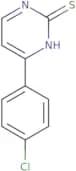
CAS:4-(4-Chlorophenyl)pyrimidine-2-thiol is an anti-cancer drug that is used in the treatment of ovarian cancer. It has been shown to be effective against cancer cells by interfering with the DNA replication process. 4-(4-Chlorophenyl)pyrimidine-2-thiol binds at the active site of topoisomerase II, which is involved in the process of transcription and replication. This drug also has been shown to induce apoptosis in fibroblast cells by inhibiting DNA synthesis and protein synthesis. 4-(4-Chlorophenyl)pyrimidine-2-thiol has a molecular weight of 181.24 g/mol and is soluble in water, methanol, and ethanol. The colorimetric assay for this compound has a detection limit of 1 µg/mL.
Pureza:Min. 95%2'-Deoxy-N4,5-dimethylcytidine
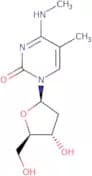
CAS:2'-Deoxy-N4,5-dimethylcytidine is an activator that has the ability to activate a variety of nucleoside analogs. The compound is synthetically derived and used as an antiviral agent. It can be modified at the 5' position with phosphate groups or ribonucleosides. 2'-Deoxy-N4,5-dimethylcytidine is also a novel monophosphate nucleoside that has been shown to inhibit the growth of cancer cells in vitro and in vivo. This drug inhibits DNA synthesis by preventing the incorporation of diphosphate nucleotides into DNA during DNA replication. 2'-Deoxy-N4,5-dimethylcytidine is not active against RNA synthesis because it does not have any activity at this site.
Fórmula:C11H17N3O4Pureza:Min. 95%Peso molecular:255.27 g/mol2',3'-Stannyluridine
2',3'-Stannyluridine is a novel modified ribonucleoside. It is synthesized by the condensation of 2'-deoxyuridine and 3'-hydroxy-2-methylpropiophenone. This product has been shown to have anticancer and antiviral activities. 2',3'-Stannyluridine inhibits the synthesis of DNA, RNA, and protein in cells by binding to the ribonucleotide reductase enzyme. It also has an effect on phosphoramidite synthesis, which is an important step in DNA replication. The CAS number for this product is 57824-03-1.
Pureza:Min. 95%Fialuridine 5'-monophosphate
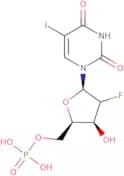
CAS:Fialuridine 5'-monophosphate is an analog of fialuridine, a drug used to treat HIV. Fialuridine 5'-monophosphate inhibits mitochondrial DNA synthesis by inhibiting hepg2 in the mitochondria and blocks the conversion of uracil to thymine in nuclear DNA. The inhibition of these two processes prevents viral replication and cell division. Fialuridine 5'-monophosphate also has antioxidant properties that protect cells from oxidative damage induced by reactive oxygen species. This drug may be beneficial for cancer treatment as well as hepatitis C or herpes simplex virus infection.Fórmula:C9H11FIN2O8PPureza:Min. 95%Peso molecular:452.07 g/mol2'-Deoxy-2'-fluoroadenosine-5'-triphosphate lithium salt - 100mM aqueous solution
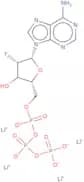
CAS:2'-Deoxy-2'-fluoroadenosine-5'-triphosphate lithium salt is an analog of ATP that has significant inhibitory effect on DNA polymerase. It inhibits the synthesis of RNA and protein by binding to the enzyme DNA gyrase. This drug is used in cell culture as a nucleotide analog to study how cells are affected by atp analogs. 2'-Deoxy-2'-fluoroadenosine-5'-triphosphate lithium salt is used at high concentrations in vitro, where it inhibits topoisomerases and prevents cell division.Fórmula:C10H11FN5O12P3·4LiPureza:Min. 95%Peso molecular:532.9 g/mol6-Propylamino-7-deazapurine
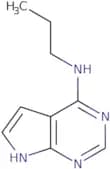
CAS:6-Propylamino-7-deazapurine is a synthetic nucleoside with antiviral and anticancer properties. It is an activator of DNA synthesis and is modified to have a high quality. 6-Propylamino-7-deazapurine has been shown to be effective against HIV and other viruses in vitro, as well as in animal models, but it is not yet approved for use in humans.6-Propylamino-7-deazapurine has also been shown to inhibit the growth of cancer cells in vitro and in vivo.
Fórmula:C9H12N4Pureza:Min. 95%Peso molecular:176.22 g/mol2'-Deoxy-5'-O-DMT-uridine 3'-succinyl CPG 1000Å
2'-Deoxy-5'-O-DMT-uridine 3'-succinyl CPG 1000Å is an anticancer drug that is used in the treatment of acute myeloid leukemia. This compound is a modified nucleoside. It has been shown to inhibit the growth of cultured cells and induce apoptosis by causing DNA damage. The anticancer properties of 2'-deoxy-5'-O-DMT-uridine 3'-succinyl CPG 1000Å are mediated by its inhibition of DNA synthesis, RNA synthesis, and protein synthesis.
Pureza:Min. 95%Sapacitabine
CAS:Sapacitabine is an oral prodrug that is converted to its active form, the cytotoxic agent 9-β-D-arabinofuranosyladenine (araA), by cellular enzymes. It has potent antitumor activity against solid tumours and has been shown to be effective in a variety of human cancer cell lines. Sapacitabine targets intracellular targets, including DNA methyltransferases and other enzymes involved in the synthesis of RNA and DNA. The drug has been shown to have synergistic effects when used with other cytotoxic agents such as 5-fluorouracil and gemcitabine, which are also inhibitors of DNA methyltransferase.
Fórmula:C26H42N4O5Pureza:Min. 95%Peso molecular:490.64 g/mol3'-Azido-2',3'-dideoxy-N2-isobutyrylguanosine
3'-Azido-2',3'-dideoxy-N2-isobutyrylguanosine is an antiviral agent that belongs to the class of nucleosides. It is a novel phosphoramidite which can be used in the synthesis of ribonucleosides and deoxyribonucleosides. 3'-Azido-2',3'-dideoxy-N2-isobutyrylguanosine has shown anticancer activity, with a potential use as an inhibitor of cellular proliferation, including tumor cells. 3'-Azido-2',3'-dideoxy-N2-isobutyrylguanosine also inhibits viral replication by interfering with the initiation and elongation steps of viral DNA synthesis.Pureza:Min. 95%N2-Isobutyryl-N-trityl-morpholinoguanine methyl dimethylphosphoramide chloridate
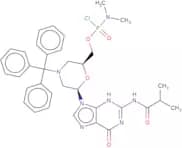
CAS:N2-Isobutyryl-N-trityl-morpholinoguanine methyl dimethylphosphoramide chloridate is a novel modified nucleoside analog with antiviral and anticancer activity. It is a phosphoramidite that is used in the synthesis of oligonucleotides and polynucleotides. N2-Isobutyryl-N-trityl-morpholinoguanine methyl dimethylphosphoramide chloridate has been shown to inhibit viral replication in vitro by inhibiting viral DNA polymerase, as well as tumor growth in vivo by inducing apoptosis. This compound has also been shown to be an activator for RNA polymerases I, II, and III.Pureza:Min. 95%2,2’-Anhydro-5’-O-DMT-uridine
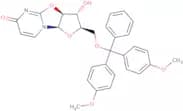
CAS:2,2’-Anhydro-5’-O-DMT-uridine is a high purity synthetic nucleoside that is modified with a hydroxymethyl group in the 2' position. It is a monophosphate and diphosphate derivative of uridine. This nucleoside has antiviral and anticancer properties, as well as the ability to inhibit HIV replication.Fórmula:C30H28N2O7Pureza:Min. 95%Peso molecular:528.55 g/molN4-Acetyl-2'-deoxy-5'-O-DMT-cytidine 3'-Me phosphoramidite
N4-Acetyl-2'-deoxy-5'-O-DMT-cytidine 3'-Me phosphoramidite is a novel monophosphate nucleoside that is synthesized using an acetylation and methylation reaction. It has a cytidine base and is modified with an acetyl group and a methyl group. N4-Acetyl-2'-deoxy-5'-O-DMT-cytidine 3'-Me phosphoramidite has been shown to inhibit the growth of cancer cells in vitro, as well as to have antiviral and anticancer activity. This product is available in high purity, high quality, and with modifications to improve its stability.Fórmula:C39H49N4O8PPureza:Min. 95%Peso molecular:732.8 g/mol2'-Deoxy-5'-O-DMT-5-methylcytidine
CAS:2'-Deoxy-5'-O-DMT-5-methylcytidine is a nucleoside analog that can be used to treat cancer. This compound is synthesized by the conversion of 5′-O-dimethoxytrityl (DMT)-2'-deoxycytidine to its 5′-O-DMT phosphoramidite. The phosphoramidite is then reacted with methylene chloride, methanol, and ammonia to form the monophosphate. 2'-Deoxy-5'-O-DMT-5-methylcytidine has been shown to be an effective anticancer drug in vitro and in vivo. It targets DNA synthesis, which prevents the duplication of genetic material necessary for cell division.Fórmula:C31H33N3O6Pureza:Min. 95%Cor e Forma:White to off-white solid.Peso molecular:543.63 g/mol8-(4-Aminophenyl)-2'-deoxyguanosine
8-(4-Aminophenyl)-2'-deoxyguanosine is an Activator that has novel properties. It is a diphosphate of 8-(4-Aminophenyl)thymidine and is also known as 8-APT. It has been shown to have anticancer and antiviral activity in animal models, and it may be a potential treatment for HIV infection. The chemical name for 8-APT is 2'-deoxyguanosine, 8-(4-aminophenyl)-, (8R*,9S*)-.
Fórmula:C16H18N6O4Pureza:Min. 95%Peso molecular:358.35 g/mol5'-O-DMT-5-methyl-2'-O-pentyluridine
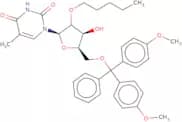
5'-O-DMT-5-methyl-2'-O-pentyluridine is a monophosphate nucleoside with anticancer activity. It is a novel, synthetic, high purity and quality compound that is modified from 5'-O-DMT-5-methyluridine. This compound has been shown to be an effective antiviral agent against HIV and HSV, as well as an inhibitor of DNA synthesis in cells.
Fórmula:C36H42N2O8Pureza:Min. 95%Peso molecular:630.74 g/mol1,N6-Ethenoadenosine-5'-diphosphate, Sodium salt
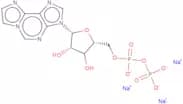
CAS:Emission max - 415nmMolar extinction coefficient ε [L·mol⁻¹·cm⁻¹] - 6000Fluorescent analogue of 5'-ADP, NA10698Fórmula:C12H15N5O10P2Pureza:Min. 95%Peso molecular:451.22 g/mol5,6-Dichloro-(1-b-D-ribofuranosyl) benzimidazole 3',5'-cyclic monophosphothioate, Sp-isomer sodium salt
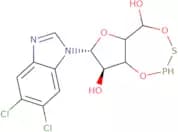
CAS:5,6-Dichloro-(1-b-D-ribofuranosyl) benzimidazole 3',5'-cyclic monophosphothioate, Sp-isomer sodium salt (SPP) is a cytostatic agent that binds to the α subunit of the voltage-dependent Ca2+ channel. It has been shown to inhibit tumor growth in mouse models of hyperproliferative diseases such as bladder cancer and pulmonary fibrosis. SPP also inhibits the proliferation of human bladder cells in culture by inhibiting cyclic nucleotide phosphodiesterase activity. This leads to an increase in intracellular calcium concentrations and activation of cation channels. SPP is an analog of rolipram, which has been shown to have anti-inflammatory effects on detrusor muscle cells.Fórmula:C12H10Cl2N2O5P·NaPureza:Min. 95%Peso molecular:419.16 g/mol