Nucleosídeos
Foram encontrados 3569 produtos de "Nucleosídeos"
3'-Azido-5'-O-tert-butyldimethylsilyl-3'-deoxythymidine
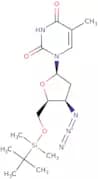
CAS:3'-Azido-5'-O-tert-butyldimethylsilyl-3'-deoxythymidine (BUdR) is an antiviral agent that is used in the synthesis of DNA and RNA. BUdR is a modified phosphoramidite that is activated with diphosphate. It has a high quality, high purity, and a novel structure. BUdR has been shown to have anticancer properties as well as inhibitory effects on HIV production in cells.
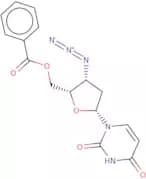
Fórmula:C16H27N5O4SiPureza:Min. 95%Peso molecular:381.51 g/mol3'-Azido-5'-O-benzoyl-2',3'-dideoxyuridine
3'-Azido-5'-O-benzoyl-2',3'-dideoxyuridine is a novel nucleoside that is synthesized by reacting 3'-azido-5'-deoxyuridine with 5-(benzoyl)salicylic acid. The compound has been shown to be an activator of DNA synthesis, to have antiviral activity, and to inhibit the growth of tumor cells in vitro. 3'-Azido-5'-O-benzoyl-2',3'-dideoxyuridine is a nucleoside analogue that may be useful in anticancer therapy.
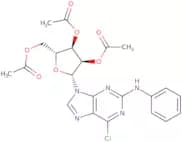
Fórmula:C16H15N5O5Pureza:Min. 95%Peso molecular:357.32 g/mol6-Chloro-N-phenyl-9-(2,3,5-tri-O-acetyl-b-D-ribofuranosyl)-9H-purin-2-amine
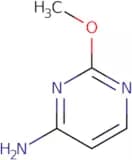
CAS:6-Chloro-N-phenyl-9-(2,3,5-tri-O-acetyl-b-D-ribofuranosyl)-9H-purin-2-amine is a monophosphate nucleoside analog. It is an antiviral agent that inhibits the synthesis of DNA and RNA. 6CNP has been shown to be cytotoxic against cancer cells in vitro, as well as in vivo. This compound also shows anticancer activity by inhibiting the production of ribonucleosides and deoxyribonucleosides.Fórmula:C22H22ClN5O7Pureza:Min. 95%Peso molecular:503.89 g/mol4-Amino-2-methoxypyrimidine
CAS:4-Amino-2-methoxypyrimidine is a fluorescent compound that is used for the detection of hydrogen bonds, and as a precursor in the synthesis of other compounds. 4-Amino-2-methoxypyrimidine has been shown to be able to absorb ultraviolet radiation, which leads to its fluorescence. The compound can also form hydrogen bonds with other molecules and it has been shown to react with n-hexane. 4-Amino-2-methoxypyrimidine reacts with orthophosphate, producing singlet oxygen and transferring a proton. It also reacts with solvents such as water or ethanol, giving off light.Fórmula:C5H7N3OPureza:Min. 95%Peso molecular:125.13 g/mol2',3'-Di-O-acetyl-5'-deoxy-5-fluoro-N-[(2-methylbutoxy)carbonyl]cytidine
CAS:2',3'-Di-O-acetyl-5'-deoxy-5-fluoro-N-[(2-methylbutoxy)carbonyl]cytidine is an activator, anticancer, monophosphate nucleoside that is synthesized from 2'-deoxycytidine and 5'-fluorouracil. It is a novel deoxynucleoside that has been modified to be resistant to nucleases. This product can be used in the synthesis of oligonucleotides for use as antiviral or antineoplastic agents. 2',3'-Di-O-acetyl-5'-deoxy-5-fluoro-N-[(2-methylbutoxy)carbonyl]cytidine is also known by its CAS number 1341231-51-3.Fórmula:C19H26FN3O8Pureza:Min. 95%Peso molecular:443.42 g/mol2'-Deosy-O6-diphenylcarbamoyl-5'-O-DMT-N2-isobutyrylguanine
2'-Deoxy-2'-O-diphenylcarbamoyl-5'-O-DMT-N2-isobutyrylguanine (2'-DPCG) is a novel antiviral and anticancer agent. It has been shown to inhibit the replication of both DNA and RNA viruses. 2'-DPCG is synthesized in a high yield and purified to near homogeneity. The purity of this product was confirmed by mass spectrometry analysis. The CAS number for this product is 1227071-12-0.Pureza:Min. 95%Myristoyl coenzyme A lithium salt
CAS:Myristoyl coenzyme A lithium salt is an activator that can be used in the synthesis of Ribonucleosides and Deoxyribonucleosides. It has a high purity, which ensures high quality synthesis. Myristoyl coenzyme A lithium salt is a novel nucleotide precursor that can be used to synthesize DNA or RNA for use in anti-cancer or antiviral treatments.
Fórmula:C35H62N7O17P3S·xLiPureza:Min. 95%Peso molecular:977.89 g/molN4-Benzoyl-3'-O-tert-butyldimethylsilyl-5'-O-DMT-cytidine
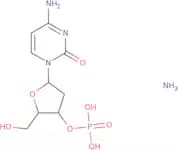
N4-Benzoyl-3'-O-tert-butyldimethylsilyl-5'-O-DMT-cytidine is a nucleoside with anticancer, antiviral, and antiretroviral properties. It is synthesized by reacting cytidine with benzoyl chloride in the presence of tert-butyldimethylsilyl chloride. N4-Benzoyl-3'-O-tert-butyldimethylsilyl-5'-O-DMTcytidine has shown to be a novel and potent inhibitor of the human immunodeficiency virus type 1 (HIV1) reverse transcriptase. It also inhibits DNA synthesis and has been shown to inhibit tumor cell growth in vitro.Fórmula:C43H49N3O8SiPureza:Min. 95%Peso molecular:763.95 g/mol2'-Deoxycytidine-3'-monophosphate ammonium salt
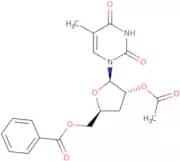
CAS:2'-Deoxycytidine-3'-monophosphate ammonium salt is a synthetic compound that is used in the production of phosphite fertilizers. It is also used to detect the presence of phosphorus and sulfur in elements, as well as to synthesize alkylene compounds. In addition, 2'-Deoxycytidine-3'-monophosphate ammonium salt can be used in the synthesis of ribozymes and deoxyadenosyl compounds.Fórmula:C9H14N3O7P·2NH3Pureza:Min. 95%Peso molecular:341.26 g/mol2'-O-Acetyl-5'-O-benzoyl-3'-deoxy-5-methyluridine
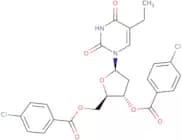
CAS:2'-O-Acetyl-5'-O-benzoyl-3'-deoxy-5-methyluridine (ABT-888) is a nucleoside analog that inhibits DNA synthesis and RNA transcription. It has been shown to induce apoptosis in human cancer cells, including leukemia, lymphoma and breast cancer cells. ABT-888 also has antiviral activity against herpes simplex virus type 1 and 2, vaccinia virus, and vesicular stomatitis virus.Fórmula:C19H20N2O7Pureza:Min. 95%Peso molecular:388.37 g/mol5-Ethyl-3',5'-bis-(p-chlorobenzoyl)-2'-deoxyuridine
CAS:5-Ethyl-3',5'-bis-(p-chlorobenzoyl)-2'-deoxyuridine is a phosphoramidite nucleoside analog that inhibits viral replication. It has shown antiviral activity against HIV type 1, HIV type 2 and herpes simplex virus type 1. 5-Ethyl-3',5'-bis-(p-chlorobenzoyl)-2'-deoxyuridine is an analogue of the natural nucleoside uridine and is used in the synthesis of modified DNA and RNA molecules. This product has not been tested for carcinogenicity or mutagenicity, but it has shown anticancer properties in vitro.
Fórmula:C25H22Cl2N2O7Pureza:Min. 95%Peso molecular:533.36 g/mol1,5-Anhydro-4,6-O-benzylidene-2,3-dideoxy-2-[uracil-1-yl]-D-glucitol
CAS:1,5-Anhydro-4,6-O-benzylidene-2,3-dideoxy-2-[uracil-1-yl]-D-glucitol is a synthetic nucleoside that is used as an antiviral agent. This compound is a potent inhibitor of human immunodeficiency virus (HIV) reverse transcriptase and has been shown to be active against influenza A virus. 1,5-Anhydro-4,6-O-benzylidene-2,3-dideoxy-2-[uracil]-D glucitol is also an anticancer agent that inhibits DNA synthesis in cancer cells. As a modified nucleoside with a sugar group at the 5' position, this compound inhibits the incorporation of uridine into DNA by competitively inhibiting ribonucleotide reductase.
Fórmula:C17H18N2O5Pureza:Min. 95%Peso molecular:330.34 g/mol1-(5',6'-Dideoxy-6'-dimethylphosphono-2'-O-(2-methoxyethyl)-5-methyl-b-D-ribo-hex-5(E)-enofuranosyl)uracil 3'-CE phosphoroamidite
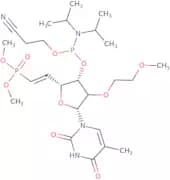
1-(5',6'-Dideoxy-6'-dimethylphosphono-2'-O-(2-methoxyethyl)-5-methyl-b-D-ribo-hex-5(E)-enofuranosyl)uracil 3'-CE phosphoroamidite is a novel nucleoside analogue that has antiviral activity. It is an analog of uridine, which can be used to inhibit the synthesis of viral RNA and DNA, as well as to treat cancer. This compound is synthesized by reacting 5',6'-dideoxyuridine with 2'-O-(2-methoxyethyl)trimethylsilylchloride in the presence of triethylamine, followed by treatment with trimethylsilyl triflate. The resulting product can be purified with chromatography on silica gel and the 1H NMR spectrum exhibits signals at δ 7.06 (d, J = 8 Hz) andFórmula:C25H42N4O10P2Pureza:Min. 95%Peso molecular:620.57 g/mol6-Aminothymine
CAS:6-Aminothymine is a polyamine that exerts its inhibitory activity by hydrogen bonding to the enzyme's active site. It has been shown to inhibit protein synthesis and growth factor synthesis in HL-60 cells. 6-Aminothymine also has cancer inhibiting properties, which may be due to its ability to bind DNA and interfere with replication or transcription.
Fórmula:C5H7N3O2Pureza:Min. 95%Peso molecular:141.13 g/mol2'-Deoxy-5'-O-DMT-5-(3-methacryloyl)uridine 3'-CE phosphoramidite
CAS:2'-Deoxy-5'-O-DMT-5-(3-methacryloyl)uridine 3'-CE phosphoramidite is a synthetic nucleoside analogue. It is an antiviral and anticancer agent that inhibits viral DNA synthesis by inhibiting the enzyme DNA polymerase. The compound also induces apoptosis in cancer cells by inhibiting RNA synthesis. 2'-Deoxy-5'-O-DMT-5-(3-methacryloyl)uridine 3'-CE phosphoramidite has been shown to be cytotoxic to human breast cancer cells, and is currently being studied as a potential treatment for prostate cancer.Fórmula:C43H51N4O10PPureza:Min. 95%Peso molecular:814.88 g/mol2'-Deoxyadenosine-5'-triphosphate dilithium salt
2'-Deoxyadenosine-5'-triphosphate dilithium salt is a modified nucleoside that is used in the synthesis of DNA. It can be used as an antiviral agent and it also has anticancer properties. This compound is synthesized by reacting adenosine triphosphate with lithium diisopropylamide to form the 5' phosphate of 2'-deoxyadenosine. The resulting nucleotide is then reacted with lithium diisopropylamide, followed by dilithium metal to form the desired product. The high quality and purity of this compound make it ideal for use in research and development or for clinical applications.
Fórmula:C10H13N5O12P3·2LiPureza:Min. 95%Peso molecular:502.04 g/mol2',3'-Dideoxyinosine-5'-monophosphate triethylammonium salt
2',3'-Dideoxyinosine-5'-monophosphate triethylammonium salt is a synthetic nucleoside that is used to inhibit the production of viral DNA. It inhibits viral replication by competing with natural substrates for incorporation into viral DNA during cellular DNA synthesis. 2',3'-Dideoxyinosine-5'-monophosphate triethylammonium salt also has antiviral and anticancer activity. This product is not for human use, but for research purposes only.Pureza:Min. 95%N4-Acetyl-2'-deoxy-5'-O-DMT-cytidine 3'-succinyl CPG 500 Å
N4-Acetyl-2'-deoxy-5'-O-DMT-cytidine 3'-succinyl CPG 500 Å is a novel modified nucleoside that has been shown to inhibit the replication of HIV and other viruses. N4-Acetyl-2'-deoxy-5'-O-DMT-cytidine 3'-succinyl CPG 500 Å is an activator for DNA synthesis. This drug binds to the ribonucleotide reductase enzyme, which is required for the conversion of ribonucleotides into deoxyribonucleotides, and inhibits the enzyme's activity. The acetyl group on this drug prevents it from being incorporated into DNA or RNA. This drug can be used as an antiviral or anticancer agent.Pureza:Min. 95%Cor e Forma:Powder5-Methyl-4'-thiouridine
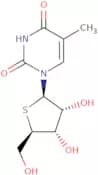
CAS:5-Methyl-4'-thiouridine is a novel, synthetic nucleoside that has antiviral and anticancer activities. It is an activator of ribonucleotide reductase and a substrate for diphosphate reductase. 5-Methyl-4'-thiouridine (also known as 5-methyluridine) is used in the synthesis of DNA, RNA, and phosphoramidites. The CAS number for this compound is 6741-71-5.Pureza:Min. 95%1,N6-Ethenoadenosine-5'-monophosphate sodium salt
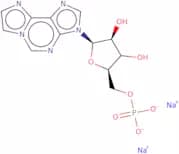
CAS:1,N6-Ethenoadenosine-5'-monophosphate sodium salt is a synthetic nucleoside analog. It serves as an antiviral and anticancer agent by inhibiting viral DNA polymerase and tumor cell proliferation. This drug has been shown to be effective in animal models of cancer. 1,N6-Ethenoadenosine-5'-monophosphate sodium salt also inhibits the enzyme ribonucleotide reductase, which is needed for deoxyribonucleotide synthesis. 1,N6-Ethenoadenosine-5'-monophosphate sodium salt is chemically related to adenosine monophosphate (AMP). However, it is not active against AMP phosphohydrolases that are found in bacteria and some protozoa.Fórmula:C12H14N5O7PPureza:Min. 95%Peso molecular:371.24 g/mol

![2',3'-Di-O-acetyl-5'-deoxy-5-fluoro-N-[(2-methylbutoxy)carbonyl]cytidine](/_next/image/?url=https%3A%2Fstatic.cymitquimica.com%2Fproducts%2F3D%2Fthumb-webp%2FND100109.webp&w=3840&q=75)



![1,5-Anhydro-4,6-O-benzylidene-2,3-dideoxy-2-[uracil-1-yl]-D-glucitol](/_next/image/?url=https%3A%2Fstatic.cymitquimica.com%2Fproducts%2F3D%2Fthumb-webp%2FNA04723.webp&w=3840&q=75)