Nucleosídeos
Os nucleosídeos são building blocks fundamentais dos ácidos nucleicos, compostos por uma base nitrogenada ligada a uma molécula de açúcar. Nesta seção, você encontrará uma ampla variedade de nucleosídeos essenciais para pesquisas em biologia molecular, bioquímica e farmacologia. Esses compostos desempenham papéis cruciais na síntese de DNA e RNA, e também são vitais em vários processos metabólicos. Os nucleosídeos são usados para estudar material genético, desenvolver terapias antivirais e anticancerígenas, e entender os mecanismos celulares. Na CymitQuimica, fornecemos nucleosídeos de alta qualidade para apoiar suas necessidades de pesquisa e desenvolvimento, garantindo pureza e confiabilidade para suas aplicações experimentais.
Foram encontrados 3569 produtos de "Nucleosídeos"
Ordenar por
Pureza (%)
0
100
|
0
|
50
|
90
|
95
|
100
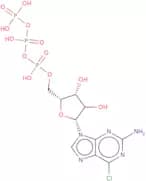
2-Amino-6-chloro-(b-D-ribofuranosyl)purine-5'-triphosphate
2-Amino-6-chloro-(b-D-ribofuranosyl)purine-5'-triphosphate is a modified nucleotide analog that is used as an antiviral agent. It inhibits the synthesis of viral DNA by competitively inhibiting the incorporation of deoxyribonucleoside triphosphates into the growing DNA chain. 2-Amino-6-chloro-(b-D-ribofuranosyl)purine-5'-triphosphate is phosphorylated to 2-[2-(2,6,8,10,12,14,16,-doxohexadecyl)-1H--imidazo[4,5--c]pyridine--1--carboxylic acid]ethanol phosphate in vivo and this active form inhibits human immunodeficiency virus type 1 (HIV1) replication in vitro with an IC 50 of 0.06 μM.Fórmula:C10H15ClN5O13P3Pureza:Min. 95%Peso molecular:541.63 g/mol4-Bromo-2-methoxypyrimidine
CAS:<p>4-Bromo-2-methoxypyrimidine is a synthetic compound that is used in the synthesis of other compounds. It reacts with alcohols, boronic acids, and benzyl halides to form heterocycles or pyrimidine compounds. The reaction system is catalytic and chemoselectively. 4-Bromo-2-methoxypyrimidine has been shown to have anticancer activity against various cell lines in vitro. It also possesses an ability to react with aryl boronic acids, such as those found in 2-pyridinones, to form new compounds. This reaction is catalyzed by palladium on carbon or copper chloride in the presence of a base. The new compounds have shown anti-inflammatory and cytotoxic activities against cancer cells.</p>Pureza:Min. 95%3'-deoxy-3',4'-didehydrouridine
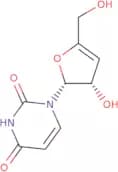
CAS:<p>3'-deoxy-3',4'-didehydrouridine is a synthetic nucleoside that inhibits viral replication. It is an antiviral agent that has been shown to be effective against DNA and RNA viruses. The synthesis of this compound has been described in the literature. This product is available in high purity and high quality, and CAS No. 2166167-51-5. 3'-deoxy-3',4'-didehydrouridine has also been shown to have anticancer activity, and is a novel synthetic nucleoside.</p>Fórmula:C9H10N2O5Pureza:Min. 95%Peso molecular:226.19 g/mol2',3',5'-Tri-O-benzoyl-2-thiouridine
CAS:<p>2',3',5'-Tri-O-benzoyl-2-thiouridine is an analog of the nucleoside thiouracil, which is a modified nucleoside. It inhibits the synthesis of DNA and RNA by competitively inhibiting the enzyme thymidylate synthase. 2',3',5'-Tri-O-benzoyl-2-thouridine has been shown to exhibit anticancer activity in vitro and in vivo. This compound also exhibits antiviral properties against herpes simplex virus type 1 (HSV1) and Herpes simplex virus type 2 (HSV2).</p>Fórmula:C30H24N2O8SPureza:Min. 95%Peso molecular:572.59 g/mol2',3'-Didehydro-2',3'-dideoxyuridine
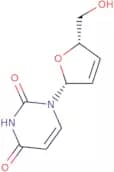
CAS:<p>2',3'-Didehydro-2',3'-dideoxyuridine (DDDU) is a nucleoside analog that inhibits the formation of HIV. It is a potent inhibitor of human immunodeficiency virus type 1 (HIV-1) replication in cell culture, and has been shown to inhibit the production of HIV-1 virions in vitro. 2',3'-Didehydro-2',3'-dideoxyuridine has been shown to bind to the enzyme glycosyltransferase, which is required for HIV-1 replication. DDU also binds to human CD4+ T cells, deflecting them from the HIV-infected target cell. This compound may be useful as an antiviral agent against HIV-1 infection by inhibiting viral replication and infectivity.</p>Fórmula:C9H10N2O4Pureza:Min. 95%Peso molecular:210.19 g/mol5-Aza-3-deaza-N4-DMF-5'-O-DMT-2'-O-methylcytidine 3'-CE phosphoramidite
5-Aza-3-deaza-N4-DMF-5'-O-DMT-2'-O-methylcytidine 3'-CE phosphoramidite is a novel modified nucleoside that is synthesized by the reaction of 5-Aza-3,8-(N4,N4)-dimethyl-1,2:5,6:8:10,11:12,-tetradeoxyribonucleosides with 2'-O,O'-Dimethoxytrityl Chloride. This product has been shown to be an activator and to have antiviral and anticancer activities. It also has a high purity and quality.Fórmula:C43H55N6O8PPureza:Min. 95%Peso molecular:814.91 g/molGuanosine-5'-carboxylic acid
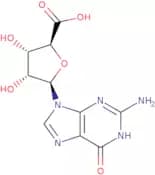
CAS:Guanosine-5'-carboxylic acid (GCA) is a nucleotide that interacts with mammalian cells. It reacts in a vessel to form the antigen, which can then be detected using an antibody. The conformational properties of this molecule are important for its function, and it has been shown to be effective against cancer cells in vivo. GCA has also been shown to interact with toll-like receptor 2 and induce an antibody response.Fórmula:C10H11N5O6Pureza:Min. 95%Peso molecular:297.22 g/molN2-DMF-9-(2'-deoxy-5'-O-DMT-b-D-ribofuranosyl)purine 3'-CE phosphoramidite
CAS:N2-DMF-9-(2'-deoxy-5'-O-DMT-b-D-ribofuranosyl)purine 3'-CE phosphoramidite is a novel, modified nucleoside analog with antiviral and anticancer properties. It is synthesized by the reaction of 2′,5′-O-(4,4′-dimethoxytrityl)-9-(2′deoxy-5′-O-DMT b D ribofuranosyl)purine 3′ with a phosphoramidite reagent in DMF at elevated temperature. The compound has been shown to inhibit viral replication in vitro and in vivo. In addition to its antiviral activity, N2DMFP3'-CE also inhibits tumor cell growth.Fórmula:C43H53N8O6PPureza:Min. 95%Cor e Forma:Off white solid.Peso molecular:808.93 g/mol3'-Deoxy-3'-fluoroinosine
CAS:3'-Deoxy-3'-fluoroinosine is a nucleoside analog that has been shown to have cytotoxic effects. It inhibits the growth of nematodes and other parasites by blocking the deacetylation of lipids in the cell membrane, which leads to their death. 3'-Deoxy-3'-fluoroinosine has also been shown to inhibit trypanosomiasis and leishmania infections by preventing the synthesis of purines and pyrimidines. This drug binds to 6-chloropurine ribonucleotide reductase, thereby inhibiting the production of nucleic acids. 3'-Deoxy-3'-fluoroinosine is not active against mammalian cells, which may be due to its inability to penetrate cell membranes efficiently.Pureza:Min. 95%3'-Deoxy-3'-fluorocytidine
CAS:<p>3'-Deoxy-3'-fluorocytidine is an activating agent that has been shown to inhibit coxsackie virus and other single-stranded RNA viruses. It is a nucleoside analogue that binds to the enzyme ribofuranoside, preventing the formation of the active site. 3'-Deoxy-3'-fluorocytidine has also been shown to inhibit the biochemical reactions involving S-adenosylhomocysteine hydrolase, which catalyzes the conversion of S-adenosylhomocysteine into adenosine, a precursor for DNA synthesis. Mechanistic studies have indicated that 3'-deoxy-3'-fluorocytidine inhibits enzymatic activity through stereochemical interactions with S-adenosylhomocysteine hydrolase.</p>Fórmula:C9H12FN3O4Pureza:Min. 95%Peso molecular:245.21 g/mol2’-Deoxy-N2-dimethylguanosine
CAS:<p>2’-Deoxy-N2-dimethylguanosine is a novel antiviral agent that inhibits the replication of human DNA viruses by binding to their diphosphate or monophosphate regions and inhibiting ribonucleotide reductase. It has also been shown to have anticancer properties in vitro.</p>Pureza:Min. 95%2-Iodo-2’-deoxyadenosine
CAS:<p>2-Iodo-2’-deoxyadenosine is a novel nucleoside that is a modified adenosine. It has been shown to possess anticancer activity. 2-Iodo-2’-deoxyadenosine has a high degree of cytotoxicity and can induce apoptosis in cancer cells. This drug also inhibits the growth of herpes simplex virus type 1 (HSV) and HIV, which are both types of viruses that infect humans. The antiviral activity may be due to the inhibition of viral DNA synthesis or RNA transcription. 2-Iodo-2’-deoxyadenosine is synthesized from adenine, iodine, and sulfuric acid with high purity and quality. It is not active against bacteria because it does not inhibit bacterial DNA gyrase or topoisomerase IV enzymes.</p>Pureza:Min. 95%8-(p-Chlorophenylthio)-cGMP
CAS:<p>8-(p-Chlorophenylthio)-cGMP is a modified nucleoside that has anticancer activity. It inhibits DNA synthesis and the activation of protein kinases, which are enzymes that transmit signals from the cell surface to the nucleus. 8-(p-Chlorophenylthio)-cGMP can also inhibit viral replication by inhibiting the production of new virus particles and by inhibiting the action of reverse transcriptase, an enzyme that converts RNA into DNA.</p>Fórmula:C16H15ClN5O7PSPureza:Min. 95%Peso molecular:487.81 g/molAdenosine 5′-diphosphoribose monosodium
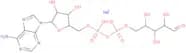
CAS:Adenosine 5′-diphosphoribose monosodium is a novel nucleotide that can be used in the synthesis of antiviral, anticancer, and anti-inflammatory drugs. Adenosine 5′-diphosphoribose monosodium is a modified form of adenosine 5′-triphosphate (ATP) with an added phosphate group at the 5′ position on the ribose sugar. It is synthesized from ATP by phosphoramidite chemistry. The CAS number for this product is 68414-18-6. Adenosine 5′-diphosphoribose monosodium has been shown to inhibit replication of human immunodeficiency virus type 1 (HIV-1) and herpes simplex virus type 1 (HSV-1).Fórmula:C15H23N5O14P2•NaPureza:Min. 95%Peso molecular:582.31 g/mol2'-O-tert-Butyldimethylsilyl-5'-O-DMT-5-iodouridine 3'-CE phosphoramidite
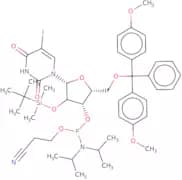
2'-O-tert-Butyldimethylsilyl-5'-O-DMT-5-iodouridine 3'-CE phosphoramidite is a modified nucleoside that can be used to synthesize oligonucleotides. The 2'-O group is a protecting group and the 5' hydroxyl group is the site of attachment for the phosphate group. This product is an anticancer, antiviral, and antiretroviral agent. It has been shown to inhibit the growth of cancer cells in vitro and in vivo.Fórmula:C45H60IN4O9PSiPureza:Min. 95%Peso molecular:986.97 g/mol2'-Deoxy-N4,5-dimethylcytidine
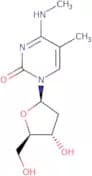
CAS:<p>2'-Deoxy-N4,5-dimethylcytidine is an activator that has the ability to activate a variety of nucleoside analogs. The compound is synthetically derived and used as an antiviral agent. It can be modified at the 5' position with phosphate groups or ribonucleosides. 2'-Deoxy-N4,5-dimethylcytidine is also a novel monophosphate nucleoside that has been shown to inhibit the growth of cancer cells in vitro and in vivo. This drug inhibits DNA synthesis by preventing the incorporation of diphosphate nucleotides into DNA during DNA replication. 2'-Deoxy-N4,5-dimethylcytidine is not active against RNA synthesis because it does not have any activity at this site.</p>Fórmula:C11H17N3O4Pureza:Min. 95%Peso molecular:255.27 g/mol5'-O-DMTr-2'-O,4'-C-methyleneuridine 3'-CE-phosphoramidite
CAS:5'-O-DMTr-2'-O,4'-C-methyleneuridine 3'-CE-phosphoramidite is a novel nucleoside phosphoramidite. It is an activator of DNA polymerase for the synthesis of diphosphate analogues of ribonucleosides and deoxyribonucleosides. This compound has been used in the synthesis of antiviral and anticancer agents, as well as in research on the development of new antiviral drugs.Pureza:Min. 95%Myristoyl coenzyme A lithium salt
CAS:<p>Myristoyl coenzyme A lithium salt is an activator that can be used in the synthesis of Ribonucleosides and Deoxyribonucleosides. It has a high purity, which ensures high quality synthesis. Myristoyl coenzyme A lithium salt is a novel nucleotide precursor that can be used to synthesize DNA or RNA for use in anti-cancer or antiviral treatments.</p>Fórmula:C35H62N7O17P3S·xLiPureza:Min. 95%Peso molecular:977.89 g/molFialuridine 5'-monophosphate
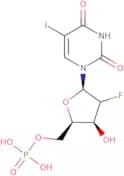
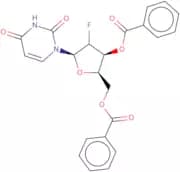
CAS:Fialuridine 5'-monophosphate is an analog of fialuridine, a drug used to treat HIV. Fialuridine 5'-monophosphate inhibits mitochondrial DNA synthesis by inhibiting hepg2 in the mitochondria and blocks the conversion of uracil to thymine in nuclear DNA. The inhibition of these two processes prevents viral replication and cell division. Fialuridine 5'-monophosphate also has antioxidant properties that protect cells from oxidative damage induced by reactive oxygen species. This drug may be beneficial for cancer treatment as well as hepatitis C or herpes simplex virus infection.Fórmula:C9H11FIN2O8PPureza:Min. 95%Peso molecular:452.07 g/mol3',5'-Di-O-benzoyl-2'-deoxy-2'-fluorouridine
<p>3',5'-Di-O-benzoyl-2'-deoxy-2'-fluorouridine is a novel nucleoside analog that has been shown to have anticancer activity in vitro. The compound is a monophosphate, which is synthesized from 2'-deoxyuridine and benzoyl chloride. 3',5'-Di-O-benzoyl-2'-deoxy-2'-fluorouridine was found to have antiviral activity against herpes simplex virus type 1 (HSV1) and cytomegalovirus (CMV). It also inhibited the production of HIV in human lymphocytes. This nucleoside analog can be activated by phosphorylation at the 5' position to form a diphosphate, which inhibits DNA synthesis by incorporating into the growing DNA chain and preventing the movement of RNA polymerase along the template strand.</p>Fórmula:C23H19FN2O7Pureza:Min. 95%Peso molecular:454.42 g/mol