Nucleosídeos
Os nucleosídeos são building blocks fundamentais dos ácidos nucleicos, compostos por uma base nitrogenada ligada a uma molécula de açúcar. Nesta seção, você encontrará uma ampla variedade de nucleosídeos essenciais para pesquisas em biologia molecular, bioquímica e farmacologia. Esses compostos desempenham papéis cruciais na síntese de DNA e RNA, e também são vitais em vários processos metabólicos. Os nucleosídeos são usados para estudar material genético, desenvolver terapias antivirais e anticancerígenas, e entender os mecanismos celulares. Na CymitQuimica, fornecemos nucleosídeos de alta qualidade para apoiar suas necessidades de pesquisa e desenvolvimento, garantindo pureza e confiabilidade para suas aplicações experimentais.
Foram encontrados 3569 produtos de "Nucleosídeos"
Ordenar por
Pureza (%)
0
100
|
0
|
50
|
90
|
95
|
100
S-(4-Nitrobenzyl)-6-thioguanosine
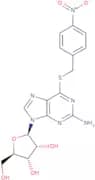
CAS:<p>S-(4-Nitrobenzyl)-6-thioguanosine is a transport inhibitor that has been shown to be active against leukemia. This drug inhibits the uptake of leukocytes into the bone marrow, which prevents their proliferation and development. S-(4-Nitrobenzyl)-6-thioguanosine also inhibits the synthesis of adenosine in erythrocytes, which leads to the accumulation of uridine and then to an increase in the levels of ATP. This drug can be used to treat chronic lymphocytic leukemia.</p>Fórmula:C17H18N6O6SPureza:Min. 95%Peso molecular:434.43 g/molN6-Benzoyl-2'-deoxy-3'-O-levulinoyladenosine
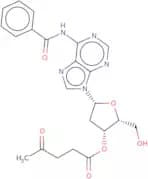
<p>N6-Benzoyl-2'-deoxy-3'-O-levulinoyladenosine is an antiviral monophosphate nucleoside that has been shown to have significant activity against HIV and herpes simplex virus. It is also an anticancer drug and a novel synthetic nucleoside. N6-Benzoyl-2'-deoxy-3'-O-levulinoyladenosine has been shown to inhibit the growth of cancer cells in culture, as well as in animal models. It also inhibits the production of DNA and RNA, which may be due to its ability to act as a competitive inhibitor of DNA polymerase or RNA polymerase.</p>Fórmula:C22H23N5O6Pureza:Min. 95%Peso molecular:453.46 g/molBenzyl-N, N-diisopropylchlorophosphoramidite
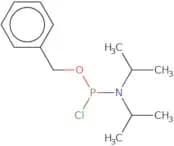
CAS:Benzyl-N, N-diisopropylchlorophosphoramidite is a novel nucleoside phosphoramidite with anticancer activity. It is synthesized from benzyl alcohol and diisopropylamine by reaction with phosphorus oxychloride in the presence of a base. This compound can be used to activate DNA for subsequent coupling reactions or for modification of DNA. Benzyl-N, N-diisopropylchlorophosphoramidite has been shown to have antiviral and antitumour activities in vitro and in vivo.Fórmula:C13H21NOPClPureza:Min. 95%Peso molecular:273.74 g/mol5-[N-(2-Aminoethyl)-3-E-acrylamido]-2'-deoxy-5'-O-DMT-uridine
CAS:5-[N-(2-Aminoethyl)-3-E-acrylamido]-2'-deoxy-5'-O-DMT-uridine is a novel, activator ribonucleoside phosphoramidite. It is used in the synthesis of oligodeoxynucleotides and has antiviral, anticancer, and antimalarial activities. 5-[N-(2-Aminoethyl)-3-E-acrylamido]-2'-deoxy-5'-O-DMT-uridine is synthesized from 2'-deoxyadenosine monophosphate (dAMP) and N-(2 aminopropyl)-3-(E acryloyl) aminopropylphosphoramidite (APEAP). This nucleoside can be used as a building block for DNA synthesis or for other purposes such as the treatment of cancer and HIV.Fórmula:C35H38N4O8Pureza:Min. 95%Peso molecular:642.72 g/mol2'-Deoxyuridine-5'-diphosphate sodium
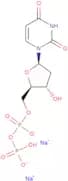
CAS:2'-Deoxyuridine-5'-diphosphate sodium salt is a novel antiviral agent that inhibits viral replication by inhibiting the activity of viral DNA polymerase. It is a synthetic nucleoside that is not found in nature, but is an analog of deoxyuridine monophosphate. This compound has been shown to be effective against tumor cells and has high purity with a CAS number 102814-06-2. 2'-Deoxyuridine-5'-diphosphate sodium salt is also used as an activator for phosphoramidites and modified nucleosides.Fórmula:C9H14N2O11P2•Na2Pureza:Min. 95%Cor e Forma:PowderPeso molecular:434.14 g/molUridylyl-3'-5'-adenosine ammonium salt
Uridylyl-3'-5'-adenosine ammonium salt is a novel antiviral agent that is used to treat hepatitis B. It is an analogue of nucleoside monophosphate, which is activated by adenylyltransferase, and inhibits viral DNA synthesis. Uridylyl-3'-5'-adenosine ammonium salt has been shown to inhibit the growth of cancer cells in vitro and in vivo. This drug also has anticancer activity against various types of cancer cell lines.Fórmula:C19H27N8O12PPureza:Min. 95%Peso molecular:590.44 g/mol4-Amino-2,6-dimethyl-8-(2'-deoxy-3',5'-di-O-toluoyl-b-D-ribofuranosyl)-7-pteridone
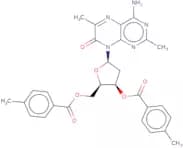
4-Amino-2,6-dimethyl-8-(2'-deoxy-3',5'-di-O-toluoyl-b-D-ribofuranosyl)-7-pteridone is a high purity, modified nucleoside that is synthesized from 2,4,6,8 tetramethylpyridine and 2'-deoxyribofuranosyl bromide. 4ADTP is an antiviral and anticancer agent that inhibits the viral DNA polymerase in the herpes family of viruses and the DNA polymerase in cancer cells. This drug has been shown to be active against HIV type 1 (HIV1) and HIV type 2 (HIV2).Fórmula:C29H29H5O6Pureza:Min. 95%Peso molecular:543.57 g/mol2'-Amino-2'-deoxyuridine-5'-triphosphate
CAS:<p>2'-Amino-2'-deoxyuridine-5'-triphosphate (2dUDP) is a nucleotide that has been shown to be a potent inhibitor of cytosolic Ca2+ release. 2dUDP binds to the Ryanodine receptor (RYR) and inhibits the release of Ca2+ from the sarcoplasmic reticulum. It is also fluorescent, and can be used to detect Ca2+ in cells. This nucleotide has been shown to inhibit populations of heterologous and homologous RYR receptors.</p>Fórmula:C9H16N3O14P3Pureza:Min. 95%Peso molecular:483.16 g/mol2'-Deoxy-5'-O-FDMT-N2-isobutyryl-guanosine 3'-CE phosphoramidite
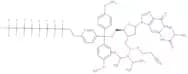
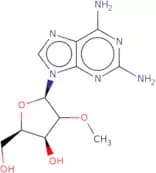
CAS:Produto Controlado2'-Deoxy-5'-O-FDMT-N2-isobutyryl-guanosine 3'-CE phosphoramidite is a modified nucleoside that is used as an antiviral agent. It is synthesized by modifying the 2'-deoxyribose sugar with a 2'-deoxy-5'-O-(4,4'-dimethoxytrityl)-N2-isobutyrylguanosine 3' phosphate. This compound has shown anticancer activity in vitro and has been studied in animal models. The synthesis of this compound can be accomplished through the use of diphosphate, which gives it an advantage over natural nucleosides because it does not require ribonucleotides.Fórmula:C54H57F17N7O8PPureza:Min. 95%Peso molecular:1,286.02 g/mol2,6-Diamino-9-(2'-O-methyl-b-D-ribofuranosyl)purine
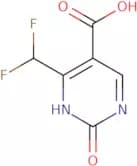
CAS:<p>2,6-Diamino-9-(2'-O-methyl-b-D-ribofuranosyl)purine is a synthetic nucleoside that is used as an antiviral and antitumor agent. It is a modified nucleoside with a purine base. It has been shown to be effective against certain cancer cells in vitro and in vivo. This drug also has antiviral properties, which may be due to its ability to inhibit DNA synthesis through the inhibition of viral RNA replication. 2,6-Diamino-9-(2'-O-methyl-b-D-ribofuranosyl)purine is resistant to phosphorylation by kinase enzymes and it can be used as a precursor for the preparation of other nucleosides.</p>Fórmula:C11H16N6O4Pureza:Min. 95%Cor e Forma:White to off-white solid.Peso molecular:296.29 g/mol4-(difluoromethyl)-2-hydroxy-pyrimidine-5-carboxylic acid
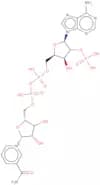
CAS:4-(difluoromethyl)-2-hydroxy-pyrimidine-5-carboxylic acid is a novel monophosphate and nucleotide analogue, which can activate the HIV reverse transcriptase. It has been shown to be cytotoxic to cancer cells in vitro. 4-(difluoromethyl)-2-hydroxy-pyrimidine-5-carboxylic acid has been used for the synthesis of phosphoramidites and DNA and RNA analogues.Fórmula:C6H4F2N2O3Pureza:Min. 95%Peso molecular:190.1 g/molb-Nicotinamide adenine dinucleotide phosphate potassium salt hydrate
CAS:b-Nicotinamide adenine dinucleotide phosphate potassium salt hydrate is a novel anticancer compound that has been shown to inhibit the growth of cancer cells in vitro. The mechanism of action of b-NADP+ is still unknown, but it may involve the inhibition of ribonucleoside reductase and deoxyribonucleoside reductase. It also inhibits viral DNA synthesis, which can be an effective antiviral drug. b-NADP+ is a nucleotide analogue that is synthesized from diphosphate and monophosphate forms, which are activated by phosphoramidites.Fórmula:C21H28N7O17P3•K•(H2O)2Pureza:Min. 95%Peso molecular:818.5 g/molGuanosine 5'-[beta,gamma-imido]triphosphate tetralithium hydrate
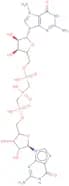
CAS:<p>Guanosine 5'-[beta,gamma-imido]triphosphate tetralithium hydrate (GTP) is a nucleotide that is synthesized from guanosine 5'-diphosphate. GTP is an effector molecule that regulates the cytosolic protein synthesis and transport pathways. It binds to a number of proteins, including the guanine nucleotide-binding protein, which regulates the metabolic processes in cells. GTP has been shown to be beneficial in treating cancer by inducing apoptosis and inhibiting tumor growth. In addition, Guanosine 5'-[beta,gamma-imido]triphosphate tetralithium hydrate has been shown to inhibit congestive heart failure by reducing free radical production and increasing intracellular adenosine levels.</p>Fórmula:C10H13Li4N6O13P3Pureza:Min. 95%Peso molecular:546 g/molN6-Benzoyl-5'-chloro-5'-deoxy-2',3'-O-isopropylideneadenosine
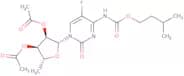
N6-Benzoyl-5'-chloro-5'-deoxy-2',3'-O-isopropylideneadenosine is a novel nucleoside that has the potential to be a therapeutic agent for cancer and antiviral therapy. It is an analog of adenosine that inhibits viral replication by inhibiting the viral enzyme RNA-dependent DNA polymerase. N6-Benzoyl-5'-chloro-5'-deoxy-2',3'-O-isopropylideneadenosine also inhibits tumor growth by inducing apoptosis. The compound has been shown to inhibit human leukemia cells in vitro, as well as mouse leukemia cells in vivo. This novel nucleoside is synthesized through a two step process starting with 5'-chloroadenosine and converting it to 5'-chloroinosidine with potassium cyanide, followed by deoxygenation at the 6 position with benzoyl chloride and sodium hydroxide.Pureza:Min. 95%2',3'-Di-O-acetyl-5'-deoxy-5-fluoro-N4-(isopentyloxycarbonyl)cytidine
CAS:2',3'-Di-O-acetyl-5'-deoxy-5-fluoro-N4-(isopentyloxycarbonyl)cytidine is an antiviral nucleoside. It is a novel nucleotide analog that inhibits human immunodeficiency virus (HIV). The cytidine monophosphate moiety of 2',3'-Di-O-acetyl-5'-deoxy-5-fluoro-N4-(isopentyloxycarbonyl)cytidine has been modified with the substitution of the acetyl group at the 2' position with a deoxyribose group, and the 5' fluoro group with a 5'-deoxyfluro group. This modification prevents phosphodiesterases from hydrolyzing it to its monophosphate form, which leads to higher antiviral activity. 2',3'-Di-O-acetyl-5'-deoxy-5-fluoro -Fórmula:C19H26FN3O8Pureza:Min. 95%Peso molecular:443.42 g/molN4-Benzoyl-2'-deoxy-5'-O-DMT-cytidine-3'-lcaa-CPG
N4-Benzoyl-2'-deoxy-5'-O-DMT-cytidine-3'-lcaa-CPG is an antiviral agent that inhibits the RNA polymerase of the virus. It is a phosphoramidite, which is a nucleoside with a phosphate group at the 5' position. N4-Benzoyl-2'-deoxy-5'-O-DMT-cytidine has been shown to be cytotoxic against cancer cells, and have less side effects than other nucleosides. It has been shown to selectively bind to ribonucleosides and deoxyribonucleosides and inhibit their synthesis by binding to the enzyme DNA polymerase. This stops DNA replication and causes cell death.Pureza:Min. 95%6-Methyl-3-(β-D-2-deoxyribofuranosyl)furano-[2,3-d]pyrimidin-2-one
CAS:6-Methyl-3-(β-D-2-deoxyribofuranosyl)furano-[2,3-d]pyrimidin-2-one is a novel nucleoside analog that has been modified to contain an antiviral agent. It is phosphorylated at the 2' position to form a monophosphate. This compound is a potent inhibitor of HIV reverse transcriptase and human DNA polymerases α and β. The structure of this compound contains a furano ring fused with the pyrimidine moiety, which is substituted with methyl groups on C6 and C3 positions. The CAS number for 6-Methyl-3-(β-D-2-deoxyribofuranosyl)furano-[2,3-d]pyrimidin-2-one is 383897−60−7.Fórmula:C12H14N2O5Pureza:Min. 95%Peso molecular:266.25 g/mol5'-O-DMT-thymidine 3'-Q Linker CPG 1000 Å
<p>5'-O-DMT-thymidine 3'-Q Linker CPG 1000 Å is an Activator that is a monophosphate and synthesized through the modification of nucleosides. It has novel anticancer properties and is a high quality, high purity, and modified nucleotide. The 5'-O-DMT-thymidine 3'-Q Linker CPG 1000 Å has been shown to have antiviral activity against herpes simplex virus type 1 (HSV-1) in human cells. It also has anticancer effects on human leukemia cells by inhibiting the growth of cancer cells.</p>Pureza:Min. 95%N4-Benzoyl-5'-O-DMT-2'-O-(2-methoxyethyl)-5-methylcytidine 3'-O succinate TEA salt
N4-Benzoyl-5'-O-DMT-2'-O-(2-methoxyethyl)-5-methylcytidine 3'-O succinate TEA salt is a novel, modified nucleoside analogue that is used as an antiviral agent. It inhibits the synthesis of viral DNA and RNA by competing with natural nucleosides during the process of nucleic acid synthesis. The drug binds to the enzyme ribonucleotide reductase, which is essential for DNA synthesis. N4-Benzoyl-5'-O-DMT-2'-O-(2-methoxyethyl)-5-methylcytidine 3'-O succinate TEA salt has been shown to be effective in treating patients with cancer.Pureza:Min. 95%m7G(5')ppp(5')Guanosine
CAS:<p>A cap analog that can incorporated into mRNA</p>Fórmula:C21H29N10O18P3Pureza:Min. 95%Peso molecular:802.43 g/mol

![5-[N-(2-Aminoethyl)-3-E-acrylamido]-2'-deoxy-5'-O-DMT-uridine](/_next/image/?url=https%3A%2Fstatic.cymitquimica.com%2Fproducts%2F3D%2Fthumb-webp%2FNA08231.webp&w=3840&q=75)


![Guanosine 5'-[beta,gamma-imido]triphosphate tetralithium hydrate](/_next/image/?url=https%3A%2Fstatic.cymitquimica.com%2Fproducts%2F3D%2Fthumb-webp%2FPCA56403.webp&w=3840&q=75)


![6-Methyl-3-(β-D-2-deoxyribofuranosyl)furano-[2,3-d]pyrimidin-2-one](/_next/image/?url=https%3A%2Fstatic.cymitquimica.com%2Fproducts%2F3D%2Fthumb-webp%2FIQA89760.webp&w=3840&q=75)