Nucleosídeos
Os nucleosídeos são building blocks fundamentais dos ácidos nucleicos, compostos por uma base nitrogenada ligada a uma molécula de açúcar. Nesta seção, você encontrará uma ampla variedade de nucleosídeos essenciais para pesquisas em biologia molecular, bioquímica e farmacologia. Esses compostos desempenham papéis cruciais na síntese de DNA e RNA, e também são vitais em vários processos metabólicos. Os nucleosídeos são usados para estudar material genético, desenvolver terapias antivirais e anticancerígenas, e entender os mecanismos celulares. Na CymitQuimica, fornecemos nucleosídeos de alta qualidade para apoiar suas necessidades de pesquisa e desenvolvimento, garantindo pureza e confiabilidade para suas aplicações experimentais.
Foram encontrados 3569 produtos de "Nucleosídeos"
Ordenar por
Pureza (%)
0
100
|
0
|
50
|
90
|
95
|
100
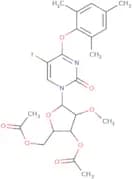
3',5'-Di-o-acetyl-5-fluoro-O4-(2,4,6-trimethylphenyl)-2'-o-methyluridine
CAS:<p>3',5'-Di-O-acetyl-5-fluoro-O4-(2,4,6-trimethylphenyl)-2'-O-methyluridine is a novel monophosphate nucleoside analog that is activated by T4 polynucleotide kinase. It is synthesized from the corresponding phosphoramidite and reacts with the 5'-OH group of a ribonucleoside to form a 3',5'-di-O-acetylribonucleoside. The diacetyl group confers increased stability to the molecule and also provides an acetyl group for incorporation into DNA. This compound has antiviral activity against herpes simplex virus type 1 (HSV1) in cell culture and has shown anticancer properties in animal studies.</p>Fórmula:C23H27FN2O8Pureza:Min. 95%Peso molecular:478.5 g/mol3’-O-tert-Butyldiphenylsilylthymidine
CAS:Used as a protected thymidine nucleoside in chemical synthesis, specifically as an intermediate in the preparation of other thymidine derivatives, particularly 5'-modified nucleosides and oligonucleotides. The tert-butyldiphenylsilyl (TBDPS) group is a silyl protecting group selectively attached to the 3' hydroxyl group of thymidine.Fórmula:C26H32N2O5SiPureza:Min. 95%Cor e Forma:White PowderPeso molecular:480.63 g/mol2'-Deoxy-5'-S-DMT-5'-thioinosine 3'-CE phosphoramidite
2'-Deoxy-5'-S-DMT-5'-thioinosine 3'-CE phosphoramidite is a novel nucleoside analogue that has antiviral activity. It can be synthesized from 2'-deoxyribonucleosides and 5'-thioinosine monophosphate. This compound inhibits viral replication by inhibiting the synthesis of viral diphosphate, which is required for DNA synthesis. The compound also has anticancer properties and can inhibit the growth of tumor cells by blocking the process of DNA synthesis.Pureza:Min. 95%2'-Deoxyadenosine-5'-O-(1-thiotriphosphate) lithium salt - 100 mM aqueous solution
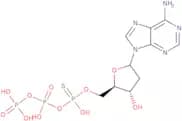
CAS:2'-Deoxyadenosine-5'-O-(1-thiotriphosphate) lithium salt is a circularization agent that can be used in the efficient method for the synthesis of DNA. It inhibits the growth of bacteria by binding to their DNA and preventing transcription. 2'-Deoxyadenosine-5'-O-(1-thiotriphosphate) lithium salt has shown inhibitory effects against tuberculosis and other infectious diseases, including diphtheria, tetanus, typhoid fever, and malaria. This drug also prevents the replication of viral RNA. The inhibition occurs through an analog mechanism at the level of nucleic acid synthesis or polymerase chain reaction (PCR). The thiophosphate group is cleaved from the triphosphate moiety in the presence of metal ions such as Zn2+, Mg2+, Mn2+, or Ca2+. The active form is enzymatically hydrolyzed by covalent enzyme activity toFórmula:C10H16N5O11P3S·xLiPureza:Min. 95%Peso molecular:507.25 g/mol2'-Deoxyadenosine-5'-carboxylic acid
CAS:dA oxidised at the 5'-position.Fórmula:C10H11N5O4Pureza:Min. 95%Peso molecular:265.23 g/molAristeromycin
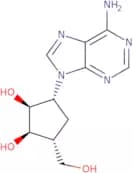
CAS:Carbocyclic nucleoside antibioticFórmula:C11H15N5O3Pureza:Min. 95%Peso molecular:265.27 g/mol2',3',5'-Tri-O-acetyl-5-methyluridine
2',3',5'-Tri-O-acetyl-5-methyluridine is a nucleoside that is used as a substrate for the enzyme, methylmagnesium (MeMg) nucleotides. It has been shown to have a high basicity and is a good substrate for the enzyme, MeMg nucleotides. 2',3',5'-Tri-O-acetyl-5-methyluridine also has stereoselectivity and can be synthesized with high purity.Pureza:Min. 95%N1-Methyladenosine hydroiodide
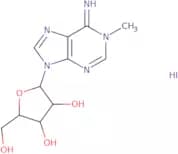
CAS:N1-Methyladenosine hydroiodide is a novel nucleoside analogue that inhibits viral replication by preventing the formation of viral DNA. It also inhibits the growth of cancer cells and is used as an anticancer drug. N1-Methyladenosine hydroiodide has been shown to be an activator of RNA polymerase II, increasing the production of messenger RNA (mRNA) in human cells. The phosphoramidite form of this compound is used for the synthesis of oligodeoxyribonucleotides, which are chemically modified in order to improve their stability and inhibit degradation by nucleases. N1-Methyladenosine hydroiodide is highly pure and has CAS No. 34308-25-3.Fórmula:C11H15N5O4·HIPureza:Min. 95%Peso molecular:409.18 g/mol6-Amino-1-methyluracil
CAS:<p>6-Amino-1-methyluracil is a synthetic drug that is used in the treatment of inflammatory diseases, including rheumatoid arthritis and psoriasis. It is also used to treat cancer, such as leukemia and in the treatment of bacterial infections. 6-Amino-1-methyluracil inhibits the synthesis of DNA by inhibiting the enzyme thymidylate synthetase. This inhibition prevents DNA replication and transcription, which leads to cell death. 6-Amino-1-methyluracil binds to cellular proteins through its amino group and hydroxyl group, which are not involved in its chemical reactions. 6-Amino-1-methyluracil has shown great promise as a template molecule for the synthesis of new drugs.</p>Pureza:Min. 95%2'-O-tert-Butyldimethylsilyl-5-methyluridine
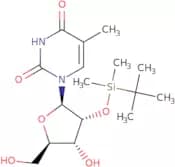
CAS:2'-O-tert-Butyldimethylsilyl-5-methyluridine is a monophosphate of 5-methyluridine. It is an analog of uracil and has been used as an antiviral agent, as well as for the prevention of colorectal cancer. 2'-O-tert-Butyldimethylsilyl-5-methyluridine is also known to be a potent activator of the ribonucleotide reductase enzyme, which may contribute to its anticancer effects. This compound has a high purity and quality, making it easy to use in various applications.Fórmula:C16H28N2O6SiPureza:Min. 95%Peso molecular:372.49 g/molBiotin-11-deoxyuridine-5'-triphosphate, triethylammonium salt - 1 mM aqueous solution
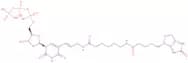
CAS:Biotin-11-deoxyuridine-5'-triphosphate, triethylammonium salt (Biotin-11-dUTP) is a nucleotide analog that is used as a fluorescent substrate for detection of DNA. It is nonradioactive and can be detected in aqueous solution. Biotin-11-dUTP binds to the 3' end of a DNA strand and becomes incorporated into the newly synthesized DNA strand during DNA replication. The incorporation of Biotin-11-dUTP into the newly synthesized strand causes an increase in fluorescence intensity, which can be detected by chemiluminescence. This nucleotide analog has been shown to have high sensitivity for detecting low levels of dsDNA in diploid cells and can be used for detection of bacterial strain, such as Salmonella enterica serovar Typhimurium.Fórmula:C34H56N7O18P3SPureza:Min. 95%Peso molecular:975.83 g/mol2'-Deoxy-5'-O-DMT-2-thio-N4-toluoylthymidine 3'-CE phosphoramidite
CAS:2'-Deoxy-5'-O-DMT-2-thio-N4-toluoylthymidine 3'-CE phosphoramidite is a novel nucleoside analogue with anticancer activity. It has been shown to inhibit the proliferation of human colon cancer cells in vitro, and inhibits the growth of HIV in cultured T-cells. In addition, this compound was found to be active against herpes virus. 2'-Deoxy-5'-O-DMT-2-thio-N4-toluoylthymidine 3'-CE phosphoramidite is a nucleoside analogue with ribonucleosides at the 2' and 5' positions, while the 4' position is modified by an acetyl group. This modification prevents incorporation into DNA or RNA, and so prevents viral replication.Fórmula:C48H56N5O7PSPureza:Min. 95%Peso molecular:878.05 g/mol3'-O-DMT-thymidine 3'-succinyl CPG 1000 Å
3'-O-DMT-thymidine 3'-succinyl CPG 1000 Å is a monophosphate nucleoside that is used in the synthesis of DNA. It is an antiviral and anticancer drug that inhibits viral replication by competing with natural diphosphate nucleosides. 3'-O-DMT-thymidine 3'-succinyl CPG 1000 Å also has shown to be effective against leukemia cells in vitro and has been shown to inhibit angiogenesis, which may be due to its ability to inhibit the proliferation of endothelial cells.Pureza:Min. 95%4-Chloro-5-aminopyrimidine
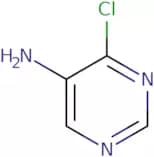
CAS:<p>4-Chloro-5-aminopyrimidine (4CAP) is an inhibitor of the enzyme purine nucleoside phosphorylase, which is involved in the synthesis of purines and pyrimidines. 4CAP has potent inhibitory activity with a Ki value of 0.06 μM, which is comparable to that of zebularine. 4CAP has also been shown to have antiinflammatory properties in lung tissue. The molecular modeling studies show that 4CAP binds to the hydroxyl group on the enzyme and prevents it from forming a covalent bond with its substrate. This causes a decrease in the rate of reaction time for the enzyme, resulting in decreased production of purines and pyrimidines.</p>Fórmula:C4H4ClN3Pureza:Min. 95%Peso molecular:129.55 g/mol3'-Azido-3'-deoxy-5'-O-tritylthymidine
CAS:An intermediate in the production of Zidovudine, the FDA approved medication for treatment of AIDS.Fórmula:C29H27N5O4Pureza:Min. 98 Area-%Cor e Forma:White PowderPeso molecular:509.56 g/mol5'-O-DMT-thymidine-3'-lcaa-CPG
5'-O-DMT-thymidine-3'-lcaa-CPG is a nucleoside, ribonucleoside, and diphosphate that inhibits viral DNA synthesis. It is a novel compound with antiviral properties that has been shown to inhibit the replication of human cytomegalovirus (HCMV) and herpes simplex type 1 virus. 5'-O-DMT-thymidine-3'-lcaa-CPG also functions as an anticancer agent by inhibiting DNA synthesis in tumor cells. This nucleoside analog is phosphoramidite, which can be used for the preparation of modified oligonucleotides. 5'-O-DMT-thymidine-3'-lcaa-CPG has high purity and high quality.Pureza:Min. 95%Cor e Forma:Powder2-Amino-benzoyl-9-(5'-O-DMT-b-D-ribofuranosyl)purine
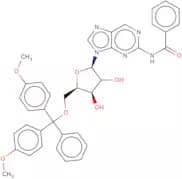
2-Amino-benzoyl-9-(5'-O-DMT-b-D-ribofuranosyl)purine is an anticancer and antiviral agent. It has been shown to be active against many viruses, including herpes simplex virus type 1, herpes simplex virus type 2, cytomegalovirus, and human immunodeficiency virus type 1. This compound also exhibits antitumor activity in mice and rats.Fórmula:C38H35N5O7Pureza:Min. 95%Peso molecular:673.71 g/mol5'-O-Acetyl-3'-azido-2',3'-dideoxy-N2-palmitoylguanosine
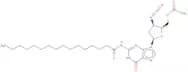
CAS:5'-O-Acetyl-3'-azido-2',3'-dideoxy-N2-palmitoylguanosine is a novel antiviral and anticancer agent. It is an analogue of the natural nucleoside guanosine. It has been modified with an acetyl group at the 5' position of the pentose moiety and an azido group at the 2' and 3' positions of the ribose moiety. The acetyl group makes this compound more water soluble, which means it can be easily administered intravenously for treatment of cancer or infection.Fórmula:C28H44N8O5Pureza:Min. 95%Peso molecular:572.7 g/molThymidylyl-(3'-5')-2'-deoxyadenosine ammonium salt
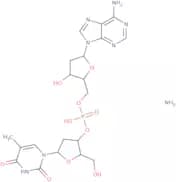
CAS:Thymidylyl-(3'-5')-2'-deoxyadenosine ammonium salt is a nucleoside that is a synthetic analog of thymidine. It has antiviral activity and is used in the synthesis of DNA and RNA. This product has shown to be effective against HIV, influenza, polio, herpes, and human papillomavirus. Thymidylyl-(3'-5')-2'-deoxyadenosine ammonium salt can also be used for the synthesis of phosphoramidites for oligonucleotide synthesis.Fórmula:C20H26N7O10P·NH3Pureza:Min. 95%Peso molecular:572.47 g/molO6-Benzyl guanosine
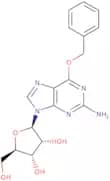
CAS:<p>O6-Benzyl guanosine is a polymerized compound that has been shown to have anticancer efficacy. It has been tested in mice with medulloblastoma, a type of brain tumor, and in rats with breast cancer. O6-Benzyl guanosine was found to be hydrophobic and bound to the methyltransferase enzyme, which resulted in the inhibition of DNA synthesis. The polymerized compound is able to form conjugates with other molecules such as iron oxide nanoparticles or hydrazone derivatives, which can be used for treatments that involve bioconjugate chemistry.</p>Fórmula:C17H19N5O5Pureza:Min. 95%Peso molecular:373.36 g/mol