Nucleosídeos
Foram encontrados 3570 produtos de "Nucleosídeos"
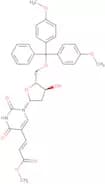
E-5-(2-Carbomethoxyvinyl)-2'-deoxy-5'-O-DMT-uridine
CAS:E-5-(2-Carbomethoxyvinyl)-2'-deoxy-5'-O-DMT-uridine is a monophosphate nucleoside analog that has been modified to be resistant to antiviral ribonucleases. This drug is phosphorylated in vivo to the corresponding diphosphate and triphosphate, which inhibits viral DNA synthesis and thus prevents the virus from replicating. E-5-(2-Carbomethoxyvinyl)-2'-deoxy-5'-O-DMT-uridine can be used as an antiviral agent against herpes simplex virus (HSV).Fórmula:C34H34N2O9Pureza:Min. 95%Peso molecular:614.66 g/molRef: 3D-NC08240
Produto descontinuado2'-O-Methyladenosine-5'-a-thiotriphosphate sodium salt
2'-O-Methyladenosine-5'-a-thiotriphosphate sodium salt is an activator that has been synthesized for therapeutic use. It is a modified nucleoside, which means that it does not occur naturally in the human body and must be made artificially. This drug is currently undergoing clinical trials and is being studied for its anticancer properties. 2'-O-Methyladenosine-5'-a-thiotriphosphate sodium salt binds to the phosphate groups on DNA and inhibits viral replication by preventing RNA synthesis. It also has antiviral activity against Herpes simplex virus type 1, HIV type 1, and influenza A virus type H1N1. The drug may have potential as a treatment for chronic hepatitis B infection as well as various cancers such as breast cancer, prostate cancer, and leukemia.
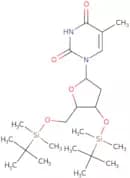
Pureza:Min. 95%3',5'-Bis-O-(t-butyldimethylsilyl)thymidine
CAS:3',5'-Bis-O-(t-butyldimethylsilyl)thymidine is a novel nucleoside phosphoramidite that can be used in the synthesis of oligonucleotides. This compound has antiviral and anticancer activities and is an excellent building block for the synthesis of modified nucleosides. 3',5'-Bis-O-(t-butyldimethylsilyl)thymidine is a high quality, high purity chemical with a CAS number of 40733-26-4.
Fórmula:C22H42N2O5Si2Pureza:Min. 95%Peso molecular:470.7 g/molRef: 3D-QBA73326
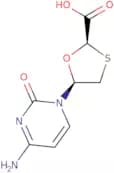
Produto descontinuadorac-Lamivudine acid
CAS:Lamivudine is an antiviral drug that is used as a nucleoside analogue. It is a prodrug that is converted to its active form, which inhibits the viral enzyme reverse transcriptase by interfering with the synthesis of viral DNA. Racemic lamivudine acid (LAM) crystallizes in the form of chains with hydrogen bonds oriented in an impurity plane. The LAM molecule has two substituents, one carboxylate and one oxathiolane group.
Fórmula:C8H9N3O4SPureza:Min. 95%Peso molecular:243.24 g/molRef: 3D-NL27534
Produto descontinuadoU-13C10, U-[15N2]-mono-Labelled Thymidylyl-3'-5'-thymidine ammonium (compound A)
U-13C10, U-[15N2]-mono-Labelled Thymidylyl-3'-5'-thymidine ammonium (compound A) is a novel anticancer drug that is synthesized by phosphoramidite chemistry. It is an activator of DNA synthesis and has been shown to be cytotoxic against cancer cells in vitro. This compound is also a high quality nucleoside analogue. The molecular weight of this compound is 434.4 g/mol and it has a CAS number of 81633-09-9.Fórmula:C20H30N5O12PPureza:Min. 95%Peso molecular:563.45 g/molRef: 3D-TM32169
Produto descontinuadoN4-Benzoyl-5'-O-tert-butyldimethylsilyl-2'-deoxy-5-iodocytidine
N4-Benzoyl-5'-O-tert-butyldimethylsilyl-2'-deoxy-5-iodocytidine is an antiviral drug that inhibits viral DNA synthesis by blocking the conversion of ribonucleotides to deoxyribonucleotides. It is a nucleoside analog that is used for the treatment of cancer and for the prevention of AIDS. N4-Benzoyl-5'-O-tert-butyldimethylsilyl-2'-deoxy-5 -iodocytidine is synthesized in high purity, with a purity level of > 98%. This product can be used as an activator or ligand in phosphoramidite synthesis.Fórmula:C22H30IN3O5SiPureza:Min. 95%Cor e Forma:PowderPeso molecular:571.48 g/molRef: 3D-NB09206
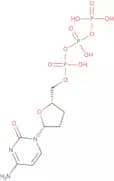
Produto descontinuadoDdCTP trilithium
CAS:2',3'-Dideoxycytidine-5'-triphosphate trilithium salt (ddCTP) is a nucleoside analogue that has been shown to inhibit the enzyme activity of DNA polymerase. The ddCTP is a prodrug, which is activated by phosphorylation catalyzed by cellular kinases and then hydrolyzed to its active form, dideoxycytidine triphosphate (ddCTP). This drug also inhibits the synthesis of DNA and RNA. In vitro studies have shown that ddCTP causes cell lysis in murine sarcoma virus-infected cells, although it does not affect uninfected cells. 2',3'-Dideoxycytidine-5'-triphosphate trilithium salt has been shown to be an effective inhibitor of HIV reverse transcriptase and HIV protease in biochemical assays. It has also been found to be an effective inhibitor of mouse monoclon
Fórmula:C9H13N3Li3O12P3Pureza:Min. 95%Cor e Forma:LiquidPeso molecular:468.96 g/molRef: 3D-ND10280
Produto descontinuadoUridylyl-3'-5'-cytidine ammonium salt
Uridylyl-3'-5'-cytidine ammonium salt is a monophosphate of cytidine. It is an antiviral agent that inhibits the replication of human immunodeficiency virus type 1 (HIV-1). Uridylyl-3'-5'-cytidine ammonium salt is synthesized by the reaction of uridyl 3'-5' -adenosine monophosphate with cytidine. This compound has been shown to be effective in inhibiting the proliferation of cancer cells. Uridylyl-3'-5'-cytidine ammonium salt has shown activity against a variety of cancers, including breast, lung, and colon cancers.
Fórmula:C18H27N6O13PPureza:Min. 95%Peso molecular:566.41 g/mol2',3'-Dideoxy-3'-thia-cytidine-5'-triphosphate (L isomer), lithium salt
2',3'-Dideoxy-3'-thia-cytidine-5'-triphosphate (L isomer) is a synthetic nucleoside that acts as an antiviral, anticancer and antineoplastic agent. It has been shown to inhibit the replication of DNA and RNA by inhibiting the activity of ribonucleoides. 2',3'-Dideoxy-3'-thia-cytidine-5'-triphosphate (L isomer) can be used in combination with other antiviral agents such as acyclovir or valacyclovir to treat herpes simplex virus type 1 infections. The drug is also effective against HIV, with a potency similar to that of zidovudine. It has been shown to be active in the treatment of leukemia, lymphoma, Hodgkin's disease and some solid tumors.Pureza:Min. 95%N6-Benzoyl-2'-deoxy-5'-O-DMT adenosine-3'-Q Linker CPG 1000 Å
N6-benzoyl-2'-deoxy-5'-O-DMT adenosine-3'-Q Linker CPG 1000 Å is a novel nucleoside with antiviral activity. It is synthesized by the condensation of 2'-deoxyadenosine monophosphate and 3'-Q linker CPG 1000 Å. The molecular weight of N6-benzoyl-2'-deoxy-5'-O-DMT adenosine-3'-Q Linker CPG 1000 Å is 878.36 g/mol, and its CAS number is 628674-06-4. This substance has antiviral activity against herpes simplex virus type 1 (HSV1) and herpes simplex virus type 2 (HSV2). N6-benzoyl-2'-deoxy-5'-O-DMT adenosine can be used as an anticancer drug because it inhibits the growth
Pureza:Min. 95%Ref: 3D-NB11617
Produto descontinuadoNPOM-Caged-dT CEP
CAS:Please enquire for more information about NPOM-Caged-dT CEP including the price, delivery time and more detailed product information at the technical inquiry form on this page
Fórmula:C50H58N5O13PPureza:Min. 95%Peso molecular:968 g/molRef: 3D-SMB21871
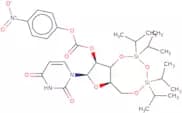
Produto descontinuado3',5'-O-(1,1,3,3-Tetraisopropyl-1,3-disiloxanediyl)-2'-(p-nitrophenylcarbonyloxy)uridine
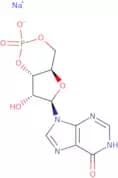
CAS:3',5'-O-(1,1,3,3-Tetraisopropyl-1,3-disiloxanediyl)-2'-(p-nitrophenylcarbonyloxy)uridine is a novel phosphoramidite. It is modified with p-nitrophenyl carbonyloxy group at the 3' position of the uracil moiety. This phosphoramidite has antiviral activity against Hepatitis C and HIV. It also has anticancer activity in vitro and in vivo. 3',5'-O-(1,1,3,3-Tetraisopropyl-1,3-disiloxanediyl)-2'-(p-nitrophenylcarbonyloxy)uridine is a nucleoside that can be used for DNA synthesis or as a monophosphate or diphosphate for RNA synthesis. It is synthesized from deoxyFórmula:C28H41N3O11Si2Pureza:Min. 95%Peso molecular:651.81 g/molInosine-3',5'-cyclic-monophosphate sodium
CAS:Inosine-3',5'-cyclic-monophosphate sodium (cIMP) is a metabolite of inosine and is generated by the enzyme inosine monophosphate cyclohydrolase. cIMP has been shown to be related to colorectal adenocarcinoma, cancer, and body mass index. It has also been implicated in the diagnosis of cancer and infectious diseases. cIMP is involved in energy metabolism and DNA synthesis, which are important for the progression of renal cell cancer. In addition, it has been shown that cIMP can function as a biomarker for prognosis when used with multivariate logistic regression.Fórmula:C10H11N4O7P·NaPureza:Min. 95%Peso molecular:353.18 g/molRef: 3D-NI170529
Produto descontinuadoN6-2-(4-Aminophenyl)ethyladenosine
CAS:N6-2-(4-Aminophenyl)ethyladenosine is a carbamazepine prodrug that is converted to the active form, carbamazepine, by esterases. It has been shown to inhibit the binding of adenosine to adenosine receptor subtypes and to have an antagonistic effect on the activity of endogenous adenosine at these receptors. N6-2-(4-Aminophenyl)ethyladenosine has also been shown to act as an antagonist at the A3 adenosine receptor. This drug has been shown to reduce bronchoconstrictor responses in animal models and may be used for treating asthma.
N6-2-(4-Aminophenyl)ethyladenosine has also been shown in vitro studies using human papillary muscle cells to enhance polymerase chain reactions (PCR).Pureza:Min. 95%2'-O-Hexylaminoguanosine
2'-O-Hexylaminoguanosine is a modified nucleoside that has antiviral properties. It is an activator of the human immune system and is used to treat cancer. 2'-O-Hexylaminoguanosine inhibits the synthesis of DNA by phosphoramidite addition to the monophosphate form of guanosine, which prevents RNA synthesis and therefore also protein synthesis. It also has anticancer effects by inhibiting the growth of cells in culture.
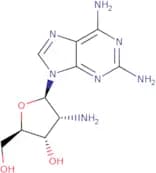
Pureza:Min. 95%2,6-Diamino-9-(2'-amino-2'-deoxy-b-D-ribofuranosyl)purine
CAS:2,6-Diamino-9-(2'-amino-2'-deoxy-b-D-ribofuranosyl)purine (dAraMP) is a novel nucleoside analogue that was synthesized and characterized. It has been shown to inhibit the growth of cancer cells in vitro. dAraMP is a monophosphate analogue of 2,6-diamino-9-(2'-deoxy-b-D-ribofuranosyl)purine (dAraP). The modified phosphoramidite approach used in its synthesis yielded high purity and yields. This product is also available as a diphosphate analogue of 2,6 diamino 9-(2'-amino 2'-deoxy b D ribofuranosyl) purine (dAMP). The diphosphate form of this product has been shown to be an activator for DNA polymerase.Fórmula:C10H15N7O3Pureza:Min. 95%Cor e Forma:White To Off-White SolidPeso molecular:281.28 g/molRef: 3D-ND06322
Produto descontinuadoN4-Benzoyl-2'-deoxy-3'-O-levulinoylcytidine
N4-Benzoyl-2'-deoxy-3'-O-levulinoylcytidine is a nucleoside that is used as an antiviral and anticancer agent. It is a modified deoxyribonucleoside that has antiviral activity against HSV-1, HSV-2, and HIV. N4-Benzoyl-2'-deoxy-3'-O-levulinoylcytidine also has anticancer effects against leukemia cells in mice. This drug is synthesized from 2′,3′,5′triacetyladenosine by the reaction of 4-(1H)-benzoyloxymethyl)phenylacetic acid with triethylamine and levulinic acid chloride.
Fórmula:C21H23N3O7Pureza:Min. 95%Peso molecular:429.43 g/mol5’-Azido-2’,5’-dideoxyuridine
CAS:5’-Azido-2’,5’-dideoxyuridine (5ADU) is a pyrimidine nucleoside that has been used to treat cancer. It is converted to 5-azidouracil which inhibits the synthesis of thymidylate, an essential component of DNA. 5ADU is also active against herpes virus and can be used as an antiviral agent. This drug has been shown to protect against radiation damage by inhibiting the formation of free radicals. The protonation of 5ADU leads to a stereochemical rearrangement that prevents the formation of free radicals. 5ADU does not inhibit bacterial enzymes, but it does have some effect on viruses, such as herpes virus, because they contain DNA or RNA similar to human cells.
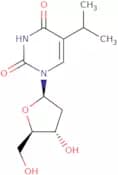
Fórmula:C9H11N5O4Pureza:Min. 95%Peso molecular:253.21 g/mol5-Isopropyl-2'-deoxyuridine
CAS:5-Isopropyl-2'-deoxyuridine is a nucleoside analog that is used in the treatment of inflammatory bowel disease. It has been shown to be effective in the treatment of Crohn's disease, ulcerative colitis, and indeterminate colitis. 5-Isopropyl-2'-deoxyuridine inhibits bacterial growth by inhibiting RNA synthesis, which leads to cell death. This drug also inhibits the production of inflammatory mediators such as prostaglandins and leukotrienes that are released from cells infected with bacteria. 5-Isopropyl-2'-deoxyuridine is converted into an active form by hydrolysis or oxidation followed by phosphorylation. This drug binds to the 5' end of bacterial DNA and prevents the formation of hydrogen bonds between adjacent bases, causing strand breakage.
Fórmula:C12H18N2O5Pureza:Min. 95%Peso molecular:270.28 g/molRef: 3D-NI16765
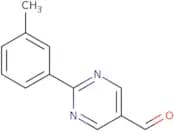
Produto descontinuado2-(3-Methylphenyl)pyrimidine-5-carbaldehyde
CAS:2-(3-Methylphenyl)pyrimidine-5-carbaldehyde is a monophosphate nucleoside analog that can be used as an antiviral drug. It has shown cytotoxic activity against cells with a high DNA content, and it inhibits the synthesis of RNA and DNA. This compound could be useful for the treatment of HIV and other viral diseases.Fórmula:C12H10N2OPureza:Min. 95%Peso molecular:198.22 g/mol


![U-13C10, U-[15N2]-mono-Labelled Thymidylyl-3'-5'-thymidine ammonium (compound A)](/_next/image/?url=https%3A%2Fstatic.cymitquimica.com%2Fproducts%2F3D%2Fthumb-webp%2FTM32169.webp&w=3840&q=75)