Nucleosídeos
Foram encontrados 3569 produtos de "Nucleosídeos"
5-Bromo-2-methylsulfanyl-pyrimidine-4-carboxylic acid
CAS:5-Bromo-2-methylsulfanyl-pyrimidine-4-carboxylic acid is a pyrimidine derivative that inhibits protein kinases. The compound has been shown to inhibit the activity of protein kinase C, which is involved in mediating inflammatory responses, and phosphorylation of the insulin receptor substrate 1. 5-Bromo-2-methylsulfanyl-pyrimidine-4-carboxylic acid is an efficient inhibitor of kinases and can be used as a lead compound for the development of new compounds with therapeutic potential.Fórmula:C6H5BrN2O2SPureza:Min. 95%Peso molecular:249.09 g/molRef: 3D-NB44268
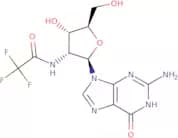
Produto descontinuado2'-TFA-NH-dG
CAS:2'-TFA-NH-dG is a novel nucleoside analog that is used as an antiviral and anticancer agent. It is a synthetic monophosphate with a modified 2'-hydroxyl group and a deoxyribose sugar backbone. It has been shown to inhibit HIV replication in vitro by interfering with the synthesis of viral DNA and RNA, which may be due to its ability to bind to the viral reverse transcriptase enzyme. 2'-TFA-NH-dG has also been shown to have anticancer activity against human A549 cells in vitro by inhibiting the proliferation of these cells. This drug is available for purchase as a white powder at CAS No. 144089-98-5.
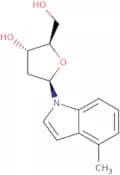
Fórmula:C12H13F3N6O5Pureza:Min. 95%Peso molecular:378.26 g/mol1-(2-Deoxy-b-D-ribofuranosyl)-4-methylindole
CAS:1-(2-Deoxy-b-D-ribofuranosyl)-4-methylindole is a nucleoside that can be used as an activator for phosphoramidite synthesis. It is also known to have antiviral, anticancer, and antimalarial properties. 1-(2-Deoxy-b-D-ribofuranosyl)-4-methylindole has been shown to inhibit the proliferation of human leukemia cells in culture. It has also been shown to suppress HIV replication in vitro by inhibiting viral RNA synthesis.Fórmula:C14H17NO3Pureza:Min. 95%Peso molecular:247.3 g/molRef: 3D-ND06396
Produto descontinuado2',3',5'-Tri-O-benzoyl-2-thiouridine
CAS:2',3',5'-Tri-O-benzoyl-2-thiouridine is an analog of the nucleoside thiouracil, which is a modified nucleoside. It inhibits the synthesis of DNA and RNA by competitively inhibiting the enzyme thymidylate synthase. 2',3',5'-Tri-O-benzoyl-2-thouridine has been shown to exhibit anticancer activity in vitro and in vivo. This compound also exhibits antiviral properties against herpes simplex virus type 1 (HSV1) and Herpes simplex virus type 2 (HSV2).
Fórmula:C30H24N2O8SPureza:Min. 95%Peso molecular:572.59 g/molRef: 3D-NT16569
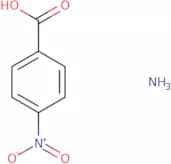
Produto descontinuadoAmmonium 4-nitrobenzoate dihydrate
CAS:Ammonium 4-nitrobenzoate dihydrate is a corrosion inhibitor that prevents the corrosion of metal parts and other materials. It is used in the production of plastics, coatings, adhesives, and lubricants. The corrosion inhibition activity of aminobenzoates can be attributed to their ability to form hydrogen phosphate (HPO) anions as well as their ability to complex with metal ions. The hydration process is also important for the corrosion inhibition activity of ammonium 4-nitrobenzoate dihydrate. This process involves the release of water molecules from the ammonium salt, which provide a protective coating around the metal surface. Ammonium 4-nitrobenzoate dihydrate also has additive properties that are beneficial for other industrial applications such as antistatic agents, surfactants, and stabilizers.
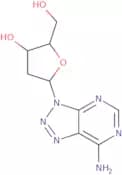
Pureza:Min. 95%8-Aza-2'-deoxyadenosine
8-Aza-2'-deoxyadenosine is an anion that is cytotoxic to cells and can be activated to form a phosphate ester. It has been shown to have a higher cytotoxicity than adenosine in cell cultures, but is less effective in animal studies. 8-Aza-2'-deoxyadenosine has been shown to have a significant toxicity in rats and mice when administered at doses greater than 500 mg/kg body weight. The activation of 8-aza-2'-deoxyadenosine into the phosphate ester can be stereoselective. This activation has also been shown to cause enhancement of tumor growth inhibition.
Pureza:Min. 95%Ref: 3D-NA141794
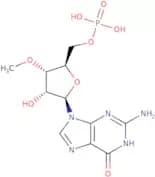
Produto descontinuado3'-O-Methyl-5'-guanylic acid
CAS:3'-O-Methyl-5'-guanylic acid is a novel antiviral, synthetic deoxyribonucleoside which is activated by phosphoramidites to produce 3'-O-methyl-5'-guanylic acid phosphoramidite. It has high purity and quality and can be used as a nucleoside activator for DNA synthesis. 3'-O-Methyl-5'-guanylic acid has been shown to be an anticancer agent that inhibits the growth of cancer cells in vitro by inhibiting DNA synthesis and cell division. This drug also has a potential use as an antiviral agent.
Fórmula:C11H16N5O8PPureza:Min. 95%Peso molecular:377.25 g/mol8-(p-Chlorophenylthio)-cGMP
CAS:8-(p-Chlorophenylthio)-cGMP is a modified nucleoside that has anticancer activity. It inhibits DNA synthesis and the activation of protein kinases, which are enzymes that transmit signals from the cell surface to the nucleus. 8-(p-Chlorophenylthio)-cGMP can also inhibit viral replication by inhibiting the production of new virus particles and by inhibiting the action of reverse transcriptase, an enzyme that converts RNA into DNA.
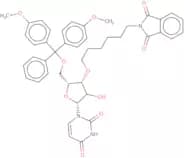
Fórmula:C16H15ClN5O7PSPureza:Min. 95%Peso molecular:487.81 g/mol5'-O-DMT-3'-O-hexylphthalimidouridine
5'-O-DMT-3'-O-hexylphthalimidouridine is an antiviral and anticancer agent that is a nucleoside analog. It inhibits viral replication by preventing the production of RNA, which is necessary for the synthesis of DNA. It also prevents the proliferation of cancer cells and induces apoptosis by inhibiting DNA synthesis. 5'-O-DMT-3'-O-hexylphthalimidouridine is a monophosphate that has been modified to form a phosphoramidite. The synthesized product was purified to high purity and quality with a novel structure.
Fórmula:C44H45N3O10Pureza:Min. 95%Peso molecular:775.86 g/molRef: 3D-ND08518
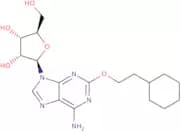
Produto descontinuado2-(2-Cyclohexylethoxy)adenosine
CAS:2-(2-Cyclohexylethoxy)adenosine (CX-5461) is a new chemical entity that has been shown to have an incremental effect on muscle contraction. The mechanism of action of CX-5461 is not fully understood, but it has been shown to be nonselective and to bind to adenosine receptors. This binding produces a response in the cell similar to that of adenosine, which is a small molecule involved in the regulation of blood pressure and heart rate. CX-5461 also binds with platelet membranes at the site of inflammation and causes vasodilation. It has been shown to be effective in animal models of pertussis, where it reduces the severity of muscle spasms and increases the duration before death. These effects are due to CX-5461's ability to lower intracellular calcium concentrations by preventing calcium release from internal stores or from outside sources such as muscle cells or platelets.
Fórmula:C18H27N5O5Pureza:Min. 95%Peso molecular:393.44 g/molRef: 3D-NC16523
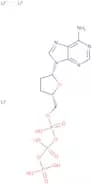
Produto descontinuado2',3'-Dideoxyadenosine-5'-triphosphate lithium salt - 100mM aqueous solution
CAS:2',3'-Dideoxyadenosine-5'-triphosphate lithium salt is a novel antiviral nucleoside that has the potential to be used in the treatment of various viral infections. It is synthesized from 2',3'-dideoxyadenosine monophosphate and lithium salt, and has been shown to have high antiviral activity against DNA viruses such as herpes simplex virus and adenovirus. It also inhibits the replication of RNA viruses such as influenza A virus, vesicular stomatitis virus, and measles virus. 2',3'-Dideoxyadenosine-5'-triphosphate lithium salt is a modified nucleoside that is phosphoramidite activated with a group at the 2' position on the ribose sugar. The phosphate group can be removed by hydrolysis or enzymatic catalysis, which leaves behind an unsaturated sugar moiety. This leads to an increased rate of incorporation into
Fórmula:C10H12N5O11P3·4LiPureza:Min. 95%Cor e Forma:PowderPeso molecular:498.91 g/molRef: 3D-ND32077
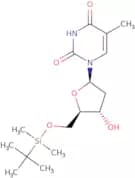
Produto descontinuado5'-O-tert-Butyldimethylsilylthymidine
CAS:5'-O-tert-Butyldimethylsilylthymidine is a nucleoside that is used for the synthesis of oligoribonucleotides. It can be prepared by treating 5'-O-tert-butyldimethylsilylthymidine with alkyl bromides in the presence of microwaves and catalytic amounts of a base such as sodium methoxide. The product is purified by vacuum distillation or column chromatography and can be hydrolyzed to uridine, which has been shown to have anti-inflammatory properties. 5'-O-tert-Butyldimethylsilylthymidine can also be converted into deoxyribose through the use of ultrasound.Fórmula:C16H28N2O5SiPureza:Min. 95%Peso molecular:356.5 g/molRef: 3D-NB08945
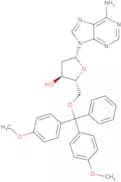
Produto descontinuado2'-Deoxy-5'-O-DMT-adenosine
CAS:2'-Deoxy-5'-O-DMT-adenosine is a nucleoside that is structurally related to adenosine. It is synthesized by the phosphoramidite approach and can be used as an activator for RNA synthesis. 2'-Deoxy-5'-O-DMT-adenosine has shown anticancer activity in vitro and in vivo, which may be due to its ability to inhibit RNA synthesis and DNA replication.
Fórmula:C31H31N5O5Pureza:Min. 95%Cor e Forma:PowderPeso molecular:553.61 g/molRef: 3D-ND57357
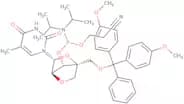
Produto descontinuado5'-O-DMT-2'-O,4'-C-methylene-5-methyluridine 3'-CE-phosphoramidite
CAS:5'-O-DMT-2'-O,4'-C-methylene-5-methyluridine 3'-CE-phosphoramidite is a high purity, novel DNA monophosphate that is synthesized from 2',4'-diaminotoluene and 5'-O-dimethoxytritylthymidine. It has antiviral and anticancer properties and has shown to be an activator of RNA polymerase II in vitro. This product is used in many applications such as the synthesis of oligonucleotide probes for DNA sequencing, the synthesis of RNA for gene expression studies, and for the production of oligonucleotides for therapeutic purposes.Fórmula:C41H49N4O9PPureza:Min. 95%Peso molecular:772.82 g/molNonadecanoyl coenzyme A
CAS:Nonadecanoyl coenzyme A is a fatty acid that is produced by the bovine liver and has been shown to have anabolic effects. Nonadecanoyl CoA is involved in the synthesis of various lipids, such as phospholipids, cholesterol, and glycolipids. It also plays a role in biosynthesis of fatty acids and in regulating ATP production. Nonadecanoyl CoA is synthesized from acetate by the enzyme acetyl-CoA carboxylase (ACC). ACC catalyzes the conversion of acetyl-CoA to malonyl-CoA, which can then be used for fatty acid synthesis. Nonadecanoyl CoA has been found to play an important role in regulating mitochondrial function through its ability to activate long-chain acyl-CoAs desaturase (LCAD). LCAD converts long-chain acyl-CoAs into their corresponding dicarboxylic acids.
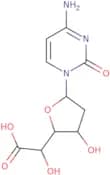
Fórmula:C40H72N7O17P3SPureza:Min. 95%Peso molecular:1,048.02 g/mol2'-Deoxycytidine-5'-carboxylic acid
CAS:2'-Deoxycytidine-5'-carboxylic acid (2'-DC) is a modified nucleoside that has been used as an anticancer, antiviral, and synthetic agent. 2'-DC inhibits the synthesis of DNA by binding to the enzyme DNA polymerase. It also inhibits viral replication by inhibiting the activity of reverse transcriptase and can be used as a potential anti-HIV drug. In addition, 2'-DC has been shown to have cytotoxic effects against cancer cells in vitro. This compound is synthesized from cytidine 5-monophosphate and phosphoramidite reagents in high purity and quantity. The CAS number for this compound is 4603-72-9.
Fórmula:C9H11N3O5Pureza:Min. 95%Peso molecular:241.2 g/mol5’-O-DMT cET-N2-isopropylguanosine 3’-OCE amidite
CAS:Please enquire for more information about 5'-ODMT cEt G Phosphoramidite including the price, delivery time and more detailed product information at the technical inquiry form on this page
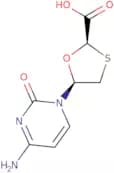
Fórmula:C46H56N7O9PPeso molecular:881.95 g/molrac-Lamivudine acid
CAS:Lamivudine is an antiviral drug that is used as a nucleoside analogue. It is a prodrug that is converted to its active form, which inhibits the viral enzyme reverse transcriptase by interfering with the synthesis of viral DNA. Racemic lamivudine acid (LAM) crystallizes in the form of chains with hydrogen bonds oriented in an impurity plane. The LAM molecule has two substituents, one carboxylate and one oxathiolane group.
Fórmula:C8H9N3O4SPureza:Min. 95%Peso molecular:243.24 g/molRef: 3D-NL27534
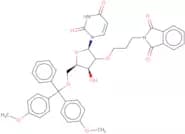
Produto descontinuado5'-O-DMT-2'-O-propylphthalimidouridine
5'-O-DMT-2'-O-propylphthalimidouridine is a synthetic nucleoside that has antiviral and anticancer properties. It is used as a precursor for the synthesis of other nucleosides, including uridine and cytidine. 5'-O-DMT-2'-O-propylphthalimidouridine can be modified with phosphoramidites to create novel modified nucleosides. The chemical name is 1-(5'-O-dimethoxytrityl)-2-[(2' -propyl)thio]uracil. This drug has CAS number 61381-14-4 and molecular weight of 271.11 g/mol.
Fórmula:C41H39N3O10Pureza:Min. 95%Peso molecular:733.78 g/molRef: 3D-ND08421
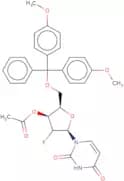
Produto descontinuado3'-O-Acetyl-2'-deoxy-5'-O-DMT-2'-fluorouridine
3'-O-Acetyl-2'-deoxy-5'-O-DMT-2'-fluorouridine is a novel, activator, ribonucleosides, deoxyribonucleosides, diphosphate, phosphoramidites, modified nucleosides. It can be used as an anticancer and antiviral agent.
Fórmula:C32H31FN2O8Pureza:Min. 95%Peso molecular:590.6 g/molRef: 3D-NA08460
Produto descontinuado