Nucleosídeos
Foram encontrados 3569 produtos de "Nucleosídeos"
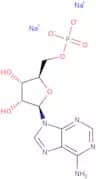
Adenosine 5'-monophosphate sodium
CAS:Adenosine 5'-monophosphate sodium is a nucleotide that is involved in the energy metabolism of cells. It has been shown to inhibit oxidative injury and to activate signal pathways in response to external stimuli, such as glucose deprivation. Adenosine 5'-monophosphate sodium can be synthesized from ATP by the enzyme adenosine kinase.
Fórmula:C10H13N5O7P·NaPureza:Min. 98 Area-%Cor e Forma:White PowderPeso molecular:369.2 g/molRef: 3D-NA10369
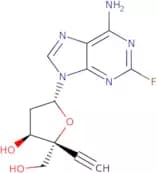
Produto descontinuado2'-Deoxy-4'-ethynyl-2-fluoroadenosine
CAS:2'-Deoxy-4'-ethynyl-2-fluoroadenosine (EFdA) is an analog of adenosine. EFdA is a potent inhibitor of HIV replication, and has been shown to be effective against other viruses such as influenza virus, herpes simplex virus, and vesicular stomatitis virus. EFdA was the first nucleoside analog to show antiviral activity in tissue culture against these viruses. This drug also inhibits the synthesis of mitochondrial rRNA and reduces the formation of mitochondrial DNA in human cells by inhibiting mitochondrial DNA polymerase γ. EFdA also prevents the binding of monoclonal antibodies to human B lymphocytes, which may be due to its steric interactions with plasma RNA. This drug is metabolized by cytochrome P450 2C8 and 2C9 into a variety of metabolites that are excreted in urine as glucuronides or sulfates. EFdA has a long
Fórmula:C12H12FN5O3Pureza:Min. 95%Peso molecular:293.25 g/molDMTr-TNA-C(Bz)-amidite
CAS:Please enquire for more information about DMTr-TNA-C(Bz)-amidite including the price, delivery time and more detailed product information at the technical inquiry form on this page
Fórmula:C45H50N5O8PPeso molecular:819.9 g/mol2'-O-Methyluridine-5'-monophosphate triethylammonium
CAS:2'-O-Methyluridine-5'-monophosphate triethylammonium salt is a modified nucleoside analogue that is an antiviral agent. It inhibits viral replication by acting as an inhibitor of RNA synthesis and DNA polymerase, which are necessary for the virus to replicate. This compound also has anticancer activity and can be used as a chemotherapeutic agent. 2'-O-Methyluridine-5'-monophosphate triethylammonium salt is synthesized from uracil, phosphoramidite, and triethylamine. It has high purity and high quality with a CAS number of 67624-43-5.
Fórmula:C10H15N2O9P•(C6H15N)2Pureza:Min. 95%Cor e Forma:PowderPeso molecular:439.21 g/molRef: 3D-NM167710
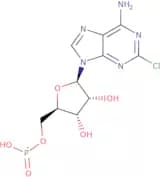
Produto descontinuado2-Chloroadenosine 5'-monophosphate triethylamine salt
CAS:2-Chloroadenosine 5'-monophosphate triethylamine salt is a phosphoramidite that has anticancer and antiviral activities. It is synthesized by reacting 2-chloroadenosine with triethylamine. This product has a novel chemical structure and it can be used as an activator for the synthesis of modified DNA, RNA, and other nucleosides. It is also used in the manufacture of deoxyribonucleosides, ribonucleosides, and other nucleotides.
Fórmula:C10H13ClN5O7P·C12H30N2Pureza:Min. 95%Peso molecular:584.05 g/molRef: 3D-NC10383
Produto descontinuado2'-O-(2-Methoxyethyl)guanosine 5'-monophosphate
CAS:10umol is approx 5mg.2'-O-(2-Methoxyethyl)guanosine 5'-monophosphate is a novel nucleoside phosphorylated on the 5' position
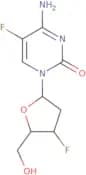
Pureza:Min. 95%2',3'-Dideoxy-3',5-difluorocytidine
CAS:2',3'-Dideoxy-3',5-difluorocytidine (ddF) is a nucleotide analogue that inhibits the viral polymerase. It binds to the enzyme and prevents it from synthesizing DNA, which is needed for viral replication. ddF has been shown to be effective against different types of cancer cells, including breast and prostate cancers. This drug also has antiviral properties and is used as an antiviral agent in AIDS therapy. ddF may also be used as a precursor in the synthesis of other nucleosides or nucleotides.
Pureza:Min. 95%dNaM
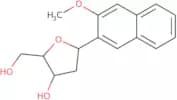
CAS:dNaM is a metabolite of DNA that has been shown to be a potential biomarker for metabolic disorders and autoimmune diseases. dNaM levels are elevated in the blood of pregnant women, which may serve as a marker for preeclampsia. Elevated levels have also been observed in patients with type 2 diabetes, obesity, and cancer. Methylation plays an important role in dNaM metabolism. The enzyme DNA methyltransferase (DNMT) catalyzes the transfer of methyl groups from S-adenosyl methionine to cytosine residues on the DNA molecule. DNMT activity is increased by high body mass index (BMI), low vitamin B12 levels, and HIV infection. This enzyme is also inhibited by valproic acid and deprenyl, which may affect dNaM methylation status.
Fórmula:C16H18O4Pureza:Min. 95%Peso molecular:274.31 g/molArchaeosine
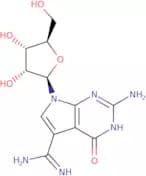
CAS:Archaeosine is a low energy chemical compound that inhibits the enzyme transcriptase polymerase chain reaction (PCR), which is an enzyme that catalyzes the synthesis of DNA from RNA. Archaeosine has significant interactions with human proteins, such as leukocyte antigen, and can be used to study protein-protein interactions and enzyme kinetics. The asymmetric synthesis of archaeosine has been studied in rat liver microsomes, which is a type of cell found in the tissues of the liver. Archaeosine also prevents bacterial enzymes from synthesizing DNA.
Fórmula:C12H16N6O5Pureza:Min. 95%Peso molecular:324.29 g/mol