Nucleosídeos
Os nucleosídeos são building blocks fundamentais dos ácidos nucleicos, compostos por uma base nitrogenada ligada a uma molécula de açúcar. Nesta seção, você encontrará uma ampla variedade de nucleosídeos essenciais para pesquisas em biologia molecular, bioquímica e farmacologia. Esses compostos desempenham papéis cruciais na síntese de DNA e RNA, e também são vitais em vários processos metabólicos. Os nucleosídeos são usados para estudar material genético, desenvolver terapias antivirais e anticancerígenas, e entender os mecanismos celulares. Na CymitQuimica, fornecemos nucleosídeos de alta qualidade para apoiar suas necessidades de pesquisa e desenvolvimento, garantindo pureza e confiabilidade para suas aplicações experimentais.
Foram encontrados 3569 produtos de "Nucleosídeos"
Ordenar por
Pureza (%)
0
100
|
0
|
50
|
90
|
95
|
100
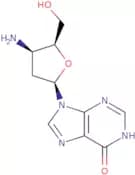
3'-Amino-2',3'-dideoxyinosine
CAS:3'-Amino-2',3'-dideoxyinosine acts as a chain terminator in DNA synthesis due to the absence of a 3'-hydroxyl group. The 3'-amino group allows for the attachment of various molecules to the 3' end of oligonucleotides, and the inosine base introduces the potential for wobble base pairing, making it a specialized tool for research and potential diagnostic applications.Fórmula:C10H13N5O3Pureza:Min. 95%Peso molecular:251.24 g/mol4’-C-Methyl-4-deoxyuridine
CAS:4’-C-Methyl-4-deoxyuridine is an antiviral and anticancer drug that belongs to the group of nucleosides. It has shown novel anti-tumor activities in vitro and in vivo, as well as antiviral effects against herpes simplex virus type 1 (HSV-1) and type 2 (HSV-2). 4’-C-Methyl-4-deoxyuridine is a modified nucleoside that is synthesized from uridine. It has been shown to inhibit viral replication by inhibiting viral DNA synthesis. This drug also inhibits the multiplication of tumor cells by inhibiting DNA synthesis. The product is high purity, high quality, and CAS No. 1064364-21-1.Pureza:Min. 95%N4-Acetyl-2'-O-tert-butyldimethylsilyl-5'-O-DMT-cytidine 3'-CE phosphoramidite
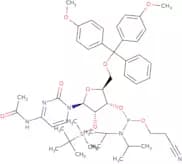
CAS:N4-Acetyl-2'-O-tert-butyldimethylsilyl-5'-O-DMT-cytidine 3'-CE phosphoramidite is a novel nucleoside analogue with antiviral and anticancer potential. It is a modified nucleoside that contains an acetyl group at the 4' position. The 3'-OH group has been replaced by a tertiary butyldimethylsilyl group, which renders the compound resistant to deamination by nucleases. N4-Acetyl-2'-O-tert-butyldimethylsilyl-5'-O-DMT-cytidine 3'-CE phosphoramidite also shows high purity and high quality.Fórmula:C47H64N5O9PSiPureza:Min. 98 Area-%Cor e Forma:White PowderPeso molecular:902.11 g/mol7-Methyl-2'-deoxywyosine
7-Methyl-2'-deoxywyosine is a nucleoside analogue that inhibits the growth of cells by interfering with DNA replication. It is a modified form of deoxywyosine, which is the natural precursor of DNA and RNA. 7-Methyl-2'-deoxywyosine has antiviral activity against herpes simplex virus type 1 (HSV-1) and human cytomegalovirus (CMV). This compound has shown anticancer activity in vivo and in vitro, as well as high purity and quality.Pureza:Min. 95%1-(3',5'-Di-O-benzoyl-2'-deoxy-2'-fluoro-β-D-arabinofuranosyl)thymine
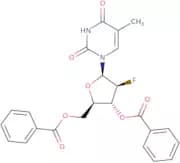
CAS:1-(3',5'-Di-O-benzoyl-2'-deoxy-2'-fluoro-b-D-arabinofuranosyl)thymine is a chemically modified nucleoside analog. This compound contains a thymine base, a 2'-fluoro-β-D-arabinofuranose sugar, which alters biological stability and function and benzoyl protecting groups at the 3' and 5' positions, commonly used in nucleoside synthesis to control selective modifications.Fórmula:C24H21FN2O7Pureza:Min. 95%Cor e Forma:White To Off-White SolidPeso molecular:468.43 g/molAdenosine 5'-O-(3-thiotriphosphate), BODIPY FL thioester sodium salt - 5mM buffered aqueous solution
Adenosine 5'-O-(3-thiotriphosphate), BODIPY FL thioester sodium salt - 5mM buffered aqueous solution is a novel nucleoside that is synthesized from the corresponding phosphoramidites. This compound is an activator of DNA synthesis in mammalian cells and a potent inhibitor of viral replication. It has antiviral activity against HIV, herpes, and influenza viruses. The molecule can be modified to include different substituents such as fluoro, bromo, or chloro groups and has been shown to have anticancer activity.Fórmula:C24H27BF2N8Na3O13P3SPureza:Min. 95%Peso molecular:878.28 g/molAcetoacetyl coenzyme A lithium salt
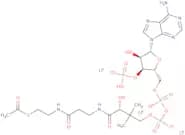
CAS:Acetoacetyl coenzyme A lithium salt is a novel phosphoramidite building block. It's a modified nucleoside that can be used in the synthesis of oligonucleotides and DNA. Acetoacetyl coenzyme A lithium salt has antiviral, anticancer, and antifungal activities.Fórmula:C25H36N7O18P3SLi4·5H2OPureza:Min. 96 Area-%Cor e Forma:PowderPeso molecular:965.42 g/mol2’-O,4’-C-Methyleneadenosine 5’-monophosphate triethyl ammonium salt
2’-O,4’-C-Methyleneadenosine 5’-monophosphate triethyl ammonium salt is a novel antiviral agent that inhibits the synthesis of viral RNA. This compound has been shown to be active against herpes simplex virus type 1 and cytomegalovirus in cell culture. It also inhibits the replication of human immunodeficiency virus type 1 in cell culture. 2’-O,4’-C-Methyleneadenosine 5’-monophosphate triethyl ammonium salt is a phosphoramidite nucleoside analog that can be used as an activator for DNA synthesis. It can also serve as a building block for the synthesis of deoxyribonucleosides and ribonucleosides.Pureza:Min. 95%5'-(Furan-2-yl)-5'-O-DMT-2’-O-methylcytidine
CAS:5'-(Furan-2-yl)-5'-O-DMT-2’-O-methylcytidine is a high purity phosphoramidite, deoxyribonucleoside, and ribonucleoside that can be used in the synthesis of antiviral drugs, anti-cancer agents, and nucleotides. 5'-(Furan-2-yl)-5'-O-DMT-2’-O-methylcytidine has been shown to inhibit the growth of various cancer cells. This product also belongs to a novel class of synthetic nucleosides that can be modified with fluorine or other substituents at any position on the sugar ring.Pureza:Min. 95%Kinetin riboside
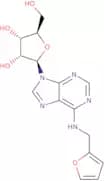
CAS:Kinetin is a plant hormone that regulates cell proliferation and differentiation. Kinetin riboside is a derivative of kinetin in which the ribose moiety has been converted to ribosyl-ribitol. Kinetin riboside has shown the ability to inhibit cancer cells by inducing apoptosis, which may be related to its ability to inhibit cyclin D2 and mitochondrial membrane potential. In addition, kinetin riboside has been shown to protect against oxidative stress and decrease mitochondrial function in cells. This compound may have therapeutic potential for cancer treatment and other diseases caused by oxidative stress or mitochondrial dysfunction.Fórmula:C15H17N5O5Pureza:Min. 98 Area-%Cor e Forma:White PowderPeso molecular:347.33 g/mol8-Bromoadenosine 3',5'-cyclic monophosphate sodium salt
CAS:Membrane-permeable brominated cAMP analog and activator of cAMP-dependent protein kinase A (PKA). In stem cell research, the compound enhanced the induction of pluripotency and efficiency of cellular reprogramming of human neonatal fibroblasts that were transduced with different transcription factors.Fórmula:C10H10BrN5O6P·NaPureza:Min. 95%Cor e Forma:White PowderPeso molecular:430.08 g/mol5'-O-tert-Butyldimethylsilyl-2,2'-anhydrouridine
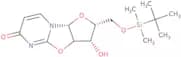
5'-O-tert-Butyldimethylsilyl-2,2'-anhydrouridine is a modified nucleoside that has been used as an anticancer agent and antiviral and antifungal agent. It has been shown to inhibit the growth of tumor cells in animal models by inhibiting DNA synthesis and repair. 5'-O-tert-Butyldimethylsilyl-2,2'-anhydrouridine is also able to bind to RNA with high affinity, making it a potential candidate for use as an antiviral agent against HIV. This compound does not occur naturally in cells and can be synthesized from other nucleosides.Fórmula:C15H24N2O5SiPureza:Min. 95%Peso molecular:340.45 g/mol5-Iodouridine
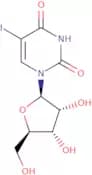
CAS:5-Iodouridine is a pyrimidine nucleoside that is found in the human body. It is used as a starting material for the synthesis of 5-iodo-2'-deoxyuridine, which has been shown to have biological properties. 5-Iodouridine binds to the dna template and prevents radiation from altering it's conformation. This binding has been shown to be specific for ultraviolet (UV) radiation, with little absorption at visible wavelengths. The biological effects of 5-iodouridine are dependent on its acidic pH and hydrogen bonding ability. In vitro assays have demonstrated that this compound can inhibit prostate cancer cells from proliferating and may be useful in treating cervical cancer.Fórmula:C9H11IN2O6Pureza:Min. 95%Cor e Forma:White PowderPeso molecular:370.1 g/mol3'-Amino-5'-O-p-anisoyl-2',3'-dideoxyuridine
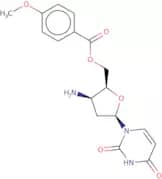
3'-Amino-5'-O-p-anisoyl-2',3'-dideoxyuridine is a novel compound that has been synthesized. This compound is a diphosphate, which can be used as an activator for the synthesis of modified nucleosides and antiviral agents. It is also a DNA phosphoramidite, which can be used in the synthesis of oligonucleotides with high purity and high quality.
Fórmula:C17H19N3O6Pureza:Min. 95%Peso molecular:361.35 g/mol5-Fluorocytidine
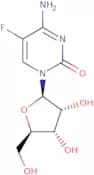
CAS:5-Fluorocytidine (5FC) is an antiviral drug that inhibits the synthesis of DNA. 5FC is a prodrug that is converted to cytosine in vivo, and then incorporated into viral DNA by polymerase chain reactions. The incorporation of 5FC into viral DNA prevents replication and transcription, which can lead to the death of cells infected with HIV. In addition, 5FC has been shown to be effective in treating chronic viral hepatitis and bowel diseases such as Crohn's disease. It also has potential use as a drug target for cancer treatments. 5FC has been shown to inhibit transcription activators in murine hepatoma cells and inhibit the growth of tumors in transfection experiments using human colon cancer cells. This antiviral agent has also been shown to have antimicrobial activity against Gram-positive bacteria, including Clostridium difficile, Staphylococcus aureus, Streptococcus pyogenes and Enterococcus faecFórmula:C9H12FN3O5Pureza:Min. 99 Area-%Cor e Forma:White PowderPeso molecular:261.21 g/mol2'-Deoxy-N2-isobutyryl-5'-O-MMT-guanosine
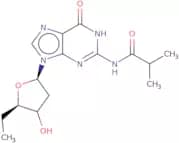
CAS:2'-Deoxy-N2-isobutyryl-5'-O-MMT-guanosine is a synthetic, modified nucleoside. It is an activator of DNA synthesis, and it has been found to inhibit the growth of cancer cells in vitro. This compound has shown success in the treatment of HIV infection in vitro and has also been shown to be effective against hepatitis B virus (HBV) and herpes simplex virus type 1 (HSV). The compound may be useful as an antiviral agent.Fórmula:C34H35N5O6Pureza:Min. 95%Peso molecular:609.69 g/mol3'-Azido-N6-benzoyl-5'-O-DMT-2',3'-dideoxyadenosine
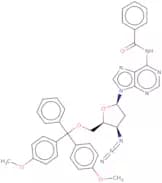
3'-Azido-N6-benzoyl-5'-O-DMT-2',3'-dideoxyadenosine is a nucleoside analog and activator that inhibits the replication of DNA. It is a novel antiviral drug that has antiproliferative properties and may be useful in the treatment of cancer. 3'-Azido-N6-benzoyl-5'-O-DMT-2',3'-dideoxyadenosine is synthesized by reacting an activated phosphoramidite with 2',3'-dideoxyadenosine monophosphate to produce 3',5' dideoxythymidine 5'-monophosphate, which is then converted to 3',5' dideoxyuridine 5'-monophosphate. The last step involves the conversion of 3',5' dideoxyuridine 5'-monophosphate to 3' azidouridine 5'-monophFórmula:C38H34N8O5Pureza:Min. 95%Peso molecular:682.73 g/mol1', 2', 3', 4', 5'- ¹³C5-Adenosine
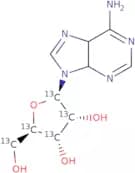
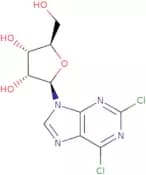
CAS:1', 2', 3', 4', 5'- ¹³C5-Adenosine is adenosine which has all five carbon atoms of the ribose sugar replaced with the stable isotope carbon-13 (^13C). Possible applications are in proteomics studies.Fórmula:C5C5H13N5O4Pureza:Min. 97 Area-%Cor e Forma:White PowderPeso molecular:272.2 g/mol2,6-Dichloro-9-(β-D-ribofuranosyl)purine
CAS:2,6-Dichloro-9-(β-D-ribofuranosyl)purine is a nucleoside analog composed of a modified purine base and a ribose sugar. It has possible applications as an intermediate in nucleoside chemistry, particularly for the synthesis of functionalized purine nucleosides used in biological and pharmaceutical research.Fórmula:C10H10Cl2N4O4Pureza:Min. 95%Cor e Forma:PowderPeso molecular:321.12 g/molInosine 5'-diphosphate disodium salt
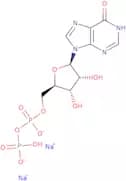
CAS:Inosine-5'-diphosphate disodium salt (IDPS) is a nitro compound that is used in the synthesis of antibacterial drugs. It is also used in the production of polymers and as a precursor to other organic compounds. IDPS has been shown to have antibacterial activity against halogeno bacteria, such as buprestidae, and many Gram-positive bacteria, including encapsulated strains. IDPS has been shown to be effective against both damaged cells and healthy cells in culture. The mechanism of action may involve inhibition of protein synthesis by blocking the ribosomes or by interfering with DNA replication. This drug also inhibits growth rate of japonica rice and heterocycles.Fórmula:C10H12N4Na2O11P2Pureza:Min. 90.0 Area-%Cor e Forma:White PowderPeso molecular:472.15 g/mol