Nucleosídeos
Foram encontrados 3569 produtos de "Nucleosídeos"
Acetoacetyl coenzyme A lithium salt
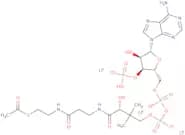
CAS:Acetoacetyl coenzyme A lithium salt is a novel phosphoramidite building block. It's a modified nucleoside that can be used in the synthesis of oligonucleotides and DNA. Acetoacetyl coenzyme A lithium salt has antiviral, anticancer, and antifungal activities.Fórmula:C25H36N7O18P3SLi4·5H2OPureza:Min. 96 Area-%Cor e Forma:PowderPeso molecular:965.42 g/mol2'-C-Methylguanosine 5'-diphosphate triethylammonium salt
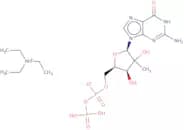
2'-C-Methylguanosine 5'-diphosphate triethylammonium salt is a synthetic nucleotide analog for use in researchFórmula:C11H16N5O11P2·C18H45N3Pureza:Min. 95%Cor e Forma:PowderPeso molecular:759.79 g/mol2'-Deoxy-N2-DMF-5'-O-DMT-guanosine
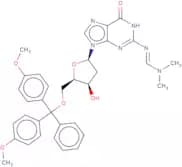
CAS:2'-Deoxy-N2-DMF-5'-O-DMT-guanosine is a monophosphate nucleoside that has antiviral, anticancer, and high purity properties. It is synthesized by the phosphoramidite method from 2'-deoxy-N2-DMF and 5'-O-DMT guanosine. This compound has been shown to inhibit the growth of human cancer cells in vitro and in vivo. It also inhibits HIV replication in vitro and is not toxic to normal cells.Fórmula:C34H36N6O6Pureza:Min. 95%Cor e Forma:White PowderPeso molecular:624.7 g/mol1-Methylpseudouridine
CAS:1-Methylpseudouridine is a substitute for uridine in modified mRNA. This substitution has shown to increase transfection by reducing immuogenicity. The 1-methylpseudouridine substituted mRNA increases protein expression due to low immune stimulation as it evades detection by the edosomal Toll-like receptor (TLR3).Fórmula:C10H14N2O6Pureza:Min. 98.0 Area-%Peso molecular:258.23 g/molRef: 3D-M-4320
-Unit-ggA consultar1gA consultar5gA consultar250mgA consultar500mgA consultar2500mgA consultar5-Fluorocytosine
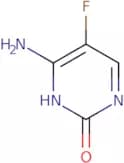
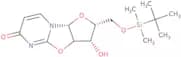
CAS:Flucytosine is an antifungal agent that inhibits the synthesis of DNA by preventing the conversion of deoxyuridine monophosphate to uracil monophosphate. It is used as an antiretroviral therapy in combination with other drugs, such as zidovudine and dideoxyinosine, to treat HIV infections. Flucytosine has been shown to have a strong antitumor response in a model system involving mice with sarcoma 180. This drug can cause serious side effects, including drug interactions and resistance mutations in microorganisms. These side effects are often observed in patients undergoing cancer chemotherapy or immunosuppressive therapy.Fórmula:C4H4FN3OPureza:Min. 95%Cor e Forma:White PowderPeso molecular:129.09 g/mol5'-O-tert-Butyldimethylsilyl-2,2'-anhydrouridine
5'-O-tert-Butyldimethylsilyl-2,2'-anhydrouridine is a modified nucleoside that has been used as an anticancer agent and antiviral and antifungal agent. It has been shown to inhibit the growth of tumor cells in animal models by inhibiting DNA synthesis and repair. 5'-O-tert-Butyldimethylsilyl-2,2'-anhydrouridine is also able to bind to RNA with high affinity, making it a potential candidate for use as an antiviral agent against HIV. This compound does not occur naturally in cells and can be synthesized from other nucleosides.Fórmula:C15H24N2O5SiPureza:Min. 95%Peso molecular:340.45 g/mol2’,3’-Bis-O-tert-butyldimethylsilyl-5’-deoxy-4’,5’-Didehydrouridine
CAS:2’,3’-Bis-O-tert-butyldimethylsilyl-5’-deoxy-4’,5’-Didehydrouridine is a phosphoramidite that is used in the synthesis of DNA, RNA and nucleotide analogues. It has antiviral and antitumor properties and can be used for the treatment of leukemia. 2’,3’-Bis-O-tert-butyldimethylsilyl-5’-deoxyuridine is an activator for ribonucleotides and deoxyribonucleotides. It also has anticancer properties due to its ability to inhibit DNA replication, which may lead to apoptosis or cell death.Pureza:Min. 95%3'-Azido-3'-deoxy-5-fluoro-b-L-cytidine
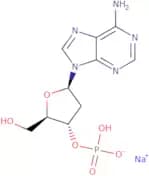
CAS:3'-Azido-3'-deoxy-5-fluoro-b-L-cytidine is an antiviral drug. It is a modified nucleoside with phosphoramidite and azido groups. This product can be used as an activator for DNA synthesis, in anticancer drug development, as well as in the treatment of HIV. 3'-Azido-3'-deoxy-5-fluoro-b-L-cytidine has been shown to inhibit the growth of human tumor cells by inhibiting protein synthesis and enhancing the production of reactive oxygen species (ROS). It also inhibits the activity of ribonucleotide reductase, which is a critical enzyme for DNA synthesis.Pureza:Min. 95%2'-Deoxyadenosine-3'-monophosphate sodium salt
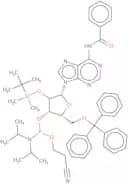
CAS:2'-Deoxyadenosine-3'-monophosphate sodium salt (dAMP) is a novel nucleoside analog that is the sodium salt of 2'-deoxyadenosine-3'-monophosphate. It has shown anticancer and antiviral activity in vitro, as well as cytotoxicity against some human cancer cell lines. It has also been shown to be active against HIV-1 and herpes simplex virus type 1. The drug is modified with an amino group at the 2' position of the ribose sugar, which increases its stability in vivo and reduces its toxicity. This product also contains high purity, high quality, and novel deoxyribonucleosides that are synthesized by a phosphoramidite method.Fórmula:C10H14N5O6P·2NaPureza:Min. 95%Cor e Forma:PowderPeso molecular:377.2 g/molN6-Benzoyl-2'-O-tert-butyldimethylsilyl-5'-O-trityladenosine 3'-CE phosphoramidite
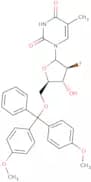
N6-Benzoyl-2'-O-tert-butyldimethylsilyl-5'-O-trityladenosine 3'-CE phosphoramidite is a novel modified nucleoside. It is an antiviral and anticancer agent that has been shown to inhibit the replication of DNA in vitro. It also inhibits the synthesis of RNA and protein, which may contribute to its anti-cancer properties. N6-Benzoyl-2'-O-tert-butyldimethylsilyl-5'-O-trityladenosine 3'-CE phosphoramidite is synthesized from 2,6,8 trichloroquinoline and 2,3,4 trimethoxybenzaldehyde via a novel process with high purity.Fórmula:C51H62N7O6PSiPureza:Min. 95%Peso molecular:928.17 g/mol1-(2'-Deoxy-5'-O-DMT-2'-fluoro-β-D-arabinofuranosyl)thymine
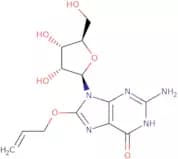
CAS:1-(2'-Deoxy-5'-O-DMT-2'-fluoro-b-D-arabinofuranosyl)thymine is a chemically modified nucleoside that contains a fluorinated sugar moiety and a thymine base, with a dimethoxytrityl (DMT) protecting group on the 5'-hydroxyl of the sugar.Fórmula:C31H31FN2O7Pureza:Min. 95%Peso molecular:562.6 g/mol8-(Allyloxy)guanosine
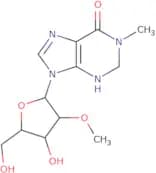
CAS:8-(Allyloxy)guanosine is a nucleoside analog. It is an antiviral and anticancer drug that inhibits DNA synthesis by inhibiting the enzyme DNA polymerase. 8-AOG also inhibits the expression of genes involved in inflammatory responses, such as lipoxygenase, cyclooxygenase 2, and 5-lipoxygenase. This compound has been shown to be effective against herpes simplex virus types 1 and 2, cytomegalovirus, Epstein-Barr virus, adenovirus type 3, and human immunodeficiency virus type 1 (HIV-1). 8-(Allyloxy)guanosine can be used to inhibit the tumor growth of human cancer cells in vitro. 8-(Allyloxy)guanosine has been shown to have a low toxicity to healthy cells in vitro and when administered in vivo.Fórmula:C13H17N5O6Pureza:Min. 95%Cor e Forma:PowderPeso molecular:339.3 g/mol1-Methyl-2'-O-methylinosine
CAS:1-Methyl-2'-O-methylinosine is a nucleoside that is naturally found in RNA. It is the methylated form of inosine, which is a nonessential amino acid and purine nucleotide. 1-Methyl-2'-O-methylinosine's chemical name is β--D--ribofuranosyl-(1'→2')--N--(6-fluoro-3-indoxyl)glycinamide monohydrochloride. This nucleoside has been researched for its potential use as an indexing tool for phylogenetic research of DNA and RNA. 1-Methyl-2'-O-methylinosine has also been shown to be structurally similar to other nucleic acids and has been classified as a nucleoside.Fórmula:C12H16N4O5Pureza:Min. 95%Peso molecular:296.28 g/molAdenosine 5′-phosphosulfate triethylammonium salt
Adenosine 5′-phosphosulfate triethylammonium salt serves as a donor of sulfate groups in biochemical processes, such as in the synthesis of sulfate esters. The triethylammonium salt form improves the solubility and stability of the compound, making it useful in laboratory applications involving enzymatic assays and the synthesis of sulfated biomolecules.
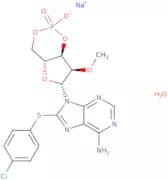
Fórmula:C10H14N5O10PS·xC6H15NPureza:Min. 98.0 Area-%Cor e Forma:PowderPeso molecular:427.29 g/mol8-(4-Chlorophenylthio)-2'-O-methyladenosine 3',5'-cyclic monophosphate sodium salt
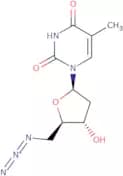
CAS:8-(4-Chlorophenylthio)-2'-O-methyladenosine 3',5'-cyclic monophosphate sodium salt (8-CPT-cAMP) is a cyclic nucleotide that activates adenyl cyclase, which increases intracellular levels of the second messenger cAMP. It also inhibits P2Y receptors and other ion channels. 8-CPT-cAMP has been shown to be effective in activating cells expressing the enzyme camp levels, such as those found in heart muscle cells. This drug is used clinically to lower blood pressure, as it has been shown to activate amp-activated protein kinase and calcium chelator. 8-CPT-cAMP may have clinical applications for the treatment of cancer due to its ability to induce cell cycle arrest and apoptosis.Fórmula:C17H16ClN5O6PS·NaPureza:Min. 95%Cor e Forma:PowderPeso molecular:507.82 g/mol5'-Azido-5'-deoxythymidine
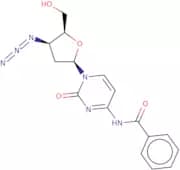
CAS:5'-Azido-5'-deoxythymidine is a synthetic analogue of thymidine. The compound has been synthesised and fluorescently labelled with ferrocene. 5'-Azido-5'-deoxythymidine is not cytotoxic to cancer cells, but it is shown to be an effective inhibitor of DNA synthesis by binding to the enzyme DNA polymerase. This causes a decrease in the rate of DNA synthesis and thus inhibits cancer cell growth.Fórmula:C10H13N5O4Pureza:Min. 95%Cor e Forma:White PowderPeso molecular:267.24 g/mol3'-Azido-N4-benzoyl-2',3'-dideoxycytidine
CAS:3'-Azido-N4-benzoyl-2',3'-dideoxycytidine is a novel nucleoside analog with antiviral and anticancer activities. It is used for the treatment of HIV, hepatitis B and C, herpes, and influenza. 3'-Azido-N4-benzoyl-2',3'-dideoxycytidine has been shown to inhibit the proliferation of cells in culture and to induce apoptosis in various cancer cell lines.
The synthesis of 3'-azido-N4-benzoyl-2',3'-dideoxycytidine starts with the condensation of 4-(hydroxymethyl)phenylacetic acid (1) with 2,6-dichloroisonicotinic acid chloride (2) in the presence of triethylamine to give 4-(hydroxymethyl)phenylacetic acid chloride (3). The N4 benzoylFórmula:C16H16N6O4Pureza:Min. 95%Cor e Forma:Off-White PowderPeso molecular:356.34 g/molN3-Methyl-2’-O-(2-methoxyethyl)uridine
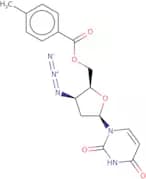
CAS:N3-Methyl-2’-O-(2-methoxyethyl)uridine is a modified nucleoside that is synthesized from deoxyribonucleosides and ribonucleosides. It has antiviral, anticancer, and antifungal properties. N3-Methyl-2’-O-(2-methoxyethyl)uridine has been shown to be an effective inhibitor of HIV replication in vitro and in vivo. This drug also inhibits the growth of human cancer cells in vitro and has been shown to be active against breast cancer cells. N3-Methyl-2’-O-(2-methoxyethyl)uridine is phosphorylated by cellular enzymes to form its active form, which binds to the viral reverse transcriptase enzyme and prevents DNA synthesis.Fórmula:C13H20N2O7Pureza:Min. 95%Peso molecular:316.31 g/mol3'-Azido-2',3'-dideoxy-5'-O-p-toluoyluridine
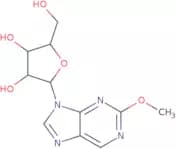
3'-Azido-2',3'-dideoxy-5'-O-p-toluoyluridine is a novel, activator ribonucleotide that has been shown to inhibit the proliferation of cancer cells and human immunodeficiency virus (HIV) with high potency. This compound is a nucleoside analog that is synthesized from diphosphate, phosphoramidites, and modified nucleosides. 3'-Azido-2',3'-dideoxy-5'-O-p-toluoyluridine has been shown to inhibit the growth of tumor cells in vitro and in vivo by arresting cell cycle progression at G1 phase. The mechanism of action for this drug is not fully understood; however, it may be related to its ability to induce apoptosis.Fórmula:C17H17N5O5Pureza:Min. 95%Peso molecular:371.35 g/mol2-Methoxy-9-(b-D-ribofuranosyl)purine
CAS:2-Methoxy-9-(b-D-ribofuranosyl)purine (2MeO) is a nucleoside that is structurally similar to adenosine. It has antiviral and anticancer activities, as well as the ability to activate phosphoramidites. The 2MeO molecule consists of a modified 9-mer ribofuranose phosphate, which can be synthesized from 2-deoxyribofuranose phosphate by selective oxidation. 2MeO has been shown to inhibit the growth of tumor cells in vitro and in vivo, and also inhibits the replication of DNA and RNA viruses. This drug is considered novel because it does not exist naturally in any organism.Pureza:Min. 95%