Nucleosídeos
Os nucleosídeos são building blocks fundamentais dos ácidos nucleicos, compostos por uma base nitrogenada ligada a uma molécula de açúcar. Nesta seção, você encontrará uma ampla variedade de nucleosídeos essenciais para pesquisas em biologia molecular, bioquímica e farmacologia. Esses compostos desempenham papéis cruciais na síntese de DNA e RNA, e também são vitais em vários processos metabólicos. Os nucleosídeos são usados para estudar material genético, desenvolver terapias antivirais e anticancerígenas, e entender os mecanismos celulares. Na CymitQuimica, fornecemos nucleosídeos de alta qualidade para apoiar suas necessidades de pesquisa e desenvolvimento, garantindo pureza e confiabilidade para suas aplicações experimentais.
Foram encontrados 3569 produtos de "Nucleosídeos"
Ordenar por
Pureza (%)
0
100
|
0
|
50
|
90
|
95
|
100
2'-Deoxy-5-methylcytidine HCl
CAS:2'-Deoxy-5-methylcytidine HCl is a cytidine derivative that is used in the synthesis of DNA. It has been shown to have anticancer and antiviral properties, as well as being a synthetic activator for RNA polymerase. The chemical name for 2'-deoxy-5-methylcytidine HCl is 5'-[(2-bromoacetyl)amino]-2'-deoxyuridine 5'-O-(1,3-dithiole-2-thiocarbonyl)-3',5' -diiodo-. It belongs to the class of deoxyribonucleosides. This product may be used in applications such as DNA synthesis, modification of DNA, and antiviral treatment.Fórmula:C10H15N3O4·HClPureza:Min. 95%Cor e Forma:White PowderPeso molecular:277.7 g/molN3-Methylcytidine
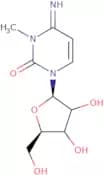
CAS:N3-Methylcytidine is a synthetic analog of uridine. It is used for the treatment of syncytial virus infection, which is a group of diseases caused by viruses that have an RNA genome and replicate by forming syncytia—large groups of infected cells. N3-Methylcytidine inhibits the synthesis of proteins in cells and inhibits the growth of bacteria. This drug has been shown to inhibit actin polymerization and prevents cell spreading. N3-Methylcytidine also binds to RNA polymerase II and blocks its interaction with DNA, inhibiting protein synthesis at the ribosome level. N3-Methylcytidine is metabolized in vivo into methylated cytidine, which can be detected in urine samples using chemical biology methods or fluorescence resonance energy transfer (FRET) analysis. Synonyms: N3-methyluridine; 3-methyluridineFórmula:C10H15N3O5Pureza:Min. 95%Cor e Forma:White PowderPeso molecular:257.24 g/mol3'-b-Azido-2',3'-dideoxy-5'-O-DMT-uridine
3'-b-Azido-2',3'-dideoxy-5'-O-DMT-uridine is a modified nucleoside that is synthesized by the phosphoramidite method. It is a novel antiviral drug with anticancer properties. This active compound has been shown to be an activator of ribonucleotide reductases, which are enzymes that catalyze the conversion of ribonucleotides to deoxyribonucleotides. 3'-b-Azido-2',3'-dideoxy-5'-O-DMT-uridine is not cytotoxic at concentrations up to 40 mM, and it has been shown to inhibit replication of human immunodeficiency virus type 1 (HIV) in tissue culture.Pureza:Min. 95%N4-Acetyl-3'-deoxy-3'-C-methylcytidine
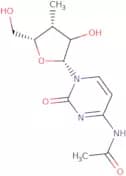
N4-Acetyl-3'-deoxy-3'-C-methylcytidine is a novel antiviral drug that is modified from cytidine. It is an activator of the monophosphate pathway of DNA synthesis, which causes the incorporation of N4-acetyl-3'-deoxy-3'-C-methylcytidine into ribonucleosides and deoxyribonucleosides. This compound has been shown to be active against a variety of cancers, including leukemia, colon cancer, breast cancer, and prostate cancer.Fórmula:C12H17N3O5Pureza:Min. 95%Peso molecular:283.28 g/mol5'-O-[Bis(4-methoxyphenyl)(phenyl)methyl]-2'-deoxy-N-isobutyrylguanosine
CAS:5'-O-[Bis(4-methoxyphenyl)(phenyl)methyl]-2'-deoxy-N-isobutyrylguanosine is a synthetic nucleoside that is used as a building block in the synthesis of oligonucleotides. This chemical has an electronegativity value of 1.7, which means that it is more electronegative than guanine (1.0). It also has a conjugated system and is stable under a range of conditions. 5'-O-[Bis(4-methoxyphenyl)(phenyl)methyl]-2'-deoxy-N-isobutyrylguanosine reacts with tetrazole in the presence of phosphoramidite, yielding the corresponding 5'-O-(4,4'-dimethoxytrityl)-2'-deoxy-N-isobutyrylguanosine, which can then be used toFórmula:C35H37N5O7Pureza:Min. 98 Area-%Cor e Forma:White PowderPeso molecular:639.71 g/mol2'-O-Methyl-2-thiouridine
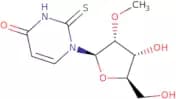
CAS:2'-O-Methyl-2-thiouridine is a modified nucleoside that is categorized as a mismatched nucleotide. It is found in RNA, where it replaces uridine and acts as a mismatch base. 2'-O-Methyl-2-thiouridine has been shown to stabilize duplex DNA against thermal denaturation by forming triplexes with complementary sequences. It also stabilizes dsDNA against hydrolysis by the enzyme ribonuclease H (RNase H) and has been used in the design of antisense therapeutics. Thermophilic bacteria use this molecule to synthesize their own thymine nucleotides, which are structurally similar to 2'-O-methyl-2-thiouridine. This modification prevents mismatches in their own dna and helps protect them from heat stress. The thermodynamic stability of this molecule has been calculated using an algorithm that takes into account the hybridization free energy, enthalpy change, entropyFórmula:C10H14N2O5SPureza:Min. 95%Cor e Forma:PowderPeso molecular:274.29 g/molN3-Cyanoethyl-5’-O-DMT-2’-O-methyluridine
N3-Cyanoethyl-5’-O-DMT-2’-O-methyluridine is a nucleoside that is synthesized from 5'-O-DMT-2’-O-methyluridine. It has antiviral and anticancer properties, as well as an inhibitory effect on DNA synthesis. N3-Cyanoethyl-5’-O-DMT-2’-O methyluridine is a novel nucleoside with DMT and methylated uracil at the 3' position of the sugar moiety. Synthesis may be achieved by using phosphoramidites or modified nucleosides such as N3-(cyanoethyl)-5'-0-(dimethoxytrityl)thymidine. This product meets high purity standards, with a CAS number of 68719–77–8.Pureza:Min. 95%7-[3,5-Bis-O-[(-2,4-dichlorophenyl)methyl]-2-C-methyl-b-D-ribofuranosyl]-4-chloro-5-iodo-7H-pyrrolo[2,3-d]pyrimidine
CAS:7-[3,5-Bis-O-[(-2,4-dichlorophenyl)methyl]-2-C-methyl-b-D-ribofuranosyl]-4-chloro-5-iodo-7H-pyrrolo[2,3-d]pyrimidine is a synthetic nucleoside that inhibits viral DNA synthesis by interfering with the viral enzyme polymerase. It has been shown to be active against HIV and HSV and may have potential therapeutic use in antiviral therapy. 7-[3,5-Bis-O-[(-2,4-dichlorophenyl)methyl]-2-C--methyl--b--D--ribofuranosyl]-4--chloro--5--iodo--7H--pyrrolo[2,3--d]pyrimidine has been synthesized for the first time by a novel process involving deoxyribonucleosides and phosphorPureza:Min. 95%3’-deoxy-3’-fluorotoyocamycin
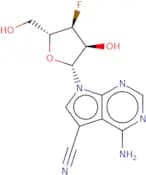
CAS:3’-deoxy-3’-fluorotoyocamycin is a nucleoside, ribonucleoside and antiviral agent. It inhibits the replication of DNA viruses by inhibiting the viral enzyme RNA polymerase. This drug also has anticancer activity and can be used to treat leukemia and other cancers. 3’-deoxy-3’-fluorotoyocamycin can be used as a monophosphate or diphosphate activator for phosphoramidites in the synthesis of modified DNA. It is also a novel drug that has been modified to contain an additional phosphate group at position 3' on the sugar moiety. The CAS number for this compound is 847649-44-9.Pureza:Min. 95%2’-O-Methy-2,5’-anhydro-5-methyluridine
2’-O-Methy-2,5’-anhydro-5-methyluridine is a modified nucleoside with antiviral and anticancer properties. It is an activator of the antiviral response and has been shown to inhibit cancer cells from dividing. This compound is synthesized in an enzymatic reaction that converts 5-methyluridine to 2'-O-methylated uridine. The synthesis involves ribonucleotide reductase, which converts ribonucleotides into deoxyribonucleotides. 2' -O -Methy -2,5'-anhydro-5-methyluridine was originally identified as a novel monophosphate derivative in the 1960s and has been shown to be more effective than other nucleoside analogues.Pureza:Min. 95%9-(2'-Deoxy-2'-fluoro-b-D-ribofuranosyl)-isoguanine
9-(2'-Deoxy-2'-fluoro-b-D-ribofuranosyl)-isoguanine is an oligonucleotide with a fluorinated nucleobase that is used to stabilize DNA duplexes. It is synthesized from 5'-deoxy-5'-fluorocytidine, which is a phosphoramidite, and 2',3',5'-triacetylpyrimidine, which is a substituent. The deprotection of the fluorinated oligonucleotide can be achieved by treatment with sodium hydroxide in ethanol or hydrochloric acid in acetic acid. 9-(2'-Deoxy-2'-fluoro-b-D-ribofuranosyl)-isoguanine has been shown to be stable and antiparallel when incorporated into double stranded DNA molecules.Fórmula:C10H12FN5O4Pureza:Min. 95%Cor e Forma:White PowderPeso molecular:285.24 g/mol2,2'-Anhydrocytidine HCl
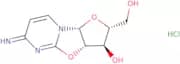
CAS:2,2'-Anhydrocytidine HCl is a nucleoside for use as a DNA synthesis inhibitor
Fórmula:C9H11N3O4·HClPureza:Min. 98 Area-%Cor e Forma:White PowderPeso molecular:261.66 g/mol5’-O-DMT-3’-O-levulinyl-2’-deoxyadenosine
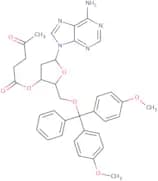
CAS:5’-O-DMT-3’-O-levulinyl-2’-deoxyadenosine is a monophosphate antiviral agent. It has been shown to inhibit the activity of DNA and RNA polymerases in vitro. The drug is novel, and its antiviral properties have not been tested in vivo. 5’-O-DMT-3’-O-levulinyl-2’-deoxyadenosine has been synthesized using phosphoramidites and was found to be of high quality and purity. It has also been modified at the 2' position with an acetyl group and at the 3' position with a levulinoyl group.Pureza:Min. 95%2'-O-tert-Butyldimethylsilyl-5'-O-toluoyluridine 3'-CE phosphoramidite
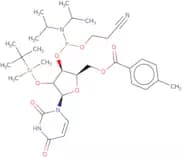
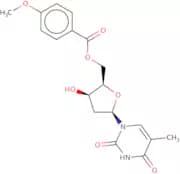
2'-O-tert-Butyldimethylsilyl-5'-O-toluoyluridine 3'-CE phosphoramidite is a modified ribonucleotide that can be used as an activator in oligonucleotide synthesis. 2'-O-tert-Butyldimethylsilyl-5'-O-toluoyluridine 3'-CE phosphoramidite is a novel nucleoside that has antiviral and anticancer properties. It has been shown to inhibit the growth of cells by inhibiting DNA synthesis, which may be due to its ability to bind to DNA and inhibit DNA polymerase. The CAS number for this product is 126214-01-3.Fórmula:C32H49N4O8PSiPureza:Min. 95%Peso molecular:676.83 g/mol5'-O-p-Anisoylthymidine
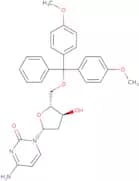
5'-O-p-Anisoylthymidine is a novel activator and ribonucleoside that has been synthesized by modifying the structure of thymidine. This compound is active against cancer and antiviral, such as herpes simplex virus type 1, herpes simplex virus type 2, varicella zoster virus, influenza A/PR/8/34 (H1N1), and influenza B/Yamagata/16/88. 5'-O-p-Anisoylthymidine activates viral transcription in cells infected with these viruses by inhibiting the synthesis of deoxyribonucleosides. It also inhibits DNA synthesis by inhibiting the incorporation of deoxyribonucleotides into DNA during replication. This product is CAS No. 138581-03-2 and comes in high purity and high quality.Fórmula:C18H20N2O7Pureza:Min. 95%Peso molecular:376.36 g/mol2'-Deoxy-5'-O-DMT-cytidine
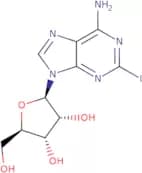
CAS:2'-Deoxy-5'-O-DMT-cytidine is an organic compound. It is a synthetic, combinational and amine nitrogen containing heterocyclic compound that is used in organic synthesis. This chemical is also used as a building block for the synthesis of heterocyclic compounds with other functional groups such as thionyl, formulae, chlorides and hydrogen atoms.Fórmula:C30H31N3O6Pureza:Min. 95 Area-%Cor e Forma:White PowderPeso molecular:529.58 g/mol2-Iodoadenosine
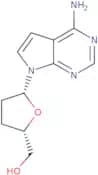
CAS:2-Iodoadenosine is a chemical compound that is produced from the oxidation of uridine. It is used in the synthesis of peptides, which are important for biological processes like signal transduction and cell growth. 2-Iodoadenosine can be made by coupling other molecules to an adenosine molecule. This process involves a cross-coupling reaction with palladium catalysts or hydroxylation reactions with sodium borohydride. The resulting product has been shown to have anticancer and anti-microbial activities against protozoan parasites and cyclic peptide structures.Fórmula:C10H12IN5O4Pureza:Min. 97 Area-%Cor e Forma:PowderPeso molecular:393.14 g/mol7-Deaza-2',3'-dideoxyadenosine
CAS:7-Deaza-2',3'-dideoxyadenosine (7DDAD) is a nucleoside analogue that has been used as an immunodeficiency agent. This drug inhibits the replication of the human immunodeficiency virus (HIV). 7DDAD is a prodrug that is converted to adenosine after it enters the cell, and this conversion prevents DNA synthesis. The effective dose of 7DDAD is 50 mg/kg in rats, but this dose may vary depending on the technique used. 7DDAD has been shown to be effective in vitro against HIV-1 and HIV-2 isolates, and it can also be used to treat cytomegalovirus infections. In addition, 7DDAD has been shown to inhibit the growth of various types of cancer cells in vitro.Fórmula:C11H14N4O2Pureza:Min. 98 Area-%Cor e Forma:PowderPeso molecular:234.26 g/mol2'-Deoxy-6-thioguanosine-5'-monophosphate
CAS:Azathioprine is a drug that suppresses the immune system and is used to treat autoimmune disorders such as rheumatoid arthritis, lupus erythematosus, and inflammatory bowel disease. It is an immunosuppressant that prevents the formation of antibodies by blocking the enzyme thiopurine S-methyltransferase. Azathioprine is metabolized in the liver to 6-mercaptopurine, which has been shown to cause leukopenia. The genetic polymorphism of this enzyme can lead to differences in the metabolism and toxicity of azathioprine therapy.Fórmula:C10H14N5O6PSPureza:Min. 95%Peso molecular:363.29 g/molN6-Benzoyl-2'-deoxy-5'-O-DMT-adenosine 3'-CE phosphoramidite
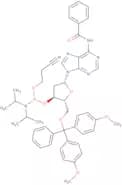
CAS:N6-Benzoyl-2'-deoxy-5'-O-DMT adenosine 3'-CE phosphoramidite is a protected adenosine amidite.Fórmula:C47H52N7O7PPureza:Min. 98 Area-%Cor e Forma:White PowderPeso molecular:857.93 g/mol



![5'-O-[Bis(4-methoxyphenyl)(phenyl)methyl]-2'-deoxy-N-isobutyrylguanosine](/_next/image/?url=https%3A%2Fstatic.cymitquimica.com%2Fproducts%2F3D%2Fthumb-webp%2FND02998.webp&w=3840&q=75)

![7-[3,5-Bis-O-[(-2,4-dichlorophenyl)methyl]-2-C-methyl-b-D-ribofuranosyl]-4-chloro-5-iodo-7H-pyrrol…](/_next/image/?url=https%3A%2Fstatic.cymitquimica.com%2Fproducts%2F3D%2Fthumb-webp%2FNB14088.webp&w=3840&q=75)