Nucleosídeos
Os nucleosídeos são building blocks fundamentais dos ácidos nucleicos, compostos por uma base nitrogenada ligada a uma molécula de açúcar. Nesta seção, você encontrará uma ampla variedade de nucleosídeos essenciais para pesquisas em biologia molecular, bioquímica e farmacologia. Esses compostos desempenham papéis cruciais na síntese de DNA e RNA, e também são vitais em vários processos metabólicos. Os nucleosídeos são usados para estudar material genético, desenvolver terapias antivirais e anticancerígenas, e entender os mecanismos celulares. Na CymitQuimica, fornecemos nucleosídeos de alta qualidade para apoiar suas necessidades de pesquisa e desenvolvimento, garantindo pureza e confiabilidade para suas aplicações experimentais.
Foram encontrados 3569 produtos de "Nucleosídeos"
Ordenar por
Pureza (%)
0
100
|
0
|
50
|
90
|
95
|
100
2’,3’,5’-Tri-O-acetyl-5-hydroxymethyluridine
CAS:2’,3’,5’-Tri-O-acetyl-5-hydroxymethyluridine (THMU) is a modified nucleoside that inhibits viral replication and tumor growth. It has been shown to inhibit the synthesis of DNA in human cells. This synthetic nucleoside is synthesized by reacting 2’,3’,5’-triphosphate 5'-deoxyribonucleotides with acetaldehyde. THMU is a monophosphate nucleotide analogue which also acts as an activator for ribonucleic acid synthesis.Pureza:Min. 95%2’-Deoxy-N1-methylguanosine
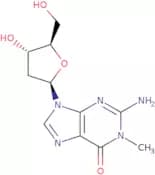
CAS:Produto Controlado2’-Deoxy-N1-methylguanosine is a modified purine nucleoside composed of a N¹-methylguanine, a guanine base where a methyl group is attached to the nitrogen at position 1 (N¹). This methylation blocks normal Watson-Crick base pairing, especially with cytosine, and can affect RNA structure and function. It also contains a 2′-Deoxyribose and has possible research applicationsFórmula:C11H15N5O4Pureza:Min. 97 Area-%Cor e Forma:PowderPeso molecular:281.27 g/mol2'-C-Methyluridine
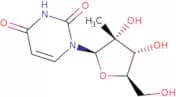
CAS:2'-C-Methyluridine is a synthetic nucleoside analog derived from uridine, modified with a methyl group at the 2'-carbon of the ribose sugar. This small chemical change has important implications for RNA biology, antiviral drug development, and biochemical research, especially in targeting RNA viruses.Fórmula:C10H14N2O6Pureza:Min. 95%Cor e Forma:PowderPeso molecular:258.23 g/molS-Adenosyl-L-methionine p-toluenesulfonate
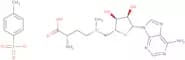
CAS:Methyl donor and a cofactor for enzyme-catalyzed methylationsFórmula:C15H23N6O5S•C7H7O3SPureza:Min. 95%Cor e Forma:White PowderPeso molecular:570.64 g/molN6-Isobutyryl-2'-O-methyladenosine
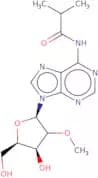
N6-Isobutyryl-2'-O-methyladenosine is a nucleoside that has antiviral, anticancer, and anti-inflammatory properties. It is an analog of adenosine that is used in the synthesis of DNA and RNA. It is modified by the incorporation of an iso-butyl group at the 2' position on the ribose ring. N6-Isobutyryl-2'-O-methyladenosine was first synthesized in 1962 and has been extensively studied due to its novel properties. The phosphoramidites are activated with tetrazole or triazole, which are both strong activators. This nucleoside can be synthesized in high purity (>98%) through a modification of the conventional phosphorylation process.Fórmula:C15H21N5O5Pureza:Min. 95%Peso molecular:351.36 g/mol5-(2',3',5'-Tri-O-benzyl-b-D-ribofuranosyl)-3-methyl-2-benzyloxypyridine
CAS:5-(2',3',5'-Tri-O-benzyl-b-D-ribofuranosyl)-3-methyl-2-benzyloxypyridine is a nucleoside analog that inhibits the growth of cancer cells. This compound has been shown to inhibit the synthesis of deoxyribonucleosides and ribonucleosides, and also inhibit the growth of certain viruses. 5-(2',3',5'-Tri-O-benzyl-b-D-ribofuranosyl)-3 methyl -2 benzyloxypyridine can be used as a phosphoramidite or activator in the synthesis of DNA or RNA.Pureza:Min. 95%N6-Benzoyl-2'-O-benzyl-5'-O-DMT-adenosine
CAS:N6-Benzoyl-2'-O-benzyl-5'-O-DMT-adenosine is a novel nucleoside with anticancer and antiviral properties. It is a phosphoramidite that can be used for the synthesis of DNA, RNA, and other nucleosides. N6-Benzoyl-2'-O-benzyl-5'-O-DMT-adenosine has been shown to inhibit the growth of cancer cells by preventing RNA synthesis and DNA replication. This chemical also has antiviral effects against HIV and can inhibit the replication of herpes simplex virus type 1. The chemical is highly soluble in water, methanol, ethanol, acetone, chloroform, ethyl ether and acetonitrile.Fórmula:C45H41N5O7Pureza:Min. 95%Peso molecular:763.84 g/mol2'-O-tert-Butyldimethylsilyl-5'-O-DMT-N6-phenoxyacetyladenosine 3'-CE phosphoramidite
2'-O-tert-Butyldimethylsilyl-5'-O-DMT-N6-phenoxyacetyladenosine 3'-CE phosphoramidite is a nucleoside analogue that is synthesized by the condensation of 5'-O-DMT-N6-phenoxyacetyladenosine and 2'-deoxyadenosine. It has antiviral, anticancer and immunomodulatory properties. This compound is novel and modified in that it contains a silyl group at the 2' position, which renders the molecule inactive as an inhibitor of human thymidine kinase. 2'-O-tert-Butyldimethylsilyl-5'-O-DMT-N6-phenoxyacetyladenosine 3'-CE phosphoramidite inhibits viral replication by interfering with DNA synthesis. It also has been shown to inhibit tumor cell proliferation and promote apoptosis in vitroFórmula:C54H68N7O9PSiPureza:Min. 95%Cor e Forma:PowderPeso molecular:1,018.25 g/mol(R)-5',P'-Ester with thiodiphosphoric acid ((HO)2P(O)OP(S)(OH)2) adenosine
CAS:(R)-5',P'-Ester with thiodiphosphoric acid ((HO)2P(O)OP(S)(OH)2) adenosine is a nucleoside monophosphate. It has been shown to be an activator of the enzyme adenylate cyclase, which converts ATP into cyclic AMP, a second messenger in cell signaling. (R)-5',P'-Ester with thiodiphosphoric acid ((HO)2P(O)OP(S)(OH)2) adenosine does not have anticancer properties and does not inhibit the production of ribonucleotides or deoxyribonucleotides. This compound is synthesized using novel methods and is of high purity and quality.Fórmula:C10H12N5Na3O9P2SPureza:Min. 95%Peso molecular:509.21 g/molUridine 5'-monophosphate disodium salt
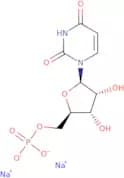
CAS:Uridine 5'-monophosphate disodium salt (UDP-MS) is a structural analog of uridine that is used as a dietary supplement. It has been shown to inhibit phosphodiesterases and cyclic nucleotide phosphodiesterases, which are enzymes that degrade the secondary messenger, cyclic adenosine monophosphate (cAMP). This inhibition leads to increased levels of cAMP in cells, which stimulates protein kinase A activity and promotes cellular differentiation. The analysis of UDP-MS has been performed using liquid chromatography with ultraviolet detection.Fórmula:C9H11N2Na2O9PPureza:Min. 98 Area-%Cor e Forma:White Off-White PowderPeso molecular:368.15 g/mol5'-O-Methyl-D3-thymidine
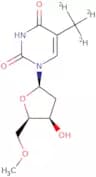
Produto Controlado5'-O-Methyl-D3-thymidine is a synthetic nucleoside that has been modified to contain a methyl group at the 5' position. It is used in the synthesis of DNA and RNA, as well as in the preparation of phosphoramidites for oligonucleotide synthesis. This nucleoside has antiviral and anticancer properties and may be useful for treating diseases such as AIDS, hepatitis B, and leukemia. The compound can also act as an activator during polymerase chain reactions. 5'-O-Methyl-D3-thymidine is readily soluble in water and in organic solvents and is highly pure with a high yield of 99%.Fórmula:C11H13N2O5D3Pureza:Min. 95%Peso molecular:259.27 g/mol1-(4’-Azido-2’-deoxy-2’-fluoro-b-D-arabinofuranosyl)N4-(n-octadecanoyl)-cytosine
1-(4’-Azido-2’-deoxy-2’-fluoro-b-D-arabinofuranosyl)N4-(n-octadecanoyl)-cytosine is an antiviral nucleoside that is synthesized from a 4′ azidodecanoyl derivative of cytosine. It has been shown to be effective against herpes simplex virus type 1 and 2 (HSV1, HSV2), varicella zoster virus (VZV), and Epstein Barr Virus (EBV). The antiviral mechanism of action for this compound is not known.Pureza:Min. 95%2’-Deoxy-2’-fluoro-N3-(n-dodecyl)uridine
2’-Deoxy-2’-fluoro-N3-(n-dodecyl)uridine (2DFO) is a novel nucleoside analog that is phosphorylated to 2DFP, which is an antiviral drug that has been shown to inhibit the replication of HIV. 2DFO inhibits the activity of DNA polymerase, RNA polymerase, and reverse transcriptase, preventing the synthesis of viral DNA and RNA. This drug also inhibits the activity of human topoisomerase II alpha and beta, which are enzymes involved in replication and transcription. 2DFO binds to purine nucleosides by competitive inhibition at the enzyme active site, preventing the formation of ribonucleotides from deoxyribonucleosides.Pureza:Min. 95%Xanthosine 5'-triphosphate disodium salt
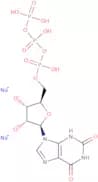
CAS:Xanthosine 5'-triphosphate disodium salt is a nucleotide that is an intermediate in the synthesis of DNA and RNA. It has a hydroxyl group at the 5' carbon atom and two carboxylic acid groups on the 3' carbon atom. Xanthosine 5'-triphosphate disodium salt can be found in many compounds, such as d-glucose, which contains six hydroxyl groups. Xanthosine 5'-triphosphate disodium salt is also used as a building block for other molecules, such as ATP, which contains adenosine with one hydroxyl group on the 2' carbon atom and three phosphate groups.Fórmula:C10H13N4O15P3·2NaPureza:Min. 95%Cor e Forma:PowderPeso molecular:568.13 g/mol9-Deazaguanosine
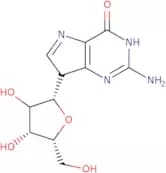
CAS:9-Deazaguanosine is a naturally occurring purine, which has been shown to inhibit the binding of adenosine deaminase enzyme. This enzyme is responsible for the conversion of adenosine to inosine, and plays a role in the replication of viruses. 9-Deazaguanosine has also been shown to have an inhibitory effect on trichomonas vaginalis, benzyl groups, and anomers. The hydroxyl group on 9-Deazaguanosine interacts with mammalian cells which may be related to its inhibitory effect on leishmania and hepatitis.
Fórmula:C11H14N4O5Pureza:Min. 95%Cor e Forma:PowderPeso molecular:282.25 g/mol5'-O-DMT-5-[N-(6-(trifluoroacetamido)hexyl)-3-E-acrylamido]-2'-deoxyuridine
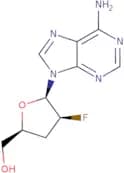
CAS:5'-O-DMT-5-[N-(6-(trifluoroacetamido)hexyl)-3-E-acrylamido]-2'-deoxyuridine is a novel phosphoramidate nucleoside monophosphate, which is a phosphate analog of 2'-deoxyuridine. It has been shown to be an activator for DNA polymerases and is able to inhibit the replication of DNA in vitro. It also has antiviral properties, as it inhibits the synthesis of viral RNA. 5'-O-DMT-5-[N-(6-(trifluoroacetamido)hexyl)-3-E-acrylamido]-2'-deoxyuridine also has anti-inflammatory effects, as it inhibits prostaglandin synthesis.Fórmula:C41H45F3N4O9Pureza:Min. 95%Cor e Forma:White PowderPeso molecular:794.83 g/mol6-Amino-9-(2',3'-dideoxy-2'-fluoro-β-D-arabinofuranosyl)purine
CAS:6-Amino-9-(2',3'-dideoxy-2'-fluoro-β-D-arabinofuranosyl)purine is a nucleoside analog that is used to treat HIV. It is a prodrug that undergoes phosphorylation by host cell kinases to form its active form, 2'-deoxycytidine monophosphate (2'DCPM). This drug has been shown to inhibit the replication of HIV in vitro and in vivo. 6-Amino-9-(2',3'-dideoxy-2'-fluoro-β-D-arabinofuranosyl)purine has antiviral potency against both group M and N HIV isolates. It also enhances polymerase chain reaction amplification of HIV DNA and can be used in tissue culture experiments to study the effects of drugs on the virus. Clinical trials have shown that 6-amino 9-(2',3'-dideoxy-2Fórmula:C10H12FN5O2Pureza:Min. 95%Cor e Forma:White PowderPeso molecular:253.24 g/mol2'-Deoxyadenosine-5'-diphosphate sodium salt
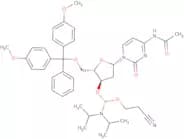
CAS:2'-Deoxyadenosine-5'-diphosphate sodium salt is a nucleotide that is involved in the synthesis of DNA. It is a structural analog of adenosine-5'-diphosphate and can be used as an experimental tool to study metabolic disorders. 2'-Deoxyadenosine-5'-diphosphate sodium salt binds to p2y receptors and blocks their activation, which inhibits cellular energy metabolism. This compound is structurally similar to adenosine-5'-triphosphate, but has been shown to inhibit the expansion of cells when heated, unlike adenosine-5'-triphosphate. 2'-Deoxyadenosine-5'-diphosphate sodium salt also inhibits cell proliferation in cancer cells and may have potential as a therapeutic agent for bowel disease.Fórmula:C10H12N5O9P2·xNaPureza:Min. 95 Area-%Cor e Forma:PowderPeso molecular:408.18 g/molN4-Acetyl-2'-deoxy-5'-O-DMT-cytidine 3'-CE phosphoramidite
CAS:N4-Acetyl-2'-deoxy-5'-O-DMT-cytidine 3'-CE phosphoramidite is a novel nucleoside that belongs to the group of deoxyribonucleosides. It is a modified nucleotide with a phosphate at the 5' position and an acetyl group in place of the hydroxyl group at the 2' position. N4-Acetyl-2'-deoxy-5'-O-DMT-cytidine 3'-CE phosphoramidite has antiviral, anticancer, and activator properties. This compound is also known as 5′N4 acetyldeoxythymidine 3′Ce, or 5′N4 acetyldeoxythymidine 3′Ce phosphoramidite.Fórmula:C41H50N5O8PPureza:Min. 97 Area-%Cor e Forma:PowderPeso molecular:771.86 g/molDihydrozeatin riboside
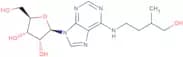
CAS:Dihydrozeatin riboside is a cytokinin, a group of plant hormones that regulate various aspects of plant growth and development. It is found in the form of an ester, dihydrozeatin riboside, which is produced by the action of trifluoroacetic acid on zeatin. The natural function of this hormone is to stimulate cell division in plants, but it has also been shown to have antibacterial effects against bacterial strains such as Bacillus subtilis and Escherichia coli. Dihydrozeatin riboside inhibits bacterial growth by binding to DNA-dependent RNA polymerase, thereby preventing transcription and replication. The high frequency of human activity has been shown using a patch-clamp technique on human erythrocytes. This active form is metabolized through a number of metabolic transformations, including hydrolysis by esterases or glucuronidases, oxidation by cytochrome P450 enzymes, reductionFórmula:C15H23N5O5Pureza:Min. 95%Cor e Forma:PowderPeso molecular:353.37 g/mol








![5'-O-DMT-5-[N-(6-(trifluoroacetamido)hexyl)-3-E-acrylamido]-2'-deoxyuridine](/_next/image/?url=https%3A%2Fstatic.cymitquimica.com%2Fproducts%2F3D%2Fthumb-webp%2FND08237.webp&w=3840&q=75)